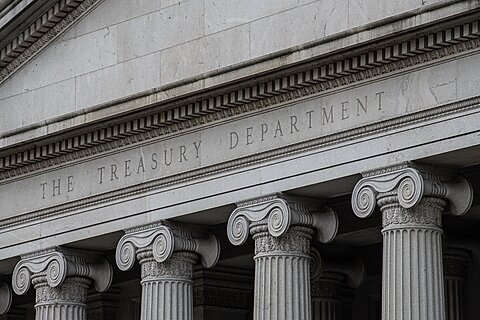

This week, the Treasury Department, under Secretary Scott Bessent, announced it would at least double the size of its long-end buyback operations, lifting the ceiling from $2 billion to at least $4 billion per operation. This decision was in response to a further climb in the 30-year yield to its highest level since 2007. Yields initially dipped on the news—as the Treasury would have hoped—but then markets erased nearly the entire drop within a day.
To run a buyback, the Treasury purchases longer-dated Treasury bonds and funds the purchases by issuing short-term Treasury bills, swapping long-term government debt for short-term government debt, and removing the long-term bonds from private hands.
The Treasury is doing this to push long-term rates down. The theory is that with fewer long-term Treasury bonds for private investors to hold, their price should rise. And because bond prices and yields move in opposite directions, the long-term Treasury rate should fall. Buying up older, less-traded issues also relieves dealer balance sheets and trims the premium those bonds carry. That is, at least, the theory behind the buybacks.
In reality, these programs are always doomed to fail as they misunderstand or misattribute the forces raising rates in the first place. The buyback is a supply/liquidity fix aimed at a problem that isn’t primarily about supply or liquidity. In other words, the Treasury is trying to reduce long-term rates by restricting the supply of those bonds. But their rates have been rising (prices falling) in response to the budget deficit, heavy overall government debt issuance, a rising term premium, and persistently above-target inflation. Moreover, the bond sell-off is global: Long-end yields hit multiyear highs in Germany, France, and Japan. This sell-off suggests that the United States alone cannot fix its rate problem because that problem is not unique to the US.
Some of the pressure comes from private borrowing to fund AI investment, which competes with Treasuries for the same capital. That competition is healthy. It is productive private demand for credit, and the government should not be leaning against it. This latest move is essentially a policy of purposely crowding out private investment with government debt to cover up policy mistakes—a bizarre if not counterproductive policy.
If the US government wants to improve its borrowing outlook, it should abandon its own harmful policies that are placing structural strain on borrowing costs in addition to global trends and private competition. The energy shock from the war in Iran pushed gasoline and fuel costs sharply higher and fed into other goods. The pass-through of tariffs has been elevating prices since Liberation Day. The cumulative effect is that consumer prices rose 3.4 percent in the year to July, well above the Federal Reserve’s 2 percent target. All this is in addition to heavy federal spending that keeps the debt burden high and oversupplies Treasuries, reducing their value and raising their yields. With the national debt near $40 trillion and annual deficits approaching $2 trillion, investors demanding more to hold long-term debt are pricing the government’s own trajectory.
It is foolhardy to think that government financial engineering, such as these bond buybacks, can counter global economic waves and poor macroeconomic policies. Around $4 billion per buyback operation against a $31.5 trillion Treasury market is the equivalent of bringing a basket of pebbles to stem the flow of a river, and it does nothing to address the policies making long-term government debt riskier.
Ironically, in 2024, economists Stephen Miran and Nouriel Roubini accused the prior Treasury of activist Treasury issuance, tilting toward short-term bills to hold down long yields ahead of an election. Bessent also criticized that tactic at the time; now he is attempting a more aggressive version of it himself. Miran and Roubini warned that once one administration reached for the tool, future ones would do the same. That prediction came true in under two years—persistent deficits create a standing temptation to manage the maturity of the debt, and it bends to whoever holds office.
The glaring ideological problem with the buyback program is that Washington can treat the interest rate as something to manage rather than a price set by the market. The market price is information. When the 30-year yield comes in higher than the government hoped, it reports on the government’s own finances and poor policies, and the remedy is to repair them rather than suppress the signal. Until Congress and the administration confront their own culpability, upward pressure on yields will keep returning as it did this week, and no amount of interventionist fine-tuning will stop it.