

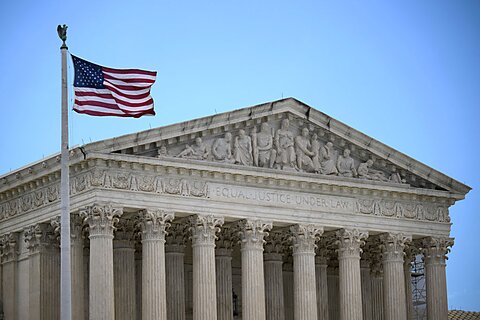

An editorial note atop Andy Craig’s June 26 article in the UnPopulist, “The Unfortunate Necessity of Court Packing to Stop America’s Authoritarian Drift,” opens with a striking observation: “Desperate times require desperate measures.” That aphorism is ancient: it dates back to Hippocrates’s precept that very sick patients require aggressive treatment. Its wisdom has traveled through centuries: in Hamlet, King Claudius explains that “Diseases desperate grown / By desperate appliance are relieved, / Or not at all.” Craig’s article diagnoses a social pathology; he prescribes adding four new Justices to the Supreme Court. He concedes that court packing will be very hard on the patient but explains that “sometimes a smaller harm is necessary to avoid a far bigger one.”
Craig’s style of expression is occasionally elliptical and figurative, so for the sake of clarity, I will summarize his argument just below.
Our Supreme Court faces a crisis of legitimacy—and the Court is largely responsible for it.
Some of the Court’s recent decisions are unacceptably radical because they grant new powers to the president and new electoral advantages to Republicans.
Negative public perception of the Court properly assesses the Court’s performance, underlies its crisis of legitimacy, and justifies court packing in the future.
The appropriate diagnosis is that the powers of the presidency have expanded alarmingly, and the recommended cure is to pack the Court.
The dangers of retaliatory, tit-for-tat court packing can be mitigated by constitutionalizing one-time-only court packing, along with other contemporaneous constitutional reforms.
Even without the ratification of such a constitutional amendment, court packing would still be justified.
Such claims warrant examination, and I think they do not survive it.
History as diagnostic instrument
David Hume famously described what we now call the “is-ought” problem. In his Treatise on Human Nature, Hume noted that authors often supply ordinary descriptive statements about the way things are and then—without warning—they suddenly switch to normative statements about what people should do.
The beginning of Craig’s article exemplifies this problem: The moral foundation for court packing is absent. He declares that, if there is a change in party governance, future court packing is “very likely.” He asserts that we all must “grapple with why this has happened and with the Court’s own role in provoking it.” Two paragraphs later, he finds that the time for grappling is over: leaping across Hume’s gap, he asserts that “we need to start working with the reality that the Court has brought it on itself” and that “half the country reasonably does not accept its moral legitimacy” because of a few of the Court’s opinions over the last few years. In short, Craig insists that court packing is probably unstoppable and has thus become imperative.
As justification, this is dubious. The moral and political argument for court packing that should begin the article is missing in action. Instead, the author detours into hypothetical and historical examples of court packing. As Craig explains, Congress last changed the size of the Supreme Court over 150 years ago, “remedying a court that was threatening the constitutional settlement itself.” He then contrasts this example with Roosevelt’s 20th-century threat to pack the Court, explaining that Roosevelt’s effort “rightly failed” for two reasons: “the Court was not constitutionally out of line, and the claims to the contrary were weak.”
Craig then asks: “Is this moment more like 1937 or 1866?” That is, should we understand the present day as comparable to 1937? Is America today struggling with grave challenges, governed by officials with significant differences of opinion about the exercise and scope of their authority—but who are ultimately able to peacefully resolve them? Or is the present day more like it was in 1866, barely recovering from a civil war that cracked the nation in two and shot through with social chasms that are comparable to those of the Civil War and Reconstruction?
Craig’s answer is controversial: He believes that we have arrived at a legitimacy crisis that puts us closer to 1866 than to 1937. Surely I am not the only reader who finds that stark assessment eyebrow-raising: The nation is far away from Reconstruction-like national fragility and broad public resistance towards our federal institutions.
Political opinion as diagnostic instrument
Craig claims that the Court’s legitimacy crisis springs from a few of its recent opinions that he believes are corrupt—that is, the Court’s opinions in which “its side’s power is directly at stake, measured against the Court’s own professed methodology.” Note that method of measurement: It’s important. But the problem is that most of (the very small sample of) the cases he provides don’t support his theory.
He provides a conventional originalist critique of Trump v. United States, the presidential immunity decision, stating that it “reached a result conservative methodology forbids.” I think this is the only opinion Craig provides that genuinely supports his argument: I’d generally agree that Trump v. US is a bad decision and was wrongly decided. It is difficult or impossible to arrive at its results from an originalist perspective, and it creates rules of criminal liability for the president that are hard to justify and harder to administer.
He then provides a highly unconventional originalist critique of Trump v. Slaughter, the opinion that scrapped agency heads’ protection from presidential removal. Craig alleges that Slaughter was jurisprudentially wrong because it overturned a 90-year-old precedent. Say what you like about Slaughter, but it is odd to suggest that it “reached a result that conservative methodology forbids.” In fairness, Craig published his article three days before Slaughter was announced; his article states that the Court’s previous stay orders telegraphed where the decision was going. But that is an understatement: The Court has been telegraphing messages about where it is going on federal agency exercise of executive power for decades. (See Free Enterprise Fund, Seila Law, or even Chadha, Morrison v. Olson, or Buckley v. Valeo.) Humphrey’s Executor, the opinion Slaughter overruled, was a relic of New Deal jurisprudence; courts were never able to reach consensus about the vague and mysterious scope of Humphrey’s central holding. In contrast, Humphrey’s consequences are not mysterious at all: The notion that federal bureaucrats should set their own agenda, rather than taking direction from the Constitution’s enumerated branches, has proven to be a gateway drug to expanded and unaccountable government. Craig’s argument that Slaughter is inconsistent with conservative judicial methodology overlooks both its doctrinal and its real-world results.
He then complains that, in Callais, the Court “dismantled the heart of the Voting Rights Act.” I think of the heart of the Voting Rights Act as preserving the right to vote based on race – and Callais doesn’t touch that. Craig presumably sees the heart of the Voting Rights Act as preventing minority voters from being packed into majority-minority congressional districts, but he dislikes the Court’s response to the problem: Callais makes the creation of such districts difficult or impossible. That is because, in the eyes of many Justices, official race-blindness is a principled perspective and a legitimate jurisprudential goal. Craig’s objection illustrates a means-ends failure on his part: In my view, racial gerrymandering is genuinely loathsome, but if addressing it is really Craig’s goal, it would make more sense to call for Congress to pursue it much more directly—by passing federal redistricting reform—than by packing the Court. In any event, this should make plain that Craig’s central charge against Callais—to repeat: that it is inconsistent with “the Court’s professed methodology”—is unsubstantiated.
Finally, he complains that the Court’s recent election decisions are “damning because they make the pattern so visible.” He claims that they violate “the Purcell principle”—allegedly a “rule” that “judicial changes to election procedures should not be imposed close to an election.” Purcell’s proper role in the Court’s recent decisions cannot be adequately summarized in a sentence or even a paragraph, but my sense is that Purcell does not provide a hard-and-fast rule. Rather, it functions best as one of several equitable tenets in play when courts decide to grant or deny injunctions. Disagreements about the application of Purcell are common; they often degenerate into disputes over which actor behaved badly (e.g., was it the plaintiff who attempted to alter the status quo ante by bringing suit, the lower court that acceded to the plea for relief, or the court of appeals that overturned the lower court’s intrusion on election processes?). But moral fault is just one factor that equity takes into account, and judicial balancing of equities is not reducible to simple rules. Lawful decisions in equity always rest on multiple factors, and it is always possible to argue about the weight any given factor should have. But such criticisms are bad evidence for Craig’s thesis that the Court has broken with its methodology.
Ultimately, Craig’s insistence that the Court has rendered itself illegitimate rests on an idiosyncratic reading of a few of the Court’s decisions. I think judicial integrity and “the Court’s own professed methodology” allow for a far wider range of results—partly because it is unsophisticated to reduce the Court’s own professed methodology to a slogan. Anyone is entitled to disagree with the Court’s decisions, but political disagreements aren’t evidence of a lack of integrity—they are just a fact of life. In short, Craig’s arguments about the Court’s illegitimacy fail.
Polling data as diagnostic instrument.
The Court’s legitimacy is far less endangered than Craig believes—and, if poll data do establish such illegitimacy, it certainly cannot be for the reasons that Craig provides. Craig has every right to argue that the Court’s legitimacy is determined by its approval ratings, but the cases that drive the Court’s approval ratings are almost certainly not the cases Craig finds problematic.
Craig claims that the Court’s immunity decision is a beacon of politicization that “is understood as such by the half or more of the American people who are correctly repulsed by it.” That is his evidence for his charge that the Court’s legitimacy “is, in large part, already gone.” That is far too quick. A significant portion of the Court’s seesawing approval ratings is driven by the results of decisions with a high social valence—e.g., Bostock, Obergefell, Dobbs, and Bruen. Such ratings rest on how much the public favors or opposes the results arrived at in each case, and they cannot seriously be understood as anything like a principled evaluation of the Court’s deliberative process or its legitimacy more broadly.
Four days after Craig’s article appeared, the Court issued Trump v. Barbara, which affirmed the constitutional status of birthright citizenship. Barbara may shrink the Court’s approval ratings more, but surely Craig would not argue that any resulting disapproval undermines the Court’s legitimacy further. Notably, Barbara undercuts Craig’s contention that the Court’s legitimacy is in jeopardy because it fails to display judicial independence. Furthermore, in the event that the Court’s approval ratings drop because of Barbara, it will be impossible to argue that changes in the Court’s approval ratings rest on disapproval of the Court’s allegedly Republican biases.
Craig’s broader argument—that the Court is illegitimate because it is insufficiently independent—is also undercut by the Court’s decision on tariffs. Craig tries to explain that problem away by describing the tariff decision as consistent with “longstanding Republican policy preferences.” That conflates the typical voter’s partisan identification (relatively static over time) with the typical voter’s policy preferences (relatively plastic): it misunderstands, e.g., the strange new respect Republicans exhibited for tariffs that coincided with Trump’s rise. And of course Craig’s insistence that the Court is insufficiently independent will require increasingly elaborate counter-explanations when the Court’s repeated refusals to allow the president to deploy National Guard troops in states with governors who do not want them there—and the Court’s repeated refusals to allow the president to deport detainees—are considered. In short, Craig’s denunciation of “what this Court does when its side’s power is directly at stake” is hard to reconcile with the real world’s record.
Of course, there will be Democratic politicians who will find the charge that the Court has become compromised persuasive, and there will be Democratic voters who will find it persuasive as well. (People often find propositions persuasive when those propositions are useful.) But Craig’s case that the Court has been compromised will likely be unpersuasive to a neutral observer who is familiar with the whole of the Court’s record. Once partisanship is removed from the scales, Craig’s case for the Court’s legitimacy crisis is thin on evidence.
The diagnosis changes, but the prescription stays the same
Next, Craig produces a laundry list of the swollen powers of the presidency that have accumulated over decades; their manifestations and abuses must be rolled back, he says, and we need a Court that can be relied upon not to stand in the way of the repair work ahead. How, he asks, will the current Court react to his reform agenda? He replies: “The honest answer is that it strikes it down.” And thus the need to pack the Court.
This is the closest that Craig comes to providing a good reason for court packing. But it fails, in part because his long chain of inferences conceals a gigantic non sequitur. Even if we grant that a constitutional amendment is the right way to roll back metastasized presidential powers, a court-packing amendment is a strange cure. It is as if a patient who presents with appendicitis encounters a doctor who advises a heart transplant. If the central problem lies in the executive, a constitutional amendment that reforms the Court is a decidedly second-best solution.
The treatment is contraindicated
Of course, there are people who desire court packing; its propriety rests on whether their reasons are good. Insisting that court packing will occur, for instance, is obviously not a reason for court packing at all. But Craig makes a different argument here: He intimates that the likelihood of court packing provides a reason to accessorize it with constitutional add-ons so that court-packing’s consequences are less awful. His idea is that constitutional accessories—term limits for the Justices, a reversion to nine Supreme Court seats, and a limit of two presidential Supreme Court appointments per term—will mitigate the injuries it causes. This is a concession that court packing really is a desperate measure—it’s a treatment that should only be offered to a very sick patient, in the hope that the accessories will mitigate the treatment’s effects. Even in desperate times, there are two large reasons that Craig’s constitutional-amendment prescription misfires.
First, Craig’s constitutional prescription ignores the dynamics of legislative decision-making. To be clear: Craig proposes a deal that conjoins court packing with the possibility of future mitigating constitutional reforms. That is an agreement that cannot be enforced and thus will never be seriously offered or accepted. The theory of a unitary executive is controversial enough, but Craig’s argument makes a much bigger leap: it assumes a unitary legislature. His proposal implies that the political forces that support court packing now can be relied on to support a reformist constitutional amendment in the future—a recommendation that forgets that lawmakers’ preferences vary over time. The prediction that legislators of any political faction will respond to court packing by supporting a constitutional amendment is unserious: it is far more likely that some of them will self-interestedly decline to follow through on any previous constitutional commitment, while the rest will scheme about how to set a second, retaliatory court-packing plan in motion. (Perhaps, for purposes of plausible deniability, this retaliation will surface as a plan to pack lower federal courts.) Craig forgets that politicians are good at capturing present benefits, but bad at shouldering future burdens; furthermore, they are excellent at nursing ancient grievances.
Second, although I am broadly sympathetic (in varying degrees) to each of Craig’s constitutional reforms in the abstract, adding these reforms to court packing doesn’t make court packing any more justifiable. By themselves, these reforms might have some merit; for instance, they might lower the temperature—and the stakes—of future confirmation processes. Under Craig’s proposal, though, they are conjoined with court packing, and court packing will have its own effects that these accessories cannot mitigate. In other words, Craig’s prescription takes us to a world in which court packing has already occurred, and in that world the constitutional reforms he proposes lose much of their value. (In particular, limiting SCOTUS appointments to two per presidential term will have consequences that are notably minimal. We have already seen blocs of senators who are willing to stall Supreme Court confirmations for long periods, so long as the succeeding election creates the possibility of a new president (even if the amendment is enacted, it makes additional Merrick Garland scenarios more likely). And because the chief value of these constitutional reforms is that they might lower the political temperature, they are outweighed by the likely prospect that court packing would raise it. To the extent that, as Craig says, every confirmation is now an apocalypse, it is hard to see how court packing would make things less inflamed.
The cure is iatrogenic
Strictly speaking, Craig’s article does not prescribe constitutional change: what it prescribes is court packing, coupled with the possibility of a reformist constitutional amendment. The constitutional reforms are just lagniappe. Craig concedes this when he writes:
And if the amendment never comes? Expansion is still warranted on the defensive ground alone—rebuilding a stable post-Trump constitutional settlement cannot survive this Court’s veto either way. But the public commitment, made from day one, is what separates restoration from capture. Without it, a necessary evil becomes an ordinary power grab.
There is an old joke about the folly of asking the barber if you need a haircut. There is reason to question Craig’s diagnostic skills: court packing is far from a necessary evil. This “ordinary power grab,” whether or not it comes with mitigating constitutional measures, would be inherently destructive to the Court’s legitimacy—whether or not it is followed by subsequent retaliation. Craig concedes that court packing “is a road to ruin,” but hypothesizes that it could be an “exit ramp” to a constitutional settlement. It is reckless to suggest a drive down a dangerous highway, even if the driver is instructed to watch for an exit ramp—and much more so if the exit ramp is not yet built. That is why court packing is myopic and dangerous, whether or not it is mitigated by a hypothetical future constitutional amendment: The power grab, as such, is a blow to judicial legitimacy, and subsequent constitutional reform is no guarantee of the Court’s reputational repair.
In my view, the big picture of constitutional law looks significantly better than it did just a few years ago. The extraconstitutional powers of administrative agencies continue to be pared back; Second Amendment freedoms and equal protection doctrine continue to advance; progress in the realm of property rights is uneven, but it is nonetheless substantial. And the nation’s speech protections are arguably the strongest that they have ever been. Packing the Court places every single one of these jurisprudential advancements at risk.
(The modern Court’s First Amendment jurisprudence deserves special attention here, given that Craig expresses top-level concerns about America’s authoritarian drift while overlooking the free-speech protections the Court has erected that block it. Such protections are the nation’s most promising antidote against authoritarianism, and in this regard Craig’s advocacy of court packing—given that it would likely put additional, less speech-friendly Justices like Jackson and Sotomayor on the bench—is especially ill-advised.)
Ultimately, justifications like “Desperate times require desperate measures” rest on shaky ground. Such language is not just a concession but a confession. It suggests a perspective at odds with that of the healing profession that originated it. The modern use of that maxim conveys an entirely non-medical sentiment—something like: Those who encounter a breach of norms are therefore entitled to breach other norms. That justification of desperate measures is regularly abused.
The abuse here is evident. The nation is not in a state of emergency; the Court is not illegitimate; partisan fevers do not justify court packing; and Craig’s proposal would endanger much of the doctrinal progress that the Supreme Court has made in recent years. The diagnosis is unwarranted, and the treatment is dangerous. As ever, the recipient of unorthodox medical advice is better off seeking a second opinion.