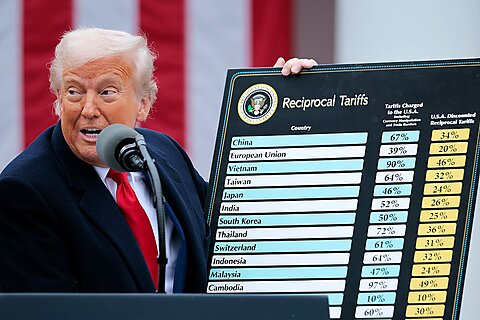

Perhaps one of the most puzzling developments in the aftermath of the Trump administration’s multiple tariff salvos has been the lack of retaliation by the governments of affected countries. Most US trading partners have (so far) refused to impose duties on American exports, and many have even negotiated “reciprocal” trade agreements with the administration. Yet, as my colleague Scott Lincicome explained in a column for The Dispatch last year, amid this lack of tit-for-tat response by foreign governments, private individuals abroad are pushing back against Trump’s trade policies by limiting their consumption of American goods and services—most notably, tourism in the United States.
While survey and government data already pointed to declines in foreign visits to the United States (see figures 1 and 2), a recent working paper finds that the “Liberation Day” tariff announcements in April 2025 led to a significant decline in tourism to the United States, costing the sector over $1 billion in lost revenue per month.
Using the “Liberation Day” announcements as a quasi-experiment and benchmarking tourist arrivals in the United States against those in Canada, the study measures the impact of singling out 75 countries and assigning them a “reciprocal” tariff rate higher than the universal 10 percent baseline. Controlling for origin-country income and bilateral exchange rates, the authors calculate that 315,000 fewer tourists from these 75 countries (i.e., “Annex I countries”) visited the United States each month through September 2025, relative to tourists from countries subject only to the 10 percent baseline rate.
The finding that Trump’s announcement of the “reciprocal” tariffs led to substantial declines in tourist arrivals from these countries—and thus tourism revenue for the US economy—also holds when the authors alternatively benchmark US tourist arrivals against those in Spain. The authors also rule out increased Immigration and Customs Enforcement (ICE) arrests, USAID cuts, and other Trump-era policy changes as alternative explanations. Importantly, because the authors’ estimates only capture the incremental effect of the “reciprocal” tariffs above the 10 percent baseline, the actual tariff-driven decline in tourist arrivals to the US might be even larger.
More notable than the study’s topline estimates, though, is its finding that the tariff-induced decline in tourism in the United States resulted less from foreigners being unable to afford US travel and more from foreigners having a diminished view of the United States following the “Liberation Day” announcements. On the one hand, other studies have found that Americans bore most of the tariffs’ costs and that the dollar weakened in the aftermath of the 2025 tariffs. On the other hand, the authors calculate that among tourists from the 75 countries assigned a higher “reciprocal” tariff rate than 10 percent, those from North Atlantic Treaty Organization (NATO) countries (i.e., “long-standing US allies”) reduced their travel to the US more than tourists from non-NATO countries.
The authors also find that tourists from countries assigned an above-median “reciprocal” tariff rate reduced their travel to the US to a similar degree as tourists from countries assigned a below-median “reciprocal” tariff rate. In sum, the authors’ results, differing “by the strength of existing geopolitical relationships but not by the magnitude of the tariff rates,” suggest that the decline in US tourism from these 75 countries is connected to a decline in America’s reputation abroad.
Having estimated a substantial reduction in monthly tourists due to the administration’s tariffs[i], the authors then calculate that the tourism sector lost more than $1 billion in monthly revenue after April 2025. But as if this were not enough, the authors also calculate that tourism firms—“firms where inbound foreign tourism plausibly represents a meaningful share of revenue (e.g., hotels, airlines, entertainment)”—experienced lower stock returns (by two to three percentage points) than other firms one to three days after “Liberation Day.” In sum, the decline in visitors also translated to financial hardship for the sector—both from actual foregone revenue and from negative investor expectations.
With more US tariffs coming down the pipeline and more uncertainty about the future of bilateral trade deals negotiated by the Trump administration with foreign countries, we will see whether foreign governments retaliate more aggressively against US exports. Yet, studies like the one discussed in this blog post confirm what anecdotal evidence has long suggested: Private individuals abroad are not waiting for their governments to respond before they adjust their consumption of US goods and services. More concerningly for the US and Americans, if such actions stem from a diminished US reputation abroad, repairing the damage from the Trump administration’s trade policies might be less straightforward than simply removing existing tariffs.
[i] In addition to estimating 315,000 fewer monthly travelers from the 75 countries subject to “reciprocal” tariff rates higher than 10 percent, the study finds that the implementation of “fentanyl” tariffs on Canada and Mexico in March 2025 led to a 20 percent decrease in the average number of monthly visitors from Canada and to slower growth in monthly visits from Mexico. Though these results are less definitive than those of the authors’ main model given the limited sample size and the absence of control destinations, their findings on Canadian tourism are consistent with other evidence that Canadians avoided travel to the US in 2025 in response to Trump’s tariffs. In fact, a recent Statistics Canada report finds that leisure-related visits by Canadians to the United States declined by 21.5 percent in 2025 (about 3.2 million visits) while leisure-related visits by Canadians to overseas destinations increased by 12.2 percent in 2025 (about 1.1 million visits). The same report finds that spending on leisure-related visits by Canadians to the United States decreased by $2.2 billion in 2025, while spending on leisure-related visits by Canadians to overseas destinations increased by $3.6 billion.