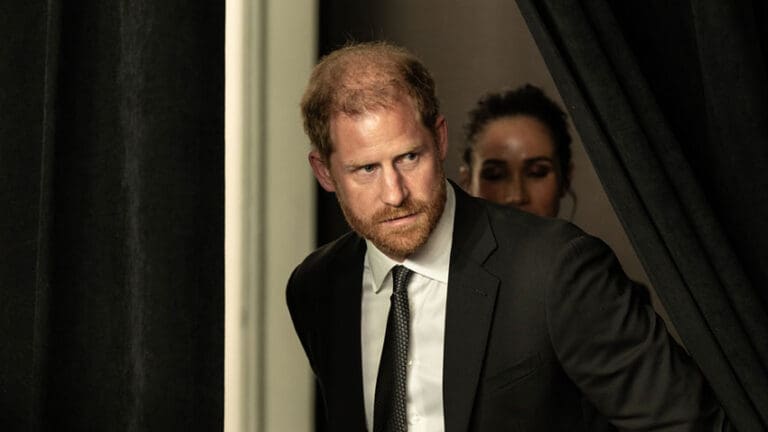
Prince Harry and his fellow claimants could be facing one of the largest costs bills ever seen in British privacy litigation, a former Costs Judge has warned, after the High Court dismissed their claims against Associated Newspapers, publisher of the Daily Mail and Mail on Sunday, in full.
Mr Justice Nicklin threw out all 97 allegations of unlawful information gathering brought by the Duke of Sussex, Sir Elton John, David Furnish, Baroness Lawrence, Elizabeth Hurley, Sadie Frost and Sir Simon Hughes, ruling that suspicion alone was not enough and that the claimants had failed to prove the publisher obtained information unlawfully. The full judgment followed a 46-day trial earlier this year.

But according to Colin Campbell, former Costs Judge at the Royal Courts of Justice and now a consultant at costs law firm Kain Knight, the financial reckoning is only just beginning.
“The litigation is not yet over,” Campbell said. “Associated Newspapers has already made clear that it intends to seek to recover the legal costs it has incurred defending these claims. Given that the litigation has lasted for several years and Associated Newspapers says more than £50 million has been spent on legal costs, the financial consequences could now become almost as significant as the judgment itself.”
Campbell believes the publisher is likely to push for costs on the indemnity basis, a form of order reserved for cases where the court considers a party’s conduct has fallen outside the norm.
“It would be no surprise if Associated Newspapers sought to recover its costs on the indemnity basis, a more favourable form of costs order that is reserved for cases where the court considers a party’s conduct has fallen outside the norm,” he said. “If granted, it would make it easier for ANL to recover a substantially greater proportion of its legal costs because it would not have to satisfy the court that those costs were proportionate and necessary, only that they were reasonably incurred. In litigation of this scale, the difference could amount to a significant amount of money.”
Indemnity costs orders are far from theoretical. Richard Desmond’s Northern & Shell was hit with a £40m costs bill on the indemnity basis following its failed National Lottery claim, a reminder of how quickly costs exposure can eclipse the substance of a dispute.
The big unknown, Campbell says, is insurance. “One important unanswered question is whether the claimants have after-the-event insurance in place, which is commonly used in high-value litigation to cover some or all of the legal costs a claimant may be ordered to pay if they lose. That is not currently known publicly, but it could become a significant issue as the proceedings move into the costs phase.”
After-the-event cover and third-party funding have become standard features of high-value claims, with a growing market built around litigation funding as a way of managing costs risk. Without such protection, the seven claimants could be personally exposed to a share of a bill running into tens of millions of pounds.
A two-day hearing to deal with consequential matters, including costs, is expected to begin on 29 July. For businesses watching from the sidelines, the case is a stark illustration of a truth that applies well beyond celebrity litigation: as recent group claims in the High Court have shown, losing at trial is often only the start of the financial pain.