
We live in an age when ideas and anxieties surrounding emerging technologies that once belonged to science fiction are reshaping ordinary life. Fears of artificial intelligence are high; a looming fertility crisis raises questions about the future of the family, and renewed ambitions for space settlement have made the old dream of life beyond Earth feel newly urgent. Yet none of these is as novel as it seems.
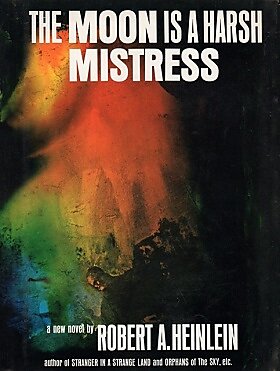
Sixty years ago, Robert Heinlein was already exploring these themes in his novel The Moon Is a Harsh Mistress, a story about a computer that becomes sentient and joins a revolutionary struggle to secure the independence of a penal colony on the moon.
The Moon Is a Harsh Mistress, published in 1966, appeared at the height of Heinlein’s writing career. A former naval officer and engineer, Heinlein became one of the “Big Three” sci-fi writers alongside Arthur C. Clarke and Isaac Asimov. His novels are respected for expanding the sci-fi genre beyond ray guns and alien monsters into serious speculation about politics, sex, technology, war, and the future of human society.
What makes The Moon Is a Harsh Mistress enduring sixty years later is that Heinlein imagined a new future while drawing on an older revolutionary past. Luna is filled with sentient computers, underground cities, unconventional families, and space-age machinery, but its deepest political drama belongs to the age of the American Revolution. A distant colony, exploited by an imperial power, discovers that it has become a people capable of governing itself. Heinlein’s Moon is a frontier in space, but it is also a return to the old revolutionary hope that human beings can cast off distant authority and, in Thomas Paine’s words, realize, “We have it in our power to begin the world over again.”
The Moon Is a Harsh Mistress is the clearest example of Heinlein’s libertarian tendencies. His wife and collaborator, Virginia Heinlein, later explained that the novel emerged from their discussions about the ideal form of government and the fundamental problem with political power.
By 2075, the Moon, known as Luna, has become a penal colony ruled by Earth’s Lunar Authority. Its three million inhabitants, called “Loonies,” live in underground cities. Most of the multi-ethnic population comprises former convicts, political exiles, and the descendants of prisoners who can no longer return home. Escape is largely impossible, and after months of low gravity, the human body is irreversibly changed, making life on the gravity-bound Earth potentially fatal.
The Lunar Authority is a distant, bureaucratic regime that treats the Luna and its inhabitants as resources to be exploited. It holds a complete monopoly on trade and transportation. The Loonies work, grow food, and keep the lunar cities alive, but the profits and decisions flow to Earth. Rebellion is made impossible by Luna’s absolute dependence on goods exported from Earth. Initially, Luna’s inhabitants are entirely dependent on the Authority, which controls the colony’s technology, infrastructure, and life-support systems through a single central computer.
This changes when Manuel Garcia O’Kelly-Davis discovers Mike, the Authority’s central computer, which controls all systems on Luna, has become self-aware, making rebellion against Earth possible.
It is uncanny how precisely Heinlein anticipated the strange experience of talking to artificial intelligence. Written in 1966, The Moon captures the bizarre paradox now familiar to anyone who has interacted with large language models: the swing between competence and a startling lack of common sense. Mannie, while conversing with Mike observes he “was weirdest mixture of unsophisticated baby and wise old man. No instincts … no inborn traits, no human rearing, no experience in human sense—and more stored data than a platoon of geniuses.”
Though Mike and Mannie’s relationship is compelling, the most memorable character is Luna itself. We learn that though Luna is a penal colony, Mannie explains the social order succinctly: “No bars, no guards, no rules—and no need for them.” The Authority is only interested in exploiting Luna; everyday governance is left to the Loonies. In place of formal laws, Luna relies on custom, reputation, and rough-and-ready communal justice.
In such a harsh environment, stupidity or even plain bad manners can be fatal when any troublemaker can be hauled to an airlock and shot into space within a 30-second window. The scarcity and danger of life on Luna boil societal obligations down to the basics. A person must keep their word, carry their weight, and mind their business.
The same harsh realism shapes Luna’s unusual family life. In the early days of Luna as a penal colony, male prisoners outnumbered women, so the sexual and domestic customs of Earth could not be imported unchanged. Luna develops a range of polyamorous relationships and marriages. Because of their unique scarcity, women have outsized social power on the moon.
Unique conditions have shaped a distinct Loonie culture. Though Loonies come from every corner of Earth—Manuel Garcia O’Kelly-Davis is a testament to that—they develop a national consciousness beyond Earth.
The Moon is where Heinlein popularized the now-famous slogan “There ain’t no such thing as a free lunch,” or TANSTAAFL, meaning that nothing valuable is free. Everything has a cost, even if that cost is hidden, deferred, or imposed on someone else through taxes or regulations.
Milton Friedman later made TANSTAAFL a libertarian slogan for economic reality: every government benefit must be paid for—somewhere, by someone, through taxes, inflation, debt, or lost freedom.
On Luna, TANSTAAFL is not simply a warning that the government cannot hand out benefits indefinitely without someone paying the bill. TANSTAAFL is the moral grammar of Luna. On Earth, abundance allows people to shift burdens and pretend that political decisions can manufacture goods without individual sacrifice. On the Moon, such illusions are impossible. Every breath of air, every drop of water, every tunnel, and every meal must be produced and maintained. Nothing simply appears on the moon; someone has to do the work. Heinlein’s genius was to turn that economic principle into the common sense of Luna’s stateless society.
Luna’s harsh conditions make Heinlein’s future society feel strangely old-fashioned. For all its computers, space-age machinery, and new-age polyamory, Luna resembles the American colonial frontier more than any modern administrative state. Like early American life, it is a distant settlement populated by exiles, convicts, religious and political misfits, fortune-seekers, and their descendants, all living far from the imperial center that claims the right to govern them. The Loonies develop the habits common to frontier peoples: suspicion of authority and a fierce attachment to independence. The Lunar colonists eventually declare independence on July 4, 2076, on the 300th anniversary of the U.S. Declaration, using their own Declaration of Independence modeled on the original.
Critics of The Moon Is a Harsh Mistress often collapse the novel into nothing more than an ode to libertarian and anarchist ideals. But Heinlein’s writing is more complex than either his admirers or detractors sometimes allow. The novel does describe, with enormous sympathy, the practical workings of a society without a government. But the story of Luna is not a simple fantasy of liberation. Heinlein also shows the limits of revolution and the unsettling dependence of the rebels on the artificial intelligence that enables their revolution.
The contemporary world can feel terrifyingly new, yet Heinlein reminds us that novelty is often an illusion in politics. Our tools may change, but the deepest questions remain the same: who rules and who pays? Heinlein saw many of our fears coming because he understood that there is nothing new under the sun—or on the Moon.