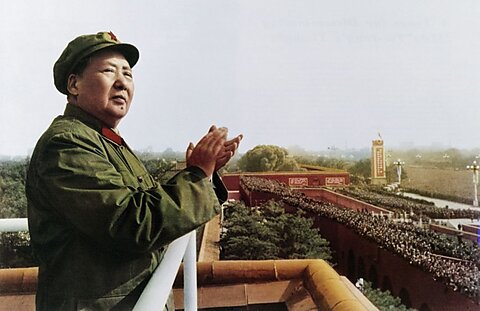

Hasan Piker, a hugely popular commentator on Twitch and YouTube, is a self-described socialist who praises and campaigns for candidates backed by the Democratic Socialists of America and in the Democratic Party. He also has a soft spot for Mao Zedong, the Chinese dictator whose communist policies caused the deaths of 65 million people.
Piker, who has more than 5 million followers, many of them young Americans, says Mao is “one of the great leaders of this world.” Piker, 35, is no dunce—his streaming has made him a multi-millionaire—and he is influential. Libertarians should use this opportunity to educate people about Mao and the horrors of socialism/communism.
On July 19, a video of Piker talking about a 2025 trip to China resurfaced on social media. In the clip, Piker says, “I got stopped by a cop [in China] who thought I was making fun of Mao Zedong, which I never would and never will. Mao Zedong is one of the great leaders of this world, okay? A man who changed the entire universe, the entire planet.”
Piker then looks at some of the comments coming in and responds, “Okay, for real, for real? Yes, I mean, there was a lot of f*****g excesses, let’s be real. But the People’s Republic of China would not exist without Mao Zedong.”
Piker spoke at the College Democrats of America 2026 Summer Convention in mid-July, sporting a Mao jacket. He dismisses Mao’s crimes—65 million deaths!—as mere “excesses.” History tells a very different story.
Mao Zedong (1893–1976) was the founding leader of the People’s Republic of China. He ruled the communist regime from 1949 until his death in 1976. During those 27 years, he implemented myriad policies to try to create a Marxist utopia—and failed miserably. In total, Mao’s actions caused the deaths of 65 million Chinese, according to The Black Book of Communism (Harvard University Press).
Like the Soviet Union and its gulag prison-work camps, Mao established the laogai prison system in 1949. Eventually, an estimated 1,000 laogai prisons operated nationwide. “Hitler had his concentration camps, Stalin had his gulag, and the Chinese Communist Party had the laogai,” said Harry Wu, activist and former political prisoner. According to the Black Book of Communism, “The most varied and sadistic tortures were quite common” in the laogai, “such as hanging by the wrists or thumbs. … One camp commander assassinated or buried alive 1,320 people in one year, in addition to carrying out numerous rapes.” Since its inception, 40–50 million Chinese were imprisoned in the laogai; an estimated 20 million Chinese died in the prisons.
Between 1958 and 1962, Mao and the Chinese Communist Party implemented the Great Leap Forward — a nationwide plan to boost China’s economic output beyond that of Great Britain within 15 years. “In the pursuit of a utopian paradise, everything was collectivized,” reports Frank Dikotter in his book, Mao’s Great Famine. “[C]oercion, terror, and systematic violence were the foundation of the Great Leap Forward.” This national plan produced a massive famine that killed 45 million people.
It was “one of the most deadly mass killings of human history,” says Dikotter, for which Mao “bears the main responsibility.” The famine led to cannibalism in many Chinese villages. Children were sold and “[h]uman flesh, like everything else, was traded on the black market.” In addition to starvation, approximately “6 to 8 percent of the victims were tortured to death or summarily killed—amounting to at least 2.5 million people.”
The death rate for children under the age of five spiked because of the Great Leap Forward—up to one in three Chinese children died. That increase influenced trends in the global death rate for children.
Because of the Great Leap Forward, China’s overall death rate rose from 11 percent in 1957 to a peak of 29 percent in 1960, according to the Black Book of Communism. Further, “Not until 1983 did productivity again reach 1952 levels.”
Mao launched the Cultural Revolution (1962–1976) to reassert his authority—damaged by the Great Leap Forward—and spread communist fervor and loyalty to him. He called upon largely high school and university students, who swore loyalty to him, wore red armbands, and carried his “Little Red Book” of quotations. These Red Guards were charged with destroying the “Four Olds”: old ideas, culture, customs, and habits. They destroyed churches, books, art, street signs, music—anything they viewed as “bourgeois” or expressive of capitalism.
The Red Guards also publicly denounced and humiliated their teachers and elders. Tens of thousands of Chinese were “hounded out of cities like Shanghai and Beijing in an effort to purify these cities,” says Dikotter. “And some of them are literally taken to task, spat upon, beaten—some of them, very much to death.” An estimated 1–2 million people died during the Cultural Revolution.
Hasan Piker and other “influencers” like him are leading people astray—by the millions. We must educate the next generation with facts about individual liberty, free markets, and peace. It is a constant struggle, as the current popularity of socialism demonstrates. As Cato’s former executive vice president, David Boaz, said, “People who value freedom will always have to defend it from those who claim the right to wield power over others.”