
The Senate Armed Services Committee appears ready to do what the Republican-controlled Congress should have put a stop to: write the Trump administration’s equity stake power grab into law.
Buried in the Senate-reported version of the latest National Defense Authorization Act is a new subtitle on “Equity Investments and Related Matters.” Its central provision, Section 1051, would give the Department of Defense’s Office of Strategic Capital (OSC) explicit authority to make equity investments in private companies. The bill would establish a new “Department of Defense Equity Investment Account” in the Treasury and authorize OSC’s director to use that account to make equity investments.
Under current law, OSC is a financing office with authority centered on loans, loan guarantees, and technical assistance. The Senate bill would add a new equity investment lane, with authority that’s nominally limited:
OSC could use it only for critical minerals, critical materials, critical chemicals, and batteries.
The bill would cap an OSC equity investment at 40 percent of the total equity investment made to the entity at the time of OSC’s investment.
Prohibit more than $500 million in aggregate equity investments in one entity.
Prevent DoD from holding more than 50 percent of a company’s ownership and bar OSC from taking board seats, directors, or other voting representation.
Those guardrails are better than no guardrails, but they’re also beside the point.
The problem begins with creating the statutory architecture for a Pentagon stock portfolio in the first place. That means Congress would not merely be tolerating a one-off emergency action but would instead provide the Pentagon with a standing legal pathway to acquire ownership stakes in private companies.
The equity authority is also unnecessary on its own terms. If Congress believes a small defense company needs capital that private markets will not provide, it can appropriate grants or use other tools. The Pentagon already has the authority to use contracts, cooperative agreements, and grants for eligible research and development projects. Ownership means continuing federal financial interest in a company’s valuation, which is precisely what creates the favoritism, conflict of interest, and political pressure risks Congress should be avoiding.
The case for subsidy is not a case for ownership.
The Senate provision follows the same mistake found in the House’s Defense Production Act reauthorization effort. The House DPA bill would allow a member of the Defense Production Act Committee to make an equity investment once the DPA Fund manager finds that the company cannot obtain private equity on commercially reasonable terms, cap aggregate government ownership below 15 percent, and require liquidation when commercially feasible. As I argued at the time, parameters and reporting requirements may make the policy look more responsible, but they also make a dangerous policy more permanent.
The Senate bill repeats the pattern with OSC by layering a process on top of the same bad policy: certifications that the investment is needed, cost-effective, and in the national security interest; ownership reviews, including foreign-ownership analysis and identification of 5 percent equity holders; and congressional reports and term-sheet notifications. After signing a term sheet, OSC would have to brief the congressional defense committees and wait 15 business days before entering a binding agreement for investments below $50 million, or 30 business days for investments of $50 million or more.
But process isn’t principle. Congress can demand better paperwork while still endorsing the wrong policy.
The Senate bill’s guardrails also seem to miss the most obvious danger. The bill is much more attentive to foreign influence than politically connected domestic influence, as it doesn’t appear to bar Pentagon officials, political appointees, presidential family members, campaign allies, or politically connected investors from benefiting from companies selected for government equity support.
That’s a very real concern, especially with this administration. ProPublica recently reported that White House adviser Peter Navarro pushed the Pentagon to secure an equity deal with rare-earth magnet producer Vulcan Elements. Donald Trump Jr.’s venture firm, 1789 Capital, had invested in Vulcan, and Vulcan later received a proposed $620 million Pentagon loan.
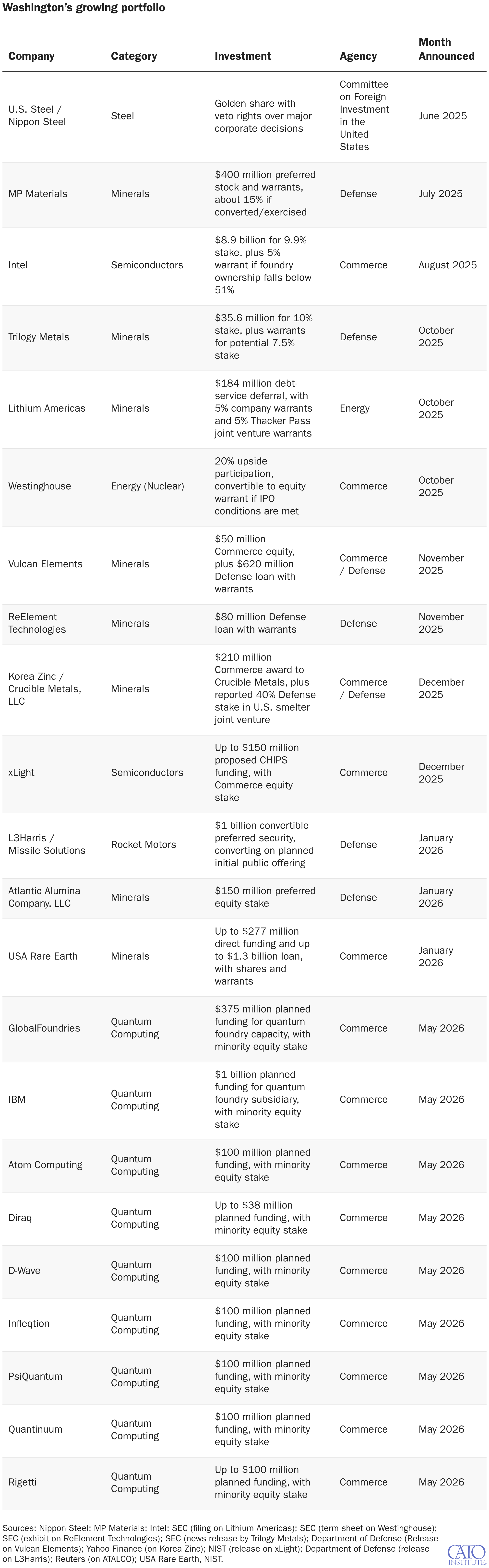
It’s also a concern that isn’t confined to OSC and the DoD. The administration has now taken or announced equity stakes in more than 20 private companies, using a patchwork of agencies, funding streams, and legal theories. The Commerce Department, for example, intends to receive $50 million of equity in Vulcan.
The Senate NDAA would require the DoD to send Congress unredacted term sheets for past equity investments, to identify the legal authorities supporting future deals, and to make OSC the sole home for Pentagon equity investments going forward. In other words, Congress knows the administration’s equity spree needs to be reigned in. But instead of stopping the practice, the Senate bill rewards the administration by giving it a cleaner statutory pathway, effectively writing the power grab into law.
Supporters will argue that critical minerals and batteries are different. They’ll say that supply chain vulnerabilities are real, that China is a problem, and that national security requires extraordinary tools. The concerns are legitimate, but the conclusion that the federal government should own stakes in private companies doesn’t follow.
If Washington wants more domestic or allied production of minerals, magnets, chemicals, or batteries, it has tools that do not require making taxpayers shareholders. It can remove permitting obstacles, reform environmental reviews, enter into procurement contracts, use transparent offtake agreements, or buy the goods it needs. It can reduce regulatory barriers and develop mutually beneficial trade ties with other countries (rather than bullying and harassing them).
What it shouldn’t do is pick favored companies and make the federal government an investor, customer, regulator, and political patron.