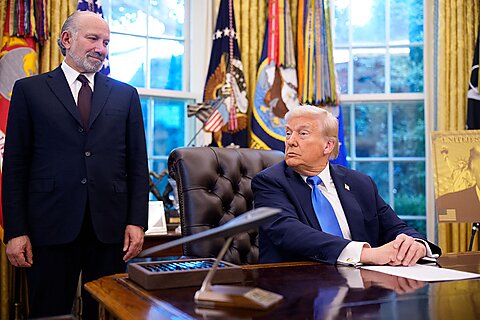

A new Wall Street Journal investigation reports that companies are comparing notes about the extra cost of doing business in Washington these days. Its most revealing section concerns companies with business before the federal government.
Several CEOs and board members told the Journal they believe their contributions and access to Trump are linked. When a company’s problem reaches him, the president reportedly wants to know how much it has given. Many companies being solicited are seeking federal contracts or lobbying on trade, defense, regulation, and appropriations.
The Journal’s analysis puts the amount raised through Trump-linked political committees and projects at more than $800 million.
Trump tracks which companies have donated, presses his fundraiser, Meredith O’Rourke, to ask some for tens of millions of dollars, and sometimes gives her the names of businesspeople who recently met with him. O’Rourke is not a government employee, yet she sometimes sits in on meetings between Trump and executives about matters affecting their companies. At $1 million-a-person dinners, she reportedly records what Trump promises donors and relays the notes to White House officials.
The “tax” is metaphorical, of course. But the economic incentive is clear.
Trump exercises firm-specific discretion over contracts, tariffs, export licenses, merger approvals, permits, subsidies, and now government equity stakes. If executives believe giving improves access or that refusing risks disfavor, a contribution becomes a rational business precaution. Unlike an ordinary tax, the money does not go to the Treasury under general rules that apply equally. It goes to Trump-linked committees and projects, while companies divert money and attention from customers, costs, and sound business judgment to stay on the president’s good side.
Yesterday, I noted that the administration’s announced deals to take ownership stakes in private companies now involve 30 companies. Under Trump, Washington is increasingly a regulator, customer, financier, and shareholder. Decisions involving contracts, trade restrictions, permits, and subsidies can affect the value of the government’s holdings and the fortunes of favored firms.
As I argued in May, routing policy through opaque, discretionary deals makes political proximity and access to the president’s circle valuable business assets. New Street Research policy adviser Blair Levin supplied the label in the title. “Another way of saying it,” Levin told the Journal, “is simply that we’re replacing the free market with the market for Trump’s affections.”
The administration continues to take ownership in more and more companies, blatantly wielding executive power to reward or punish, all while badgering firms with business before the government to pay up—or else.
That’s not free enterprise—it’s a shakedown economy.