

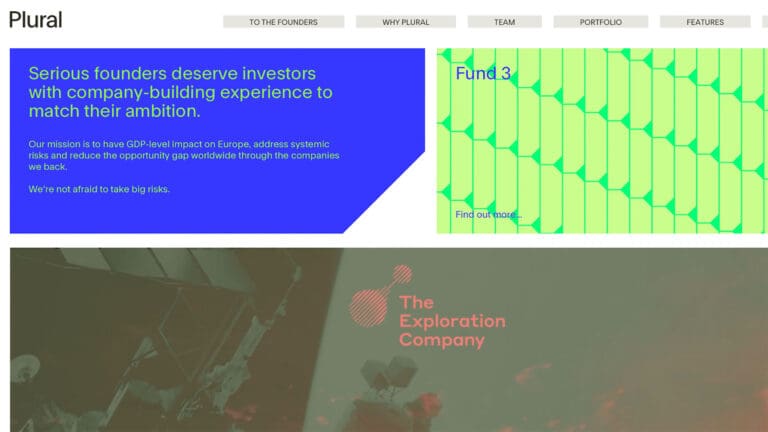
Plural, the early-stage investment firm run by former founders and operators, has raised €1bn to back European start-ups working on energy, AI infrastructure, defence, health and other frontier technologies.

The raise, announced on 16 November from London, Tallinn and Paris, is the firm’s largest to date. It is almost four times the €260m inaugural fund Plural raised in 2022 and double its €500m second fund in 2024.
Plural said its portfolio companies have raised more than €3bn in follow-on capital in the last 12 months.
Plural said that when it launched in 2022, founders working on defence, energy, space and AI infrastructure in Europe struggled to raise capital. Its partners backed start-ups in those sectors early, and portfolio companies including Helsing, Proxima Fusion, OLIX and The Exploration Company are now among the continent’s best-funded firms, according to the firm.
With the new money, Plural said it will invest more in early-stage, non-obvious companies taking on what it described as the hardest problems, with each partner leading a small number of new investments a year. It will also continue to back its breakout companies as they scale and mature.
The firm said these are unusually difficult businesses to build and that their founders need investors who have done it themselves. All of Plural’s partners are former founders and operators.
Its portfolio spans compute, quantum and AI, including OLIX, Callosum, Oriole, Orbital Industries, Phasecraft, Metaview and Validio; energy, including Proxima Fusion, Rivan, Ore Energy and Molyon; and defence, including Helsing, Hypersonica and Frankenburg Technologies.
It also holds stakes in automation and manufacturing businesses Monumental, Sunrise Robotics, CircuitHub and Gigaton; space companies The Exploration Company and Karman+; and health businesses Robeauté, Teton, IXI and Everlab.
Plural cited several technical milestones from the portfolio. It said Hypersonica completed Europe’s first privately funded hypersonic test flight nine months after finalising its design concept, and that Robeauté became the first company to use a microrobot in an animal brain. Monumental’s bricklaying robots have built 0.5 per cent of new homes constructed in the Netherlands this year, according to Plural.
Plural said European companies have in the past struggled to raise the rounds needed to build global champions because of a lack of capital at scale rather than a lack of ambition or talent.
According to the firm, more than 100 European companies have raised rounds of $100m or more in 2026, and 10 per cent of Plural’s portfolio, including Helsing, Proxima Fusion, OLIX and Callosum, are among them. Other large rounds in the sector this year include Cambridge Aerospace’s $300m series C in August, while specialist investors have also launched vehicles such as Balnord’s €70m fund for frontier and dual-use technology in the Baltic Sea region in November 2025.
Plural said its ambition is to have “GDP-level impact on Europe”. The firm argued that for two decades most of the world’s most valuable technology companies have been built in the US and China, leaving Europe a customer rather than a creator and costing the continent prosperity and bargaining power. It said rapid technological change now gives Europe a chance to catch up.
Khaled Helioui, a partner at Plural, said: “Something significant has shifted among Europe’s startups. When we started Plural, someone building a fusion reactor or a space exploration company from Europe was treated as too risky to back. Now they’re among the most sought-after founders in the world.
“That’s a generational shift in ambition and self-belief. We’re convinced these frontier founders are capable of building Europe’s first trillion-dollar company, and we want to be backing them from day one.”
Carina Namih, also a partner at Plural, said: “For too long, Europe has funded its best ideas in small increments. Founders raise a little, prove a little, and then have to raise again. That’s not how you build anything hard.
“Our new fund will back founders properly from the start, so their ambition can be as big as the problems they’re taking on.”