

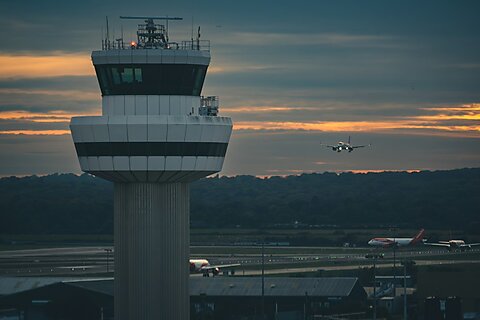

The nationwide ground stop of flights on November 13, caused by problems with the air traffic control (ATC) system, led US Transportation Secretary Sean Duffy to call for more federal spending. However, shoveling additional tax dollars at the dysfunctional ATC system would not be a reliable or cost-effective solution, especially since the government already has $11.5 billion on hand for ATC upgrades. Congress should replace government-run ATC with a privately operated, user-financed nonprofit model that has worked in other countries.
On November 17, the Trump administration sent a request to the House and Senate Appropriations Committees for $50.1 billion in supplemental funding for the Federal Aviation Administration (FAA). Of this, $10.1 billion would go to the national ATC system, $20 billion to ATC centers and towers, and $20 billion to airport infrastructure. The request could become part of the congressional lame-duck agenda. The administration previously requested $30 billion of additional aviation funding in September.
Many experts have recommended ATC privatization for decades. America’s ATC system has long relied on obsolete systems, leading to hardware servicing issues, and staffing shortages have caused flight delays. Previous attempts to focus spending on equipment upgrades, such as the NextGen initiative, fell short of expectations. Congress passed $12.5 billion in supplemental ATC funding through the One Big Beautiful Bill Act (OBBBA) in 2025, followed by $10.3 billion in regular FY 2026 appropriations. Further, the FAA is responsible for both regulating and operating the ATC system, which is a conflict of interest. There is no reason to believe that the administration’s $30.1 billion ATC request would turn the bureaucracy into a beacon of competence.
There is another reason to question the need for additional appropriations. According to the FAA’s recently released FY 2026 financial report, the FAA has still not spent $11.5 billion of the OBBBA’s ATC funds. Spending 8 percent of the $12.5 billion in over a year shows the FAA cannot quickly put money to good use.
Other countries show a better way. Canada privatized ATC in 1996, turning operations over to the nonprofit Nav Canada. Rather than receiving funding from government, Nav Canada relies on user fees. Its system reliably covers a vast airspace on a much smaller budget than America’s.
President Trump supported a similar approach to ATC 2017, though his current administration now seems committed to doubling down on the status quo.
A privatized nonprofit ATC system would avoid the thorny issue of how to maintain operations during a government shutdown. The 2025 government shutdown’s effect on ATC operations led to thousands of flight cancellations, which continued even after Congress passed new funding. Shifting ATC to a self-funded system based on user fees would improve stability and make it easier to hire and retain employees.
Congress should demand answers from the Trump administration about its failure to prevent the ground stop. The system failure occurred following a surge in ATC funding, and it appears that work to upgrade ATC hardware caused it. Depending on what an investigation of the ground stop reveals, it could be appropriate for Congress to provide the FAA with flexibility to apply existing funds to immediate ATC system needs. If poorly implemented hardware upgrades caused the ground stop, the FAA should pause further hardware replacements until it has procedures in place to prevent a recurrence. The FAA’s repeated failure to successfully upgrade the ATC system shows that Congress should establish a private ATC organization soon so that a responsible transition can begin.
The administration’s request for airports deserves equal scrutiny. Of the administration’s $30 billion September request, $18 billion was for airport infrastructure. In the new request, $20 billion is for airport infrastructure. There is no pressing need for new handouts to airports, and both of the administration’s requests use concerns about ATC to justify a broader aviation spending spree. The administration’s touting of aviation industry support for new spending in September shows that it likely wants to curry favor with powerful interest groups, as the industry would benefit most from the new tax dollars.
The federal government already provides grants to airports through the Airport and Airway Trust Fund, which primarily draws on revenue from a federal airline ticket tax and heavily subsidizes small and noncommercial airports at the expense of the most-used airports. The Essential Air Service program provides a separate subsidy stream for airlines to serve remote airports.
Ideally, airports would finance their own infrastructure needs. However, by statute, airports can levy only a modest $4.50 Passenger Facility Charge (PFC) on fliers (unchanged since 2000), meaning airports sometimes struggle to fund needed maintenance and expansion projects. Rather than enacting another $20 billion in airport subsidies, Congress should remove the PFC cap, eliminate the ticket tax, and end airport infrastructure programs.
Congress should reject the administration’s request, ensure existing funds go to urgent ATC needs, quickly begin the transition to a reliable and privatized nonprofit ATC system, and let airports finance their own infrastructure needs. New deficit spending of $50 billion would be the wrong way to respond to the ground stop incident. At minimum, Congress should fully offset the cost of any new spending to avoid digging the federal fiscal hole even deeper. The solution to America’s aviation struggles lies with reducing government control rather than giving the government more money.