

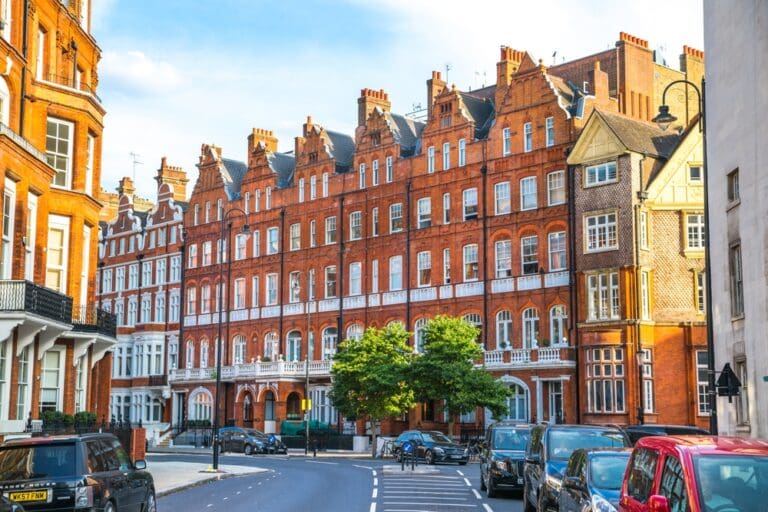
Every autumn and every summer, a few thousand households outside the United Kingdom have to arrange somewhere in London for someone to live. The person who will occupy the flat is usually a student at one of the central universities. The person paying for it, and doing the research, is often a parent several thousand miles away who will never see the building before the keys are handed over. They are buying a service remotely, on trust, with no possibility of inspection and a hard deadline set by a term date.

For any business selling to overseas buyers, that is a familiar and difficult shape of transaction. In central London lettings it has produced a distinct product, and the way it developed is instructive.
Why the standard market cannot serve it
The conventional London tenancy is built for a resident with a UK footprint. It runs for twelve months, requires a British guarantor or six months of rent in advance, arrives unfurnished, and is agreed after a viewing. Every one of those four conditions fails for a customer who needs nine months, has no UK credit history, owns no furniture in this country and is currently in Shanghai or São Paulo.
Purpose-built student accommodation answers part of the problem and introduces another. It handles the term-length let and the guarantor, but it is built around shared facilities and standardised rooms, and the central London sites are limited by the simple fact that there is very little land in Bloomsbury or Fitzrovia on which to build a thousand-bed block. The good ones fill early. The rest are a bus ride from campus, which for a twelve-week summer programme is a material part of the experience being bought.
So a gap opened between what the market offered and what a well-funded international household actually wanted: a central, private, furnished flat, on a term-length agreement, arranged before arrival.
What filled it
An open plan kitchen and dining room in a serviced apartment on Great Portland Street, Fitzrovia, a short walk from the UCL campus. Credit: Student Luxe.
The answer that emerged is the serviced apartment let on flexible terms. Mechanically it looks like a short-stay rental and commercially it behaves like hospitality: the flat comes furnished, the bills and the internet are inside the rent, housekeeping is weekly, and the building often carries a reception and a gym because it was designed for corporate lets rather than for students. No guarantor is required because the booking is treated as a reservation rather than a tenancy.
The geography concentrates tightly. The blocks that work for University College London sit in Fitzrovia and Bloomsbury, a walk of ten minutes or less from the Gower Street campus: Great Portland Street, Newman Street, Scala Street, the squares around Fitzroy Square and Charlotte Street. Student Luxe, a family business, hosts guests in accommodation near UCL within a few hundred metres of the campus, which is why availability rather than price tends to be the binding constraint in July and August.
The firms that do this well rarely own the buildings they let. What they sell is the arrangement, the certainty and the aftercare: someone who answers the phone when a boiler fails in week three, eight time zones from the person paying. It is an asset-light model, and it survives on service quality rather than on stock.
The part worth borrowing
What makes this a business story rather than a property story is the buying behaviour, because it generalises to anyone selling remotely into a market the buyer cannot inspect.
The first point is that price is not the lever. A customer who cannot visit is buying down risk, and the things they pay for are the things that reduce uncertainty: a named person who answers, a clear statement of what is included, a cancellation position, photographs of the actual unit rather than a show flat. Firms in this market compete on responsiveness and on the completeness of the answer, and the ones that compete on headline rate tend to attract the enquiries that do not convert.
The second is that the decision-maker and the user are different people with different questions. The parent wants safety, location and the identity of whoever is accountable. The student wants the room, the kitchen and how far it is to anything. A proposition that answers only one of them loses, and the firms that do well here write for both without pretending they are the same customer.
The third is the calendar. Demand arrives in two sharp waves, September and the summer programmes, with very little in between. That is a brutal shape for a business with fixed overheads, and it rewards operators who can move inventory between student and corporate lets as the year turns. It is the same seasonality problem a seaside hotel has, solved the same way.
None of this is a large market by the standards of London property. It is a small, concentrated, service-heavy niche with an unusual customer and a demanding clock. Which makes it a reasonable place to watch what happens when a buyer cannot see what they are buying, and has to be persuaded anyway.