

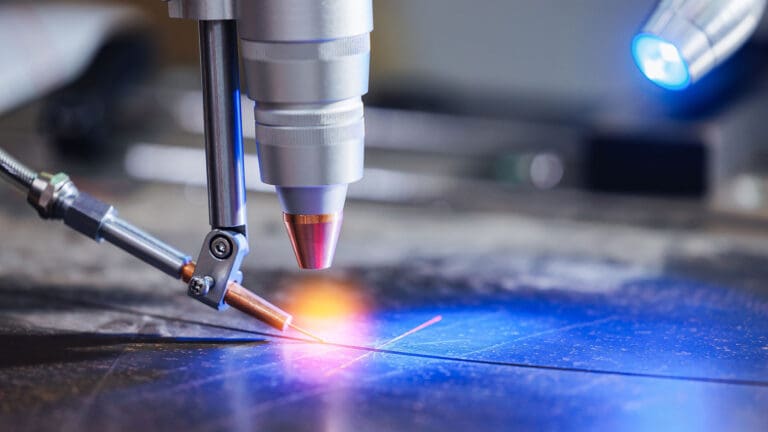
As manufacturers such as Dynalasers introduce compact air-cooled laser welders for different fabrication needs, proper laser welding safety becomes an essential part of equipment selection. A portable welding machine may be easier to relocate, but it must still operate within a suitably controlled environment.

Why Handheld Laser Welding Requires Special Safety Controls
Industrial handheld fiber laser welders are generally Class 4 systems. Under IEC laser classifications, Class 4 begins above 500 mW, or 0.5 W, of accessible laser emission under the applicable classification conditions. Industrial welding systems typically operate at hundreds or thousands of watts, far above this threshold.
Many fiber welding lasers emit near 1070 nm, an invisible infrared wavelength. Unlike a bright visible arc, this radiation may cause serious retinal injury without triggering a protective blink response.
Hazard
Practical Risk
Direct Laser Exposure
Severe eye injury or localized skin burns
Reflected Laser Radiation
Hazardous exposure to operators and nearby workers
Invisible Infrared Light
No reliable visual warning before exposure
Welding Fumes
Exposure to metal particles and coating contaminants
Fire and Thermal Hazards
Ignition of combustible materials or hot surfaces
Reflections deserve particular attention when welding aluminum, copper, polished stainless steel, or components with angled surfaces. Hazardous reflections can occur during beam initiation or when the beam does not couple properly into the workpiece.
According to the American Welding Society (AWS), Class 4 laser reflections can cause permanent eye and skin damage. The potential hazard extends beyond the person holding the welding gun.
This makes handheld laser welding safety particularly important in shared workshops where other employees may approach a welding station without recognizing the invisible radiation risk.
Laser Welding PPE: Glasses, Helmets, and Protective Clothing
Proper laser welding PPE provides an important protective layer, but it cannot replace engineered beam containment. Operators must use equipment selected for the specific laser system and the results of a documented hazard assessment.
The most important protective equipment includes:
Laser Welding Safety Glasses: Eyewear must match the laser’s emission wavelength and provide the optical density and protective performance specified by the safety assessment. A high OD number alone does not establish suitability.
Laser Welding Helmet: A purpose-designed helmet provides additional eye and face protection against relevant laser radiation and welding-process hazards. Conventional arc-welding helmets are not automatically laser-safe.
Protective Clothing and Gloves: Flame-resistant clothing, suitable welding gloves, and covered skin help reduce burns, spatter injuries, and incidental exposure.
Respiratory Protection: Local exhaust ventilation should control welding fumes at the source. Respirators may be required where exposure assessments show that engineering controls are insufficient.
For example, eyewear specified for one fiber laser wavelength should not automatically be used with a different laser source. Protective filters must be checked against the equipment’s documented emissions and the applicable eyewear standard.
Gloves also have limitations. A high-power direct laser beam can penetrate or damage ordinary welding gloves; they must never be treated as an acceptable beam stop.
All laser welding safety glasses and helmets should be inspected for damage, correct labeling, and proper fit before use.
Laser Welding Enclosures, Curtains, and Safety Interlocks
A controlled welding environment is one of the most effective ways to reduce accidental exposure. In shared fabrication shops, preventing hazardous laser radiation from reaching adjacent workstations is more reliable than expecting every nearby worker to wear laser-specific eyewear continuously.
Suitable laser welding enclosures may use rigid panels, purpose-rated curtains, controlled access doors, and protective viewing windows.
Safety Control
Function
Laser-Rated Enclosure
Contains hazardous direct and reflected radiation
Laser Safety Curtains
Provides evaluated beam containment where appropriate
Interlocked Access Door
Disables hazardous emission when protected access is opened
Emergency Stop
Provides rapid termination of laser emission
Warning Indicators
Identifies an active or enabled laser-controlled area
Beam Stops and Fixtures
Help manage foreseeable beam paths and reflections
Standard MIG or TIG welding curtains should not be assumed suitable as laser welding safety curtains. Protective materials must be evaluated for the actual wavelength, incident power density, exposure duration, and foreseeable beam direction.
Safety features incorporated into welding equipment can provide additional protection. Depending on the machine, these may include keyed activation, two-stage triggers, workpiece-contact sensing, or back-reflection detection.
However, an equipment-level safeguard does not replace a protected workstation.
Door interlocks must remain functional and should never be bypassed to simplify access. Likewise, ordinary workshop walls, windows, or temporary screens should not be considered laser-safe without appropriate assessment.
Laser Welding Safety Standards and Operator Training
Effective laser welding safety requirements combine equipment design, workplace procedures, operator qualification, and ongoing supervision. The relevant obligations vary by jurisdiction and installation type.
Manufacturers should understand the principal standards and guidance associated with industrial laser processing.
Standard or Guidance
Main Relevance
ANSI Z136.1
General principles for safe laser use
ANSI Z136.9
Laser safety in manufacturing environments
ISO 11553-1:2020
Safety requirements for laser processing machinery
IEC 60825-1
Laser product classification and safety requirements
OSHA Requirements
Applicable U.S. workplace safety obligations, including PPE and hazard controls
These documents serve different purposes and should not all be treated as interchangeable legal requirements.
AWS guidance calls for a qualified Laser Safety Officer (LSO), a documented laser safety program, and an appropriate laser-controlled area for Class 4 handheld operations.
The LSO or other appropriately designated qualified personnel should assess beam hazards, approve control measures, establish operating procedures, and coordinate laser welding safety training.
Experienced TIG welders still require laser-specific training. Understanding molten metal and welding parameters does not automatically prepare an operator to manage invisible infrared radiation, reflected beams, or interlocked access systems.
Laser Welding Safety Checklist Before Starting Production
A practical laser welding safety checklist should be completed before initial commissioning and incorporated into routine operating procedures. Daily checks become especially important when multiple operators share equipment across different shifts.
Before enabling laser emission, the responsible operator should verify:
Controlled Area: The enclosure, access restrictions, warning signs, and beam-containment measures are in place.
Safety Functions: Door interlocks, emergency stops, and applicable equipment safeguards have passed their prescribed checks.
Protective Equipment: Eyewear, helmet, gloves, and clothing are appropriate, correctly fitted, and undamaged.
Equipment Condition: The welding head, fiber cable, protective optics, and electrical connections show no visible damage.
Workstation Readiness: Fixtures are stable, combustible materials are controlled, and fume extraction is operational.
Personnel Authorization: Only trained and authorized personnel can enter or operate within the laser-controlled area.
Routine maintenance is also essential. Damaged optical components or fiber cables may affect both processing performance and equipment safety.
For multi-shift production, inspection records should identify the operator, equipment condition, and any unresolved faults.
If an interlock fails, protective equipment is damaged, or unintended laser emission is suspected, operations should stop until qualified personnel assess and resolve the problem.
A documented handover procedure is often more valuable than relying on informal assurances that the equipment was operating normally during the previous shift.
Dynalasers S, M, and D Series: Safety Considerations Before Installation
Equipment portability, power, and configuration influence how a laser welding workstation is arranged. Dynalasers offers three handheld laser welding machine series for different fabrication needs, but all installations require appropriate laser safety controls.
S Series: Compact Welding for Small Workspaces
Image Name: s-series-portable-handheld-laser-welder-dynalasers
Image Alt: Dynalasers S Series Portable Handheld Laser Welding Machine
The Dynalasers S Series focuses on compact, portable welding applications, particularly thin sheet metal and localized fabrication.
Model
Weight
Key Features
S10 Spot
<10 kg
Compact spot welding, thin metal applications
S30
<21 kg
Continuous, burst, and pulse modes
S40
< 22 kg
Compact handheld welding configuration
Despite their smaller size, S Series machines still require suitable laser-rated barriers and controlled access to prevent unintended exposure.
M Series: Flexible Handheld Welding for Industrial Fabrication
Image Name: m-series-handheld-laser-welder-dynalasers
Image Alt: Dynalasers M Series Handheld Fiber Laser Welder
The Dynalasers M Series provides different power configurations for general fabrication, with the M71 offering additional multi-function welding capabilities.
Model
Rated Power
Key Features
M30
800W
Air-cooled, portable welding
M50
1200W
Air-cooled, versatile fabrication
M70
1800W
Higher-power handheld welding
M71
1800W
Five-in-one, dual wobble, single/dual wire feeding
For workshops moving equipment between production stations, each location must be assessed for beam containment, reflected radiation, safe access, and effective fume extraction.
D Series: Integrated Air-Cooled Welding Systems
Image Name: d-series-industrial-laser-welder-dynalasers
Image Alt: Dynalasers D Series Industrial Handheld Laser Welder
The Dynalasers D Series features integrated air-cooled designs for workshops seeking compact equipment configurations with fewer external cooling components.
Model
Rated Power
Weight
D50P
1200W
<41 kg
D70P
1800W
<43 kg
An integrated design can simplify equipment placement, but it does not eliminate the need for protective enclosures, interlocks, and operator training.
Regardless of the series selected, portable equipment does not mean open-area operation is safe. Buyers should verify laser classification, safety interfaces, operating instructions, and installation requirements before commissioning.
Frequently Asked Questions
Can You Safely Use a Handheld Laser Welder in a Home Garage?
Only if the installation can satisfy the necessary Class 4 laser controls and applicable local requirements. An ordinary garage with unprotected windows, uncontrolled entry, or inadequate beam containment is unsuitable. A qualified safety assessment should establish whether the available space can be converted into a properly controlled laser work area.
What Should You Do After Accidental Laser Exposure?
Stop laser operation immediately and follow the site’s emergency response procedure. Suspected eye exposure requires urgent medical assessment, even without immediate symptoms. Skin injuries should also receive appropriate medical evaluation. The event should be documented and investigated before the equipment returns to service.
Does a Class 1 Laser Welding Cell Mean the Laser Source Is Class 1?
No. A properly enclosed system may achieve Class 1 accessible-emission classification while containing a Class 4 laser source internally. That classification applies only under the assessed operating conditions. Opening protective panels or performing maintenance may expose personnel to higher-class hazards and require additional controls.
Conclusion
Effective laser welding safety depends on more than protective eyewear. Manufacturers need suitable beam containment, working interlocks, trained personnel, and consistent operating procedures to protect both operators and nearby workers.
With S, M, and D Series welding options, Dynalasers supports different metal fabrication requirements. Regardless of equipment size or power, safe installation and documented risk assessment should remain part of every purchasing and production decision.