
Subsurface utility engineering (SUE) exists to bridge that gap: it gives project owners a structured way to decide how much certainty they need about each utility, and where to spend money to get it.

The most expensive and most reliable level of information comes from test holes, physically exposing a utility to measure its exact position, depth, size and material. The question many owners and designers struggle with is when test holes are worth the cost and when lower levels of information are enough. This article offers a practical, risk-based way to make that decision.
The Four Quality Levels in Brief
Under the ASCE 38 standard used in the United States, utility information is classified into four quality levels. The UK’s PAS 128 uses a similar, though more detailed, system.
QL-D: information from existing records or verbal accounts.
QL-C: records correlated with surveyed visible features such as manholes and valves.
QL-B: utilities detected and traced with geophysical methods, such as electromagnetic locating and ground penetrating radar, then surveyed.
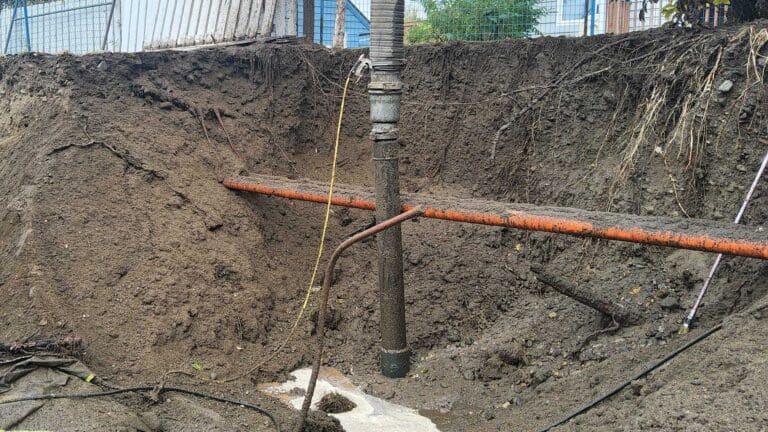
QL-A: utilities physically exposed, typically by vacuum excavation, with measured horizontal and vertical position.
Each step up the ladder costs more and reduces uncertainty. The art lies in applying the right level to the right place.
A Risk-Based Framework
Think of utility risk as a combination of two questions:
What is the consequence if this utility is wrong? Damage, injury, service outage, redesign, delay or claim.
How likely is it that the current information is wrong enough to matter? Based on record quality, utility age, site congestion and how close the design comes to the utility.
High consequence combined with meaningful uncertainty is where test holes earn their cost.
Situation
Consequence If Wrong
Recommended Minimum Level
Utility far from any proposed work
Low
QL-C or QL-D
Utility within the project footprint but not in direct conflict
Moderate
QL-B
Proposed pipe, duct or culvert crossing an existing utility
High: redesign or strike
QL-A at the crossing
Drilled shafts, piles or sign foundations near a utility
High: strike and safety risk
QL-A
High-pressure gas, fuel, high-voltage or major fiber lines
Very high
QL-A at points of interest
Utility deciding between relocating and protecting in place
High: cost difference can be large
QL-A
Where Test Holes Deliver the Biggest Return
Vertical Conflicts
Geophysical methods are usually good at horizontal position but less precise for depth. When a new storm drain or water main crosses an existing utility, the vertical clearance decides whether the design works. A single test hole can confirm the clearance or reveal the need for a design change before construction.
Relocation Decisions
Utility relocations are among the most expensive and schedule-critical items on many projects. If an exact depth shows that a utility can stay in place with protection, the savings can be dramatic.
Ambiguous Geophysical Results
Where QL-B work produces uncertain or conflicting signals, such as in congested urban corridors, one or two test holes can resolve the ambiguity for a whole area.
Calibrating the Survey
Test holes also calibrate the geophysical survey. Measured depths improve velocity models for GPR and confirm that traced lines are identified correctly, raising confidence in QL-B data across the project.
Where Test Holes Add Little
Where design has enough flexibility to avoid the utility entirely
Where the utility is well outside the zone of influence of the work
Where the design is still early and the alignment is likely to change
Where records are recent, reliable and confirmed by QL-B results
Timing Matters
The value of test holes is highest during design, when changes are cheap. During construction, the same information arrives too late to avoid redesign and delay. The most effective programs schedule QL-B surveys early, then run a targeted QL-A program once the alignment is stable and conflict points are known.
Owners and design teams that want to apply this approach consistently often work with providers of subsurface utility engineering services who can explain the quality levels clearly and recommend where each is justified. MAYA Global Group’s overview of SUE quality levels A to D is a useful reference for teams planning their first risk-based program.
Frequently Asked Questions
How many test holes does a typical project need?
There is no fixed number. It depends on how many points of conflict exist between the design and existing utilities. A risk review after QL-B mapping usually identifies the critical locations.
Are test holes disruptive?
Vacuum excavation creates small holes, usually well under a meter across, and is far less disruptive than conventional digging. Traffic management may still be needed on roads.
Can QL-B data ever replace test holes?
For horizontal position in favorable conditions, QL-B can be very reliable. For exact depth at critical crossings, physical exposure remains the standard.
Conclusion
Test holes are not a luxury, and they are not needed everywhere. Used at the right points, they turn uncertain assumptions into measured facts at exactly the places where errors would be most expensive. A risk-based approach to SUE quality levels lets project owners buy certainty where it matters and save money where it does not.