

We have learned from the new and old assaults on our liberties that good politics depends not so much on good institutions as on the good moral sentiments that support them. “Add institutions and stir” is not a recipe for success. Officers of the state enforcing regulations do good work when they ensure that the Triangle Shirtwaist Factory does not block the fire escapes or that military helicopters do not intrude on the civilian approaches to National Airport. But a regulation is unwise, as often, when its declared purpose is not even approximately attainable, or when its secret purpose is corrupt, or when officers with unwise beliefs or bad moral sentiments staff the institutions enforcing it. The institutions, such as the courts and the police, that enforce the “rule of law” are splendid—unless the laws are unwise or enforced by thugs. And even if it is kept wise and pure in its black letters, the outcome of the rule of law depends radically on who interprets it.
That is to say, if evil or unwise people take over a nation by coup or by vote, no structure of institutions or codes of laws, such as the American Constitution or the Federal Register, can reliably save us—or not as reliably as we commonly suppose. Throwing the bums out in the next election doesn’t help if new bums take over or if the bums have meanwhile corrupted the election.
On the other hand, a sufficiency of the great and good, or of the ordinary and decent, can make a ramshackle institution and its accretion of precedents—such as the English constitution and its common law—work pretty well. The good and decent people can adjust matters from time to time. And anyway, on principle, such people don’t abuse their powers, at any rate, as they understand “principle,” “abuse,” and “powers.” Ethics—not legal structures of institutions—largely runs the show.
After all, ethics—good or bad, for better or for worse—runs pretty much any group of humans, ranging in size from a conversation or a marriage or a few friends up to a sports team or a business or a nation. A meaningful conversation depends on what the philosophers call Gricean maxims. A good marriage depends on love or respect, or both. A successful sports team depends on team spirit. A successful business depends on intrinsic motivations. A successful gang of thieves depends on omertà. In other words, well-designed and well-intentioned laws, catechisms, extrinsic motives, supreme courts, social approvals, traditional formulas, and even a few good and decent people are of no avail if too many of the other people are not self-respecting, other-respecting, and transcendence-respecting adults. True, as the eighteenth-century Scottish thinkers discovered, a virtuous order might emerge at the meso level—the middle—from people who are not, in some sense, wholly virtuous at the micro level, though greed, the Scots also said, is not good. And occasionally, a tyrant like Peter the Great or Lee Kuan Yew can coerce a good result from the macro level, top-down.
But mostly, the classical, civic, democratic, or liberal-republican theorists from Aristotle and Cicero down to George Orwell and Francis Fukuyama have been correct. The functioning of institutions does reflect the predominant character of the people. In 1787, the anti-Federalists, such as George Mason, understood this well. Sometimes the character of the people can be “refined” by soulcraft and statecraft, as Madison suggested in Federalist Papers 10. Yet sometimes, as he worried there, it can be corrupted by a skilled demagogue or a selfish faction. Without widespread sentiments for an adult and dignified liberty—which can be refined by a virtuous rhetorician like President Obama or corrupted by a non-virtuous one like President Trump—a liberal-democratic republic fails. As Mercy Otis Warren of Plymouth wrote to John Adams in March 1776, “I shall have hopes that America has more than one politician who has abilities to make the characters of his people, to extinguish the vices and follies he finds, and to create the virtues he sees wanting.” Hopes.
Cato the Elder of old Rome defined the best orator as “a good man skilled at speaking,” a character vitally important for a republic in Rome and still now. Madison’s institution of separation of centralized powers in politics, like the institution of peer review in science, does not suffice—as indeed Mercy Otis Warren did later argue in her anti-Federalist writings. The republic of politics, said Tocqueville, and the republic of science, said Popper, both depend on an ethic of respect for self, other, and transcendence. Without which, not.
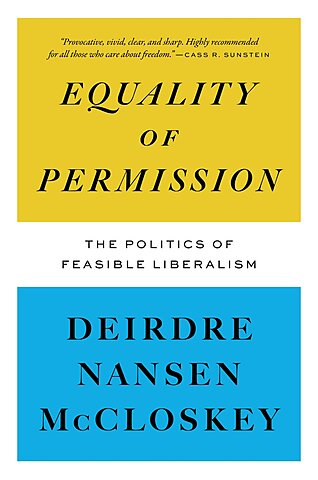
That, in brief, is what I argue in Equality of Permission: The Politics of Feasible Liberalism, just published.
The talk of ethics will seem out of place in a book about politics. Economic and political sciences have long cherished a materialist bias. “No preaching, please: we’re scientists. It’s so embarrassing for us serious-minded, scientific moderns to mention ethics.” Compare realist foreign policy. Especially in the twentieth century, ethics came to be regarded as a matter of sheer, arbitrary, culturally determined opinion, beyond logic and evidence—beliefs like the Baltimore catechism and the nuns to enforce it. It’s not to be acknowledged in a scientific undertaking—even in a science like economics or political science that, on its face, deals with ethics. The embarrassment about ethics echoes the old resolution of the wars of religion in Europe and the American maxim of politeness in a diverse country intent on keeping the peace: not bringing up religion or politics at the Thanksgiving dinner table.
But humans can’t help having, as Hume pointed out, moral sentiments, ethics, loves, hatreds. Ethics comes out. Politically, it comes out in an indignation felt against the people of the other party. Such people, one feels, are not merely stupidly misled in a way that could be corrected by instruction. No, if the rule of comity is broken, we come to see and to declare and then to fight their obvious evil. American Democrats express indignation at the evil lack of motherly charity among the Republicans; the Republicans express indignation at the evil lack of fatherly patriotism among the Democrats.[i] The American MAGA theorists, meanwhile, in the style of the Dartmouth Review under Dinish D’Souza, have taken to indulging an adolescent boy’s delight in irritating both the mother and the father—though the MAGA politicians depend on the votes of fearful traditionalists, yearning for the father.[ii]
But we should get over the embarrassment, because moral sentiments matter vitally in human affairs. We had better acknowledge them, and then, for the actual politics, get them right. In his eloquent swan song for his decades as a columnist in the New York Times, David Brooks noted “Americans’ collective loss of faith.” “The most grievous cultural wound has been the loss of a shared moral order.… It created a naked public square where there was no broad agreement about what was true, beautiful, and good. Without shared standards of right and wrong, it’s impossible to settle disputes; it’s impossible to maintain social cohesion and trust. Every healthy society rests on some shared conception of the sacred.”[iii]Yes.
To order a copy of Equality of Permission: The Politics of Feasible Liberalism, click here.