Among all traded agricultural commodities, garlic stands out as a vital primary crop for food processors, commercial kitchens, and retail chains globally.

Understanding how the global garlic trade works requires an inside look at primary production hubs, post-harvest logistics, international distribution networks, and changing market dynamics.
The Operational Lifecycle of Global Garlic Production:
To understand the economics of the international market, one must first look at the main centers of cultivation. Jinxiang County in Shandong, China, known internationally as the capital of garlic production, serves as the prime engine for global supply. With over 600,000 acres of dedicated farmland yielding approximately 800,000 tons of fresh harvest annually, this single region accounts for more than 70% of the world’s processed exports.
The trade cycle follows a strict biological and operational timeline:
Sowing and Irrigation: High-grade seed cloves undergo a 15-day cold treatment at 2–5°C to break dormancy, pushing germination rates above 95%. Sowing takes place in autumn when temperatures sit between 18–20°C, supported by structured flood irrigation.
Harvesting and Selection: In late April, stalks are hand-extracted to optimize bulb sizing, followed by the main bulb harvest in late May and early June when leaf yellowing signals peak maturity.
Sizing and Calibration: Mechanical sorting machines categorize bulbs into precise diameter classes (with strict tolerances of ±0.2 cm):
Dominant Trends Transforming the Industry:
The international trade environment is shifting rapidly toward strict standardization, sustainability, and origin verification.
1. Verification and Regulatory Compliance:
Global buyers no longer rely on simple visual inspections. Commercial imports must adhere strictly to international safety protocols, including ISO, HACCP, Halal, and Kosher certifications, as well as EU Geographical Indication credentials. These certifications verify soil and irrigation safety standards, giving importers full confidence regarding chemical residue levels and phytosanitary rules.
2. Product Diversification Beyond Raw Bulbs:
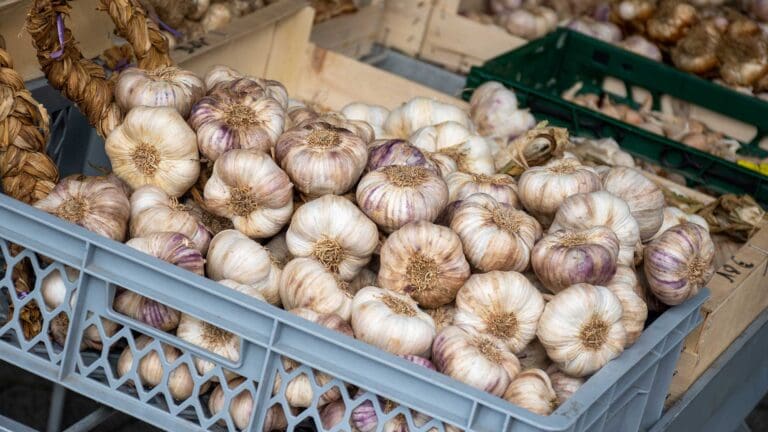
While fresh white and purple garlic bulbs remain core commodities, commercial markets are shifting heavily toward ready-to-use formats. Pre-peeled vacuum-packed cloves, dehydrated flakes, granules, and fine powders now form a massive share of total trade volume, allowing industrial food plants to streamline production and cut prep labor costs.
Supply Chain Complexities: From Cold Storage to Port Clearance:
Transporting fresh produce across oceans while maintaining strict quality standards requires robust cold-chain logistics.
Stage
Logistical Parameter
Operational Objective
Preservation
Strict -3°C Cold Storage
Keeps bulbs in a total dormant state, locking in moisture and preventing sprouting.
Packaging
Mesh Bags (200g to 10kg) & Cartons
Custom breathable designs optimized for ventilation and structural stacking.
Maritime Transit
Qingdao Port to Destination
40 to 60 days ocean journey requiring climate-controlled reefer containers.
Weather Risks and Market Price Volatility:
Daily market prices change constantly based on crop yields, cold-storage inventory reserves, and international freight rates. Because harvesting depends heavily on stable weather, unexpected rain or early freezes can shrink output, leading to sharp price movements in trading hubs worldwide.
Mitigating Long-Distance Transport Risks:
During long sea voyages, moisture buildup is the primary threat to produce quality. Utilizing specialized mesh bags and reinforced corrugated shipping cartons allows air to circulate freely. When paired with precise temperature maintenance inside transit containers, spoilage risks during 60-day sea voyages are minimized.
Strategic Business Opportunities for Importers and B2B Buyers:
For international distributors, chain restaurants, and industrial buyers, establishing reliable procurement routes directly from the source is essential for protecting profit margins.
Direct Sourcing Channels: Working directly with an established bulk garlic supplier allows commercial buyers to secure stable contract pricing, bypass broker markups, and request custom packaging formats tailored specifically to local market preferences.
Securing Year-Round Inventory: Working with production networks that maintain millions of tons in cold storage capacity protects businesses against seasonal price jumps and localized supply shortfalls.
Custom Processing and Labor Efficiency: Purchasing peeled or calibrated varieties allows commercial kitchens to optimize labor allocation, eliminate preparation waste, and maintain total consistency across multiple locations.
Final Thoughts:
Understanding how global garlic trade works gives food industry leaders a clear competitive advantage. By monitoring market trends, understanding post-harvest logistics, and securing direct supply channels with a trusted bulk garlic supplier, businesses can navigate price fluctuations, guarantee fresh arrivals year-round, and build resilient, profitable procurement systems.