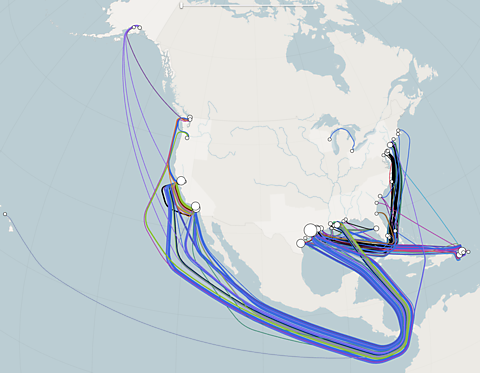

Earlier this week, the Cato Institute’s Jones Act Waiver Tracker recorded its 300th completed voyage since the waiver was issued on March 17 for the transportation of energy and fertilizer products. Those voyages carried over 80 million barrels without idling a single Jones Act tanker, providing some indication of how much domestic commerce the Jones Act has constrained.
Freed from the law’s prohibition on using foreign-built and foreign-flagged ships, tankers operating under the waiver have, on numerous domestic routes, delivered more energy cargoes in months than Jones Act vessels have in years. The following figures and charts illustrate the scale of this commerce and hint at what lasting access to foreign shipping could make possible.
Record Shipments to PADD 5
20.7 million barrels of deliveries have moved from other US regions to PADD 5 (the West Coast, Alaska, and Hawaii) under the waiver. At least three voyages to PADD 5 have taken place that are not recorded in government data and are excluded from the total.
16.1 million barrels was the previous full-year record for deliveries to PADD 5 by tanker and barge, set in 2024. Renewable diesel accounted for 98 percent of that total.
4.6 million barrels reflect the amount by which waiver deliveries exceeded the annual record in just seven months. This difference alone is greater than total waterborne petroleum deliveries to PADD 5 from other US regions in any individual year from 2008 through 2021.
A Vast Increase in Petroleum Product Deliveries
14.2 million barrels in deliveries of conventional petroleum products (excluding crude oil, biofuels, natural gas liquids, and unfinished oils) have gone to PADD 5 under the waiver. In comparison, Jones Act–compliant vessels delivered 13.5 million barrels in all 18 years from 2008 through 2025.
8.9 million barrels of gasoline blendstock and alkylate (components used to make gasoline) were delivered to PADD 5 under the waiver. The Jones Act fleet delivered 7.7 million barrels over the 17 years from 2009 through 2025 combined.
2 million barrels of finished gasoline were delivered to PADD 5 under the waiver. Jones Act–compliant vessels delivered none from other PADDs from 2018 through 2025.
2.7 million barrels of jet fuel were delivered to PADD 5 under the waiver. Jones Act–compliant vessels delivered only 1.8 million barrels over the preceding 36 years combined (1990–2025).
Surging Shipments to Puerto Rico
10.1 million barrels of petroleum products were delivered from the US mainland to Puerto Rico under the waiver. In less than seven months, those deliveries amounted to about four times the 2004–2025 annual average of 2.5 million barrels.
25 percent of waiver deliveries in less than seven months equal one-quarter of Puerto Rico’s entire 2025 petroleum supply (mainland shipments plus foreign imports). From 2004 through 2025, the mainland’s average annual share was 5.2 percent.
78 percent was the US mainland’s share of Puerto Rico’s propane imports from April through August, compared with 0.7 percent in all of 2025. March is excluded because the waiver was only partially in effect, while August is the latest month with foreign import data.
1.2 million barrels of propane were delivered from the US mainland to Puerto Rico under the waiver. That is more than three times the combined total of all mainland deliveries from 2004 through 2025, which averaged about 16,500 barrels per year.
Other Domestic Routes
1.3 million barrels of petroleum products were transported from the Gulf Coast to New England under the waiver. That exceeds the combined volume transported on this route during the previous three years (2023–2025).
3.3 million barrels of crude oil and petroleum products were sent from the East Coast and West Coast to the Gulf Coast under the waiver. That’s approximately 120,000 barrels short of what was transported in the last four years combined (2022–2025).
13.3 million barrels of crude oil were transported from the Gulf Coast to East Coast refineries. This amount surpasses the total annual volume recorded for such flows in 2016, 2017, and 2021.
196,000 barrels of propane were delivered from the US mainland to Hawaii under the waiver. Jones Act–compliant tankers delivered zero barrels of US propane to Hawaii from 2016 through 2025.
Zero Jones Act–compliant tankers are capable of carrying bulk propane. Access to foreign gas carriers has enabled US suppliers to serve domestic markets (including Hawaii, New England, and Puerto Rico) that the Jones Act tanker fleet could not.
The Jones Act Fleet: Older and Fully Employed
Zero Jones Act–compliant tankers, out of a fleet of 56, have been laid up or unemployed under the waiver.
17.6 years versus 9.7 years are the average ages of the 56 Jones Act–compliant tankers and the 223 foreign tankers, respectively, used under the waiver.
42 percent is the share of waiver tankers built in 2018 or later. In contrast, zero Jones Act–compliant tankers were built during that period.
Things Worth Keeping in Mind
In interpreting these numbers, a few factors merit consideration:
Some voyages are missing. Cato research has identified at least eight voyages that have taken place under the waiver but are not included in the US Maritime Administration’s data. This means actual volumes are even higher than what is indicated by these charts and figures.
Shipments took time to begin. Companies had to secure vessels, arrange cargoes, and complete voyages that can take weeks (about three weeks from the Gulf Coast to California). The 206-day reporting window therefore includes an initial period when shippers were still putting these movements in place.
Temporary waivers hinder long-term planning. The waiver has been issued and renewed in 60- and 90-day increments, with no certainty of continuation. Yet businesses often use multiyear shipping contracts to secure vessels for dependable transportation, and propane shipments often rely on long-term contracts to help secure supply and terminal loading access. The waiver’s temporary nature makes it harder to build these arrangements around foreign vessels serving domestic routes, limiting the waiver’s usefulness.
Tighter restrictions appear to have curtailed the waiver’s use. Bloomberg reported on October 7 that just nine energy cargoes had moved on foreign-flagged ships since August 17, compared with more than 280 voyages in the preceding five months. The slowdown followed the introduction of case-by-case review for the granting of waivers as part of the waiver’s August renewal.
Conclusion
Even with these constraints, the waiver has enabled record-high waterborne energy shipments and revealed an appetite for American energy that the Jones Act fleet has been unable to satisfy. But the waiver is temporary and currently scheduled to expire on November 15. When it ends, Americans will lose access to the foreign vessels that have made this commerce possible and face costlier alternatives.
Puerto Rico would likely revert to its overwhelming reliance on propane and other fuels from more distant foreign suppliers. East Coast refineries could replace some of the Gulf Coast crude they now receive with imports. West Coast buyers could sharply reduce their purchases of American fuel.
Congress should preserve the waiver’s gains and build on them. If access to foreign shipping can spur this much domestic energy trade, how much more commerce could Americans conduct if the same freedom extended to all products? Why should the country return to the restrictions that prevented this expanded commerce in the first place?