

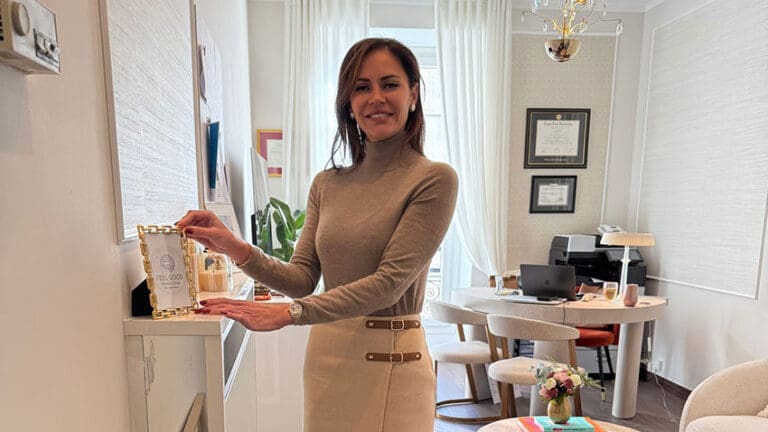
How a Finance Executive Became a Leader in Inclusive Design
What if the spaces where we work, learn, and live could actively help us feel calmer, think more clearly, and perform better?

That question sits at the center of Lydia Denimal Abdouch’s career today. As the founder and CEO of Feel Good Monaco, she is helping advance the growing field of neuro-architecture, which combines architecture, neuroscience, and sensory design to create environments that support human well-being.
Her journey to this emerging discipline did not begin in architecture. It began in finance.
“Success is creating environments that genuinely improve people’s lives,” Abdouch says. “For me, success is when a space brings calm, focus, and well-being in a measurable way.”
Who Is Lydia Denimal Abdouch?
Abdouch grew up in an international environment between Algeria, France, Europe, and North America. Raised in France’s Champagne-Ardenne region, she developed an early ability to adapt to different cultures and perspectives.
Her family also played a major role in shaping her future interests. Both of her parents were medical doctors involved in disability reintegration and autism support. Those experiences exposed her to questions of autonomy, dignity, and inclusion from a young age.
As the oldest of four sisters, she learned responsibility early.
Years later, those lessons would influence the direction of her career.
“My biggest motivation comes from my son and my family background in medicine and disability support,” she says. “It made me deeply aware that spaces can change autonomy and quality of life.”
How Lydia Denimal Abdouch Built Her Business Career
Before entering the design world, Abdouch built an impressive academic foundation.
She earned a Master’s degree from Montpellier Business School in France, studied management science at ITESM Tec de Monterrey in Mexico, and later completed an MBA at Texas Tech University’s Rawls College of Business in the United States.
Her professional career began in corporate banking.
Working in high-level financial environments across France, Latin America, and the Middle East, including Abu Dhabi, she managed strategic corporate portfolios for major organizations. Some clients generated annual revenues ranging from €50 million to more than €1 billion.
The work required analytical precision and disciplined execution.
“Early on, I learned that excellence comes from structure and process, not intuition alone,” Abdouch says. “Every challenge helped me refine my standards and strengthen my method.”
Why She Left Finance for Real Estate and Design
Although finance provided valuable experience, Abdouch became increasingly interested in real estate and the built environment.
After moving to Monaco in 2018, she launched a real estate agency serving an international luxury market. At the same time, she began leading acquisition, renovation, and resale projects.
Over more than a decade, she developed expertise across every stage of property transformation. She worked on sourcing opportunities, renovation planning, architectural enhancement, project execution, and final delivery.
To formalize her knowledge, she earned a Diploma in Interior Architecture in 2024.
This combination of finance, construction, and design gave her a unique perspective.
“You need vision, technical discipline, and the ability to deliver,” she says. “Architecture is not only about ideas. It is about precision, responsibility, and impact.”
What Is Neuro-Architecture?
As Abdouch gained experience in renovation and architecture, she noticed a recurring problem.
Most spaces were designed primarily for aesthetics or functionality. Very few considered how people actually feel inside them.
At the same time, schools, workplaces, and homes were facing growing challenges related to stress, distraction, and sensory overload.
Research continues to show that environmental factors such as lighting, acoustics, layout, and sensory stimulation can influence concentration, emotional regulation, and productivity.
Abdouch saw an opportunity to approach design differently.
“Building a new discipline like neuro-architecture requires credibility and patience,” she says. “I overcame this by combining rigorous expertise, continuous learning, and real execution on the ground.”
That vision led to the creation of Feel Good Monaco.
How Neuro-Inclusive Spaces Can Improve Daily Life
Today, Abdouch develops environments designed to support both neurodivergent individuals and the general population.
Her work focuses on multisensory spaces, sensory regulation rooms, restorative environments, and inclusive design strategies for schools, corporations, institutions, and private residences.
The goal is not simply to create beautiful spaces.
The goal is to create spaces that work better for people.
She believes many modern environments unintentionally contribute to stress and cognitive fatigue. Thoughtful design, however, can help restore focus and improve daily experiences.
“The strongest metric is people satisfaction and well-being,” she says. “Feedback matters, but the real measure is the impact a space has on the people who use it.”
The Future of Architecture and Human Well-Being
For Abdouch, architecture is entering a new era.
In the past, success was often measured by appearance alone. Today, there is growing interest in how environments influence learning, productivity, health, and quality of life.
Her work reflects that shift.
By combining strategic thinking, financial expertise, construction knowledge, and neuroscience-informed design, she is helping expand the conversation about what architecture can achieve.
“I stay connected to research, innovation, and international best practices,” Abdouch says. “Learning is a constant responsibility when you want to remain ahead.”
As organizations and communities continue exploring new ways to support well-being, leaders like Lydia Denimal Abdouch are helping demonstrate that architecture can be more than a backdrop to life. It can become an active tool for improving how people live, learn, and thrive.