

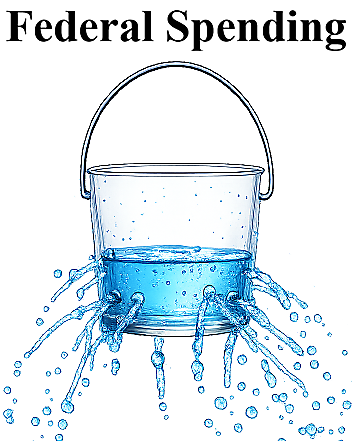

Congress is vastly overspending, and federal debt is rising by $2 trillion a year. Without major spending reforms, the government is headed toward a financial crisis. But it is also true that even if the federal budget were balanced, many spending programs would continue undermining the economy because their costs outweigh their benefits.
Such negative-value spending is the focus of my recent “Leaky Bucket” study with Ryan Bourne. We argue that the federal budget is riddled with wasteful “leaks.” The government scoops up trillions of dollars into its budget bucket, but many of them spill out due to inefficiencies and policy mistakes. The Trump administration has focused on reducing fraud, but that is only one type of leak from the federal budget bucket.
Many federal programs are leaky or inefficient, but often in different ways. This is illustrated in the table, which speculates about the severity of 10 types of leaks for a sample of programs. My rough guesses of “low,” “medium,” and “high” inefficiency are debatable in many cases. Indeed, Congress should be debating the levels of these inefficiencies as it prunes the budget of programs with high costs and low benefits.
Here are a few notes on the table. See the Leaky Bucket study for details on the inefficiencies.
Administrative Costs. Part of federal spending goes to the bureaucrats, not to program recipients. Administrative costs are high for complex programs, such as the earned income tax credit, and relatively low (from the federal perspective) for programs that primarily allocate funds through formulas, such as highway aid.
Logrolling. Congress passes most spending in large packages after intense horse-trading, which results in many low-value activities getting funded. I’ve rated passenger rail aid high because rail funding bills include wasteful spending for long-distance rural routes.
Agency Failures. The federal bureaucracy is inefficient and often makes mistakes. I rated Pentagon weapons purchases high because of frequent cost overruns.
Program Conflicts. Congress often includes provisions in programs that work at cross-purposes to the program goal. In highway spending, federal regulations that favor domestic purchases and labor unions inflate project costs, which in turn reduces the amount of highway investment.
Poor Targeting. Much federal spending goes to people other than those the policymakers claim to be helping. Community development aid is supposed to help poor communities, but much of the spending goes to wealthier communities. Farm subsidies mainly benefit wealthy landowners, not the small farmers whom policymakers claim they are helping.
Fraud and Errors. Hundreds of billions of dollars in spending are lost to fraudulent and erroneous payments every year. More than 20 percent of earned income tax credit spending is consumed by fraud and error every year, so the program rates high.
Behavior Changes. Federal spending induces recipients to change their behavior in unproductive ways. Medicare payments induce distortionary responses by health providers and individuals, and urban transit aid induces cities to spend on wasteful light rail systems rather than more efficient bus systems.
Crowding Out. Government spending displaces state, local, private, and voluntary activities. Federal welfare displaces self-help and charitable activities. Business subsidies, such as aid for broadband and computer chipmaking, displace spending that businesses should handle by themselves.
Compliance Costs. The state, local, business, and individual recipients of benefits, subsidies, and contracts gain from federal spending, but programs also cost them time and money on paperwork and compliance.
Tax Damage. Taxes to fund federal programs cost the private sector more than just the revenues raised. The extra costs include tax compliance burdens and reduced production. Funding federal programs with borrowed money increases the tax damage and shifts it forward.
Federal highway aid suffers only two “high” ratings. Does that mean it is a good program? Not all because those two highs are fatal flaws. Federal highway funding crowds out state highway funding, and it is less efficient because it comes with costly regulatory strings attached. (Note that the main funding mechanism for highways—the gas tax—is less damaging than income taxes, which fund most federal programs).
In sum, the table is based on guesswork, but it illustrates that programs should be repealed for combinations of different failings. The earned income tax credit has a fraud problem, as noted, but it also has high administrative and compliance costs. Plus, there is a serious internal program conflict—the credit encourages some people to work, but it discourages others from increasing work because the benefits are phased out as income rises.
With the government running large deficits, Congress should reconsider the need for many costly programs. Our study provides a framework for understanding why most federal spending programs undermine the economy. For most programs, more value likely leaks out and is wasted than is used to help beneficiaries in productive ways.