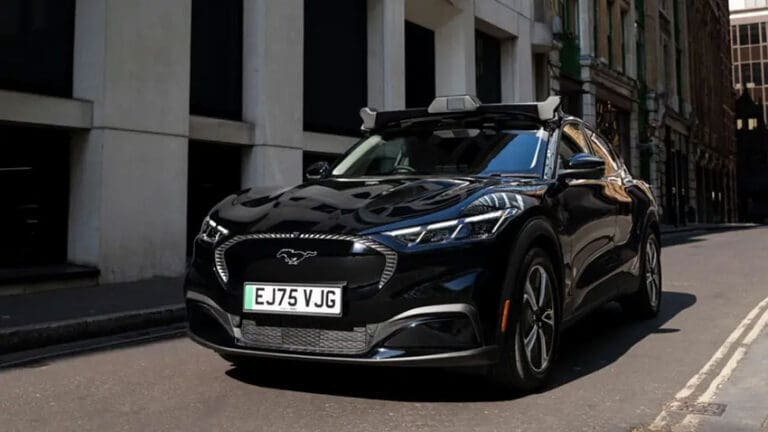
Transport for London has granted private hire vehicle licences to a fleet of autonomous cars using technology from British firm Wayve, on the condition that a qualified human driver is present and remains responsible for the vehicle. Journeys could begin later this year.
Uber said inspectors had confirmed that the vehicles met all of TfL’s policy and safety standards.

The cars being used are electric Ford Mustang Mach-Es, modified with camera pods on the roof and mirrors as well as small radar units.
The licensing completes the “triple-lock” requirement for private hire trips, under which the operator, driver and vehicle must all hold licences with the same licensing authority.
A TfL spokesperson said safety was its “top priority” and that any new vehicle licensed to carry passengers in London must align with its target of eliminating all deaths and serious injuries on London’s roads by 2041.
For the vehicles to operate without a human driver, a separate approval would be needed from the Driver and Vehicle Standards Agency. The Department for Transport opened applications in May for operators to run taxi and bus-style self-driving services under its pilot scheme.
Uber said some of the 100,000 people who signed up to express interest in experiencing robotaxis would be offered rides in the vehicles “later this summer”, ahead of a full public launch.
Caroline Russell AM, chair of the London Assembly Transport Committee, said the decision was expected. “The approval for up to 15 vehicles on a trial basis for a year, is not entirely unexpected,” she said.
“The London Assembly Transport Committee has been investigating the proposed rollout of autonomous passenger vehicles in depth for the past few months. We’ve spoken to industry experts, operators, representatives from the Taxi & Private Hire industries, Transport for London and the Department for Transport,” she said, adding that the committee had discussed the international experience of San Francisco and Oslo with experts from those cities.
“Uber and Wayve had been clear they would start by operating with a licenced private hire driver at the wheel, without actually operating in fully autonomous mode.
“The Committee still has many questions about the safeguarding of passengers, so we would not be expecting TfL to give consent at this stage for full autonomous operation. Those concerns and recommendations will be published in our report, which is due out in the next few weeks.”
The licences arrive amid growing competition to bring autonomous ride-hailing to the capital. Waymo, the self-driving arm of Alphabet, has confirmed plans to launch its own autonomous ride-hailing service in London in 2026 with fleet partner Moove, while Lyft has partnered with Baidu on UK expansion.
Wayve, the London-headquartered company whose technology powers the newly licensed fleet, signed a Memorandum of Understanding with the Department for Business and Trade in May aimed at moving automated vehicles from prototype to commercial deployment on British roads.
Ministers estimate that the autonomous vehicle sector could add £42bn to the UK economy and create close to 40,000 jobs by 2035, a figure at the centre of London’s wider contest between black cabs and driverless operators, which Business Matters has examined in depth.