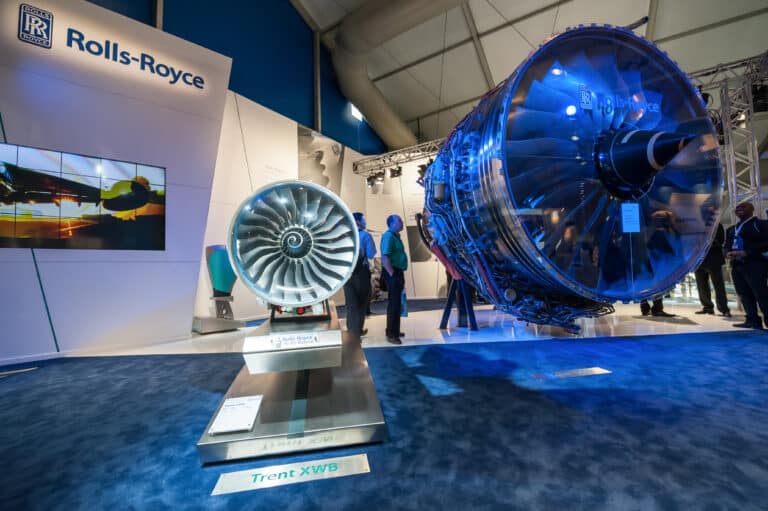
Rolls-Royce has put Britain’s new chancellor on the clock, and the deadline is now.
The Derby-based engineering group has told Andy Burnham’s government it needs a decision “as soon as possible” on financial support for its re-entry into the short-haul aircraft engine market, or it will go “elsewhere” to manufacture them.

Tufan Erginbilgic, the company’s chief executive, renewed the threat in a briefing at the Farnborough air show amid fears that without taxpayer support Rolls could move the business to Germany or the US, and Britain could lose tens of thousands of future jobs.
Asked when Rolls-Royce needed a decision, notwithstanding the latest change in government personnel, the chief executive said: “Asap [as soon as possible].” Asked how strong his threat was to go abroad, he said: “I have always said that my priority is to do it in the UK. My priority is clear. But we have other options. We have had conversations elsewhere.”
For the thousands of small engineering firms that machine, coat, cast and test components for British aerospace, this is not a story about one FTSE 100 boardroom. It is a story about whether a new tier of UK supply chain work exists at all in the 2030s.
Why narrowbody matters more than long-haul
After a 15-year hiatus, Erginbilgic wants to take Rolls back into the $1 trillion engine-making market for short-haul aircraft, also known as narrowbodies or single-aisle planes. That market is currently dominated by Pratt & Whitney of the US and its fellow American giant GE in a joint venture with Safran of France.
Rolls has since 2011 concentrated on the long-haul market, making engines for the likes of the Airbus A350 and the Boeing 787. The number of engines produced annually for short-haul aircraft is, however, between five and eight times as many needed for long-haul planes.
That multiple is the whole argument. Volume turns a handful of specialist suppliers into an industrial base, and the appetite was on display at Farnborough, where £7.7 billion of day one orders were heading to UK industry.
Rolls believes it has the proprietary UltraFan technology to re-enter the market at a time when both Airbus and Boeing are working on plans to launch new design aircraft in the 2030s to take over from the current A320 and 737 families. Miss that design window and the door shuts for a generation.
The awkward part
Industrialisation will only happen in the UK, Erginbilgic has made plain, if the government lends financial support of up to £200 million within an initial £3 billion company investment programme.
Some are astounded that Rolls-Royce is demanding support when it has become arguably the most financially successful industrial company in the country. It made an underlying pre-tax profit of £3.35 billion last year, forecasts profits above £5 billion a year by 2028, and has committed to an average of up to £3 billion a year in share buybacks for shareholders.
Erginbilgic counters that his rival enginemakers receive huge state support for their technology investment programmes, a case he has put publicly before without resolution. If Rolls does stay, he argues, it would create a sub-industry worth tens of thousands of British jobs and a transformation in UK supply chain advanced manufacturing.
The machinery to say yes already exists. The Aerospace Technology Institute programme has been extended to 2035 with up to £2.3 billion available and a dedicated SME stream, and narrowbody engines are named as a growth priority in the government’s Advanced Manufacturing Sector Plan. What is missing is a signature.
What owners should watch
Erginbilgic said he hoped to have talks with the new prime minister and new chancellor shortly, and is publicly optimistic about the man now in No 11.
“We know John Healey well from his time as defence secretary,” he said. “We are looking forward to working with him. He understands Rolls-Royce and our agenda and how we want to contribute to help grow the British economy.”
Suppliers weighing capital expenditure, apprenticeships or new capacity should treat the coming weeks as a genuine fork. A yes creates a decade of visible pipeline. A no does not close today’s order book, but it quietly caps how big any UK aerospace SME can grow.