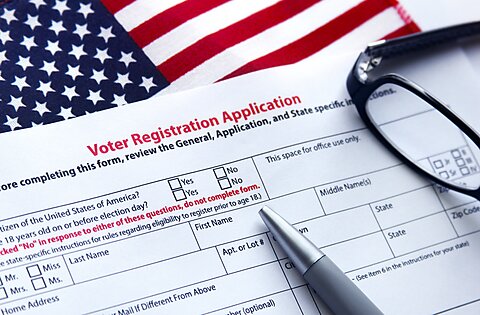

“Two weeks before this year’s primary elections,” according to a recent report, “Texas Attorney General Ken Paxton announced the creation of a tip line for the public to report people or groups suspected of voter fraud.” Oops! “Despite his own warnings, Paxton appears to have used an address where he did not live while voting in six elections in the past two years, including in May’s runoff that made him the Republican nominee for U.S. senator, according to records obtained by ProPublica and The Texas Tribune.“
Paxton’s campaign responded by calling the report “a baseless, lie-filled tabloid story” and said the candidate “is a registered Texas voter who is in full compliance with state law.” Perhaps it would be most prudent to defer drawing conclusions until after a probe can be completed. When that will happen is uncertain, given that Paxton, as incumbent state attorney general, is himself responsible for conducting any such investigation.
Yesterday, I helped record a Cato video for later release on the subjects of voter fraud and election integrity. While I didn’t bring up the Paxton allegations, I observed that the kind of voter fraud that’s probably committed most often in national elections is the kind carried on by persons with multiple residences who vote from a residence other than the one that the law designates as lawful for that purpose.
And yet, overall, it’s treated as a great big “who cares” issue. Such offenses are not pursued as a crime or punished at any great rate. One reason is that prosecutors can find it hard to prove the requisite guilty state of mind, and everyone is aware that one or two votes would not have changed the outcome anyway. Compare and contrast a related form of election misconduct that is pursued and corrected a lot—the kind that happens when candidates submit less-than-truthful current addresses because they would like to run in a certain district. In that case, the chance to knock a candidate off the ballot ensures much higher stakes and sets up a plausible complainant.
It’s not as if states and localities are without means to reduce the incidence of wrong-residence voting. One obvious step is for states and localities to maintain clean, up-to-date voter rolls and participate in interstate data clearinghouses such as the Electronic Registration Information center, or ERIC, which enables faster purging of old addresses after interstate moves as well as catching the occasional double voter. (After a campaign in opinion media to tag ERIC as liberal-coded, many conservative states dropped out.) That’s another sign that wrong-residence voting doesn’t rate as an especially high priority even in circles that express the most alarm about election integrity and urge a zero-tolerance spirit in precautionary measures.
Why is this? I have a few theories. Wrong-residence voting is not identified with a community that can be readily demonized as the “other,” unless you count college students. Indeed, I suspect it might even be especially common, and perhaps seen as a more forgivable error, by the sector of society affluent enough to be used to juggling multiple residences, which may include many professional commentators and political advisers.
Finally, I’m going to guess that wrong-residence voting is probably spread fairly evenly between red and blue households. Not only does this make it hard to treat wrong-residence voting as a plot by the other guy, but it also suggests that the deterrence introduced by impartial penalties would probably not lead to all that much change in election results. Of course, it’s even harder to be confident that a course of prosecutions would be selected impartially. Yet another widely practiced type of address truth-shading—mortgage declarations of intent to live in a certain residence—have become the subject of a gleefully one-sided enforcement campaign by the Trump administration against its enemies.
Let’s hope that wrong-residence voting someday receives the attention it merits as an election integrity problem without letting matters degenerate into that sort of lawfare.