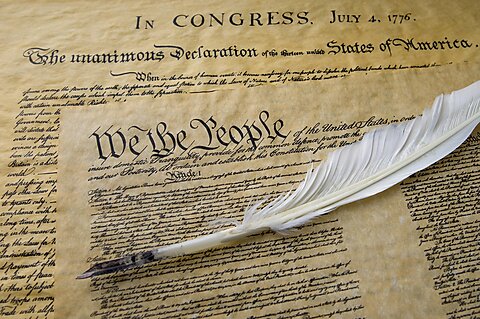

Roger Pilon wrote the preface below for the popular Cato Pocket Constitution, which was created to encourage people everywhere to better understand and appreciate the principles of government that are set forth in America’s founding documents. Mr. Pilon is a senior fellow at the Cato Institute and the founding director emeritus of Cato’s Center for Constitutional Studies. Copies of the Cato Pocket Constitution can be purchased here.
Preface
In 1776, America’s Founders gathered in Philadelphia to draft the Declaration of Independence, which dissolved the political ties that had bound the American people to Great Britain. A new nation was thus born, free and independent, the United States of America. Eleven years later, in 1787, after American patriots had won our independence on the battlefield, many of the men who had met earlier in Philadelphia, plus others, met there again to draft a plan for governing the new nation, the Constitution of the United States. In 1789, after the plan had been ratified, the new government was established. Together, the Declaration and the Constitution are America’s founding documents.
As amended over the years, the Constitution is the supreme law of the land, the nation’s fundamental law. But the broad language of the Constitution is illuminated by the principles set forth in the Declaration. To better understand and appreciate the form of government we have, therefore, it is important to look first to the Declaration, where the Founders outlined their moral vision and the government it implied.
Addressing “a candid World,” the Founders’ immediate aim in the Declaration was to justify their decision to declare independence. Toward that end, they set forth a theory of legitimate government and then demonstrated how far British rule had strayed from that ideal. But their argument served not simply to discredit British rule; in addition, it set the course for future American government. Indeed, for more than two centuries the ringing phrases of the Declaration have inspired countless millions around the world.
Appealing to all mankind, the Declaration’s seminal passage opens with perhaps the most important line in the document: “We hold these Truths to be self-evident.” Grounded in reason, “self-evident” truths invoke the long tradition of natural law, which holds that there is a “higher law” of right and wrong from which to derive human law and against which to criticize that law at any time. It is not political will, then, but moral reasoning, accessible to all, that is the foundation of our political system.
But if reason is the foundation of the Founders’ vision—the method by which we justify our political order—liberty is its aim. Thus, the cardinal moral truths are these:
that all Men are created equal, that they are endowed by their Creator with certain unalienable Rights, that among these are Life, Liberty, and the Pursuit of Happiness—That to secure these Rights, Governments are instituted among Men, deriving their just Powers from the Consent of the Governed.
We are all created equal, as defined by our natural rights; thus, no one has rights superior to those of anyone else. Moreover, we are born with those rights; we do not get them from government—indeed, whatever rights or powers government has come from us, from “the Consent of the Governed.” And our rights to life, liberty, and the pursuit of happiness imply the right to live our lives as we wish—to pursue happiness as we think best, by our own lights—provided only that we respect the equal rights of others to do the same. Drawing by implication upon the common law tradition of liberty, property, and contract—its principles rooted in “right reason”—the Founders thus outlined the moral foundations of a free society.
Only then did they turn to government. We institute government, the Declaration says, to secure our rights—our natural rights and the rights we create as we live our lives. But the powers that government may need to do that must be derived from our consent if they are to be just. Government is thus twice limited: by its end, which any of us would have a right to pursue were there no government; and by its means, which require our consent.
When it came time to draft a new constitution, the Founders drew upon the principles they had outlined in the Declaration. Having recently overthrown oppressive British rule, they were not about to reimpose oppression on themselves. Accordingly, their basic task was to devise a government that would be strong enough to secure our rights against domestic and foreign oppression yet not so powerful or extensive as to be oppressive itself. Toward that end, the document they drafted, once ratified, authorized government and governmental powers, then checked and balanced those powers through a series of extraordinarily thoughtful measures.
The Preamble sets forth the basic principle of the document: “We the People,” for the purposes listed, “do ordain and establish this Constitution.” All power, in short, comes from the people. But as a reflection of the principles of the Declaration, the power the people give to government, to exercise on their behalf, is strictly limited. Indeed, the very first sentence of Article I, following the Preamble, implies as much: “All legislative Powers herein granted shall be vested in a Congress.” That the people “herein granted” only limited legislative powers is made clear by the enumeration of those powers in Article I, section 8. And the point is reiterated, as if for emphasis, in the Tenth Amendment, the final member of the Bill of Rights that was drafted in 1789, then added, after ratification, in 1791: “The powers not delegated to the United States by the Constitution, nor prohibited by it to the States, are reserved to the States respectively, or to the people.” Plainly, only certain powers were delegated or granted by the people. Those powers were then enumerated in the Constitution. The rest were reserved to the states—or to the people, never having been granted to either level of government.
To illustrate how enumeration limits power, consider the General Welfare Clause of Article I, section 8. Were the passage containing that clause to be read simply as authorizing Congress to tax and spend for the general welfare, as some read it today, Congress would have been granted all but unlimited power and the enumeration of other powers would have been to no purpose. Thus, the passage must be read as permitting spending only for enumerated ends; and the clause restricts such spending to the general welfare only, not to the welfare of particular parties. Similarly, the power given Congress to regulate “commerce among the states” could not have been a power to regulate anything that “affects” commerce, which in principle is everything, for that too would have made pointless any limits imposed by enumeration. Rather, the Commerce Clause was meant primarily to restrain state power: to ensure the free flow of goods and services among the states, Congress was given the power to regulate such commerce—to make it “regular.” Those limitations are reinforced by the Necessary and Proper Clause, which limits the means available to Congress to those that are “necessary” for executing enumerated powers—without such means, the enumerated powers could not be executed—and “proper” for a government dedicated to liberty.
As their many writings make clear, the Founders intended the doctrine of enumerated powers to be our principal defense against overweening government: if there were no power to do something, the government would have no authority to do it. But they provided other defenses as well. Thus, in addition to dividing power between the national and the state governments, leaving most power with the states or with the people, they separated powers among the three branches of the national government—legislative, executive, and judicial—then devised a series of checks and balances to further restrain those powers. Within the bounds of its enumerated powers, for example, Congress may enact legislation; but the president has a power to veto such legislation, which Congress may then override only by a supermajority vote. Likewise, in deciding cases or controversies before them, the courts may exercise the judicial power by reviewing the actions of the other two branches to ensure that they do not exceed the limits imposed by the Constitution, a power that was extended to state actions as well after ratification of the Civil War Amendments; but the president and the Senate determine who shall sit on the federal courts. Again, the Bill of Rights was added in 1791, for their political officials, which was a final check on overweening power. greater caution; but because no such bill could list all of our rights, the Ninth Amendment states: “The enumeration in the Constitution, of certain rights, shall not be construed to deny or disparage others retained by the people.” And of course the people retained the power to elect
The Declaration and the Constitution, together, address mankind’s most basic political questions. Resting on a firm moral foundation, they articulate the first principles of political organization. Thus, they were meant to serve not simply the 18th century but generations to come, which would face those same basic questions, whatever their particular circumstances, whatever their state of material progress. Because the principles the Founders articulated transcend both time and technology, they will serve us well as we move through the 21st century, if only we understand them correctly and apply them properly.
In the end, however, no constitution can be self-enforcing. Government officials must respect their oaths to uphold the Constitution; and we the people must be vigilant in seeing that they do. The Founders drafted an extraordinarily thoughtful plan of government, but it is up to us, to each generation, to preserve and protect it for ourselves and for future generations. For the Constitution will live only if it is alive in the hearts and minds of the American people. That, perhaps, is the most enduring lesson of our experiment in ordered liberty.