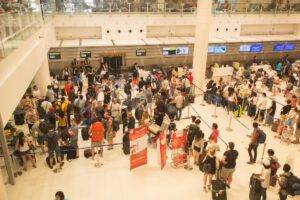
The head of Europe’s airports trade body has urged politicians to “stop pretending” that the European Union’s new digital border system is working, warning that the chaos now unfolding at passport control is keeping industry bosses awake at night.
Earlier this year the EU completed the roll-out of its Entry-Exit System (EES), which requires travellers from outside the bloc to register biometric information, including facial scans and fingerprints, when they enter most European countries. That data is then checked each time they cross the borders of the Schengen free-travel zone. For Britain’s roughly four million summer holidaymakers heading to the continent, it has become the most consequential change to cross-Channel travel since Brexit.

While the system has bedded in smoothly in some countries, it has been blamed for significant delays at a number of airports, with some passengers missing flights altogether.
Stefan Schulte, president of ACI Europe and chief executive of the company that owns Frankfurt Airport, did not mince his words at an industry gathering in Prague. Politicians, he said, should “stop pretending that EES is working just fine. It is not.” He added: “Passengers are queueing for hours at peak traffic times and I just do not know how we will be able to cope in the coming weeks with the expected increase in traffic.”
The warning lands at the worst possible moment for the travel industry, with the summer peak now under way and passenger volumes climbing week on week.
The disruption is no longer hypothetical. Earlier this month, dozens of Ryanair passengers were left stranded in Athens after their flight to London Luton departed without them. Ryanair blamed border delays, while the airport pointed to congestion linked to “additional processing requirements”. Neither party stated directly that EES was the culprit, but the episode fits a now familiar pattern.
In April, passengers due to fly from Milan Bergamo and Milan Linate to Manchester also missed their flights because of problems at passport control. Wizz Air, meanwhile, has gone as far as advising British holidaymakers to arrive at European airports three hours before their return flights to absorb the lengthening queues.
The friction is a direct consequence of the new requirement for most travellers from outside the European Economic Area to register biometric data on entry, a process that takes considerably longer than the old practice of stamping a passport. As Business Matters has reported, the Port of Dover has warned that the EU border system carries lasting “negative impacts” for cross-Channel traffic, and UK officials had already feared port chaos well before the scheme went live.
Schulte is pressing for the system to be made far more flexible. “We urgently need full flexibility for border control authorities to suspend the EES whenever needed to avoid further chaos, along with a rethink of those processes,” he said. “This is about showing respect and decency for those who chose to travel to the EU, and safeguarding our reputation as a welcoming and efficient destination.”
The European Commission is permitting EES to be suspended in certain circumstances until September. But Schulte told the BBC’s World at One that the decision to suspend rests with individual governments rather than airports, and that queues simply grow longer while those decisions are being weighed. He cautioned that the summer peak runs well beyond early September, after which the industry could be staring at the “complete collapse of the system”.
The official UK government guidance confirms that British travellers should expect biometric checks under the EU’s Entry-Exit System, with the requirements rolling out in phases across member states. The House of Commons Library has set out in detail how EES interacts with the forthcoming travel authorisation scheme, underlining how much remains in flux.
For travellers, part of the frustration is the inconsistency between countries. Earlier this year Greece’s tourism minister, Olga Kefalogianni, said she did not want visitors “burdened” by bureaucratic procedures, and promised British passengers would not face biometric checks when travelling to Greece this summer. The picture was muddied when the Greek Foreign Ministry subsequently disputed that any exemption existed.
There were also reports that Portugal and Italy were weighing exemptions for British nationals at their airports, only for the European Commission to insist no such plans were in place.
The confusion is unlikely to reassure an industry already braced for a difficult summer, and it comes ahead of a further layer of bureaucracy: from next year, British holidaymakers will also need to pay for an EU visa waiver under the ETIAS scheme. For now, the message from Europe’s airport bosses is blunt. The system, as it stands, is not coping, and pretending otherwise will not make the queues any shorter.