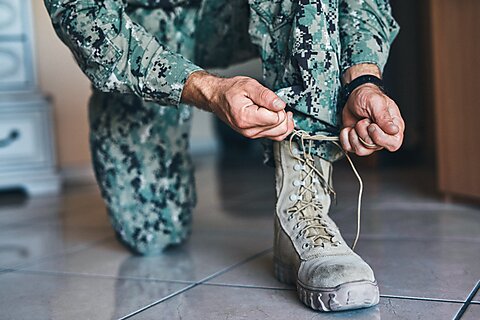

As Congress undertakes the annual task of drafting the National Defense Authorization Act, the United States Footwear Manufacturers Association (USFMA) is using the occasion to push for a protectionist measure that would shield the organization from competition at the expense of US servicemembers. Called the Better Outfitting Our Troops (BOOTS) Act, the legislation would forbid members of the armed forces from wearing so-called “optional” combat boots—footwear not standard-issued by the military but still authorized for wear as part of the uniform—that are made overseas.
In short, the measure would deny servicemembers the ability to find boots that best fit their feet so US manufacturers can make a few extra bucks. And if anyone thinks this assessment is overly harsh, that’s pretty much how the armed forces themselves see it. As a Marine Corps representative recently stated at the Modern Day Marine military equipment and technology expo, the military is facing a “legislative battle pushed forward by an aggressive lobby that has shown its willingness to put profits ahead of the warfighter.”
The alarm over the BOOTS Act is easy to understand. Last year, the Marine Corps found quality problems so severe that nearly 25 percent of inspected US-made boots were returned to manufacturers.
For US servicemembers, few pieces of equipment are more critical than a good pair of boots. As retired Marine Corps Master Sergeant Michael MacKay, a Marine Corps special operations veteran with eight overseas deployments, told me last year, “If your feet are torn up and you’re halfway through a mission, you’re slower, more vulnerable to infection, and a liability. Why would we even consider taking away that kind of footwear flexibility, especially when the commercial market is willing and able to provide it?”
Kyle S. Reyes, a recent attendee at Modern Day Marine, relayed a conversation to me that he had with a Marine who had recently returned from a training exercise in Norway. The Marine spoke about firsthand experience with boot failures and described the problem with cold-weather boots failing in the field as “rampant.” The solution? Norwegian-made boots. It may not be optimal for US bootmakers, but American servicemembers no doubt prefer to avoid frostbite and stay on mission.
Reyes also spoke with multiple operators at SOF Week, noting that one 20-year special forces veteran admitted he had never worn a US-made boot while on mission. “The quality, comfort, and performance is just not there,” he said.
To make their case, BOOTS Act supporters cite Chinese-made boots as a supply chain vulnerability. But a couple of items bear mentioning here. First, the BOOTS Act does not take aim at China but at all foreign-made boots. Second, and perhaps more importantly, the bill’s own text undermines this argument. The USFMA says the BOOTS Act includes narrow operational exemptions for combat-deployed personnel where mission requirements require a foreign-made boot. But if foreign boots were a genuine wartime threat, a waiver for the troops most likely to be in combat would be a strange way to address it.
Furthermore, the protectionist Berry Amendment already ensures that all issued boots are domestically made. The BOOTS Act is simply about boots that servicemembers choose to buy with their own money or clothing allowance because they fit and perform better than what they’re issued.
More importantly, the armed forces themselves view boots produced by US allies as an asset, not a vulnerability. Although 100 percent domestic manufacturing may seem strategically sound, Marine Corps Colonel Paul Gillikin, program manager for Combat Support Systems, says that wargaming (including in the First Island Chain, a clear China scenario) has shown the need for suppliers from both domestic and allied sources.
Gillikin also points out that competition helps drive innovation. His verdict is clear: “We need to keep all options on the table—competition directly supports operational effectiveness and readiness.”
It’s worth asking what forbidding foreign boots would do to that dynamic, particularly given that American bootmakers already struggle to keep a quarter of their product off the reject pile. Instead of devoting resources to lobbying, maybe they should figure out how to make a better boot.