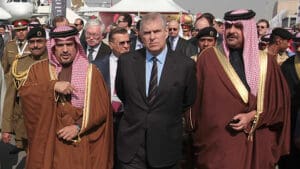
The late Queen Elizabeth II was “very keen” that her second son, then the Duke of York, take on a “prominent role in the promotion of national interests” as the United Kingdom’s special representative for international trade and investment, according to confidential papers on his 2001 appointment released by Downing Street this week.
The cache of 11 files, published on Thursday following a successful Liberal Democrat motion in the Commons, sheds fresh light on how Andrew Mountbatten-Windsor came to occupy one of British business diplomacy’s most senior unpaid posts, a role he held for a decade and which has since become the focus of a Metropolitan Police criminal inquiry.

A royal recommendation, in writing
In a memorandum to the then-foreign secretary Robin Cook dated February 2000, Sir David Wright, the chief executive of British Trade International, the predecessor to today’s Department for Business and Trade, set out the palace’s thinking in unusually direct terms.
“The Queen’s wish is that the Duke of Kent should be succeeded in this role by the Duke of York,” Sir David wrote. “The Duke of Kent is to relinquish his responsibilities around April next year. That would fit well with the end of the Duke of York’s active naval career. The Queen is very keen that the Duke of York should take on a prominent role in the promotion of national interests.”
He added: “No other member of The Royal Family would be available to succeed the Duke of Kent. The Duke of York’s adoption of his role would seem a natural fit.”
For Whitehall officials charged with selling British plc abroad, the recommendation from Buckingham Palace was, in the language of the time, treated as decisive.
The envoy who preferred ‘sophisticated countries’
If the appointment had a regal sheen, the papers also reveal a markedly less flattering portrait of the working envoy. In a letter dated 25 January 2000, Kathryn Colvin, then head of the Foreign Office’s Protocol Division, recorded a briefing from the duke’s principal private secretary, Captain Neil Blair, on his employer’s travel preferences.
The ex-prince, the note records, “tended to prefer more sophisticated countries” and preferred “ballet over theatre”. Captain Blair also stipulated that “the Duke of York should not be offered golfing functions abroad. This was a private activity and if he took his clubs with him he would not play in any public sense”.
For an envoy whose taxpayer-funded brief was to open doors for British exporters in fast-growing emerging markets, the attitudes set out in the briefing will sit uncomfortably with the SME exporters who relied on the office to act as a battering ram into difficult jurisdictions. As former business secretary Sir Vince Cable noted earlier this year, the conduct of Andrew’s tenure deserves serious examination by investigators, not least because the role traded on the prestige of the Crown to win commercial advantage.
From soft power to criminal inquiry
Andrew Mountbatten-Windsor’s arrest on 19 February, his sixty-sixth birthday, has transformed what was once a footnote of royal soft power into a constitutional and commercial headache for the Government. The arrest followed allegations that the former envoy shared sensitive material with the late paedophile financier Jeffrey Epstein during his time as trade representative.
Emails published by the US Department of Justice indicate that Andrew forwarded official reports of trips to Singapore, Hong Kong and Vietnam to Epstein in 2010 and 2011, within minutes of receiving them from his then special adviser. Metropolitan Police Commissioner Sir Mark Rowley has reportedly pressed US authorities to expedite the release of unredacted exchanges held in the wider Epstein files.
Detectives are understood to be considering whether to broaden the scope of their inquiry beyond the offence of misconduct in public office — a notoriously difficult charge to mount — to encompass potential corruption offences as well as alleged sex trafficking. Any prosecution will fall to the Crown Prosecution Service’s Special Crime Division, which handles the most sensitive matters.
Lord Peter Mandelson, the former business secretary and a mutual acquaintance of both men, was himself arrested following the release of the Epstein files in the United States, accused of having disclosed sensitive information. Both men deny any wrongdoing and have been released under investigation; both maintain they had no knowledge of Epstein’s crimes.
What it means for British business
For owner-managers and SME exporters, the readership Business Matters has championed for more than two decades, the documents matter for reasons that go well beyond royal soap opera.
The Special Representative for International Trade and Investment was, until 2011, the public face Britain put forward to court inward investors and to bang the drum for UK companies in capitals from Riyadh to Astana. It was, in effect, a brand. The newly-published file makes plain that the appointment process was driven less by a forensic assessment of commercial fit than by dynastic convenience and palace preference.
That has implications for how the present generation of trade envoys, and the export support architecture around them, is scrutinised. UK Export Finance has spent the past three years dramatically expanding its direct support for SME exporters, precisely because the soft-power model that underpinned the Andrew era proved fragile when its figurehead became politically toxic. The unwinding of Pitch@Palace, the ex-prince’s own start-up showcase, tells a similar story.
The Government’s decision to release the file, under duress from the Liberal Democrats and against the backdrop of an active criminal inquiry, as the BBC reported earlier this year, is a tacit acknowledgement that public confidence in the way British trade promotion was conducted at the turn of the century has not survived contact with the Epstein files. As RTÉ noted in its coverage of Thursday’s release, the documents arrived “just months after lawmakers accused the king’s brother of putting his friendship with Jeffrey Epstein ahead of the nation”.
For Britain’s exporters, the lesson from these dusty memoranda is brisk and uncomfortable: the credibility of UK trade promotion abroad now depends on transparent process, not royal patronage. The sooner Whitehall internalises that, the better for the businesses that pay its salaries.
Read more:
Andrew trade envoy files: Queen ‘very keen’ ex-prince led UK plc abroad, Whitehall papers reveal