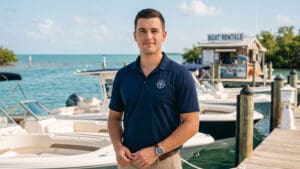
Christopher Pulichene did not follow a straight line into his career. He followed curiosity.
Born in 1999 and raised in Seattle, Washington, Chris grew up in a stable home shaped by structure, family dinners, and routine. He was adopted at birth by his parents, Penelope and Pieter, and raised alongside his twin sisters, Liv and Adriana. That environment gave him something simple but powerful: consistency.

“Sundays were always about family,” he says. “That rhythm taught me that structure matters.”
That idea would later shape how he works in high-paced tourism environments.
Early Life: Discipline Through Sports and Family
As a kid, Christopher Pulichene played baseball and hockey. Sports gave him discipline. They also gave him perspective.
“In hockey, if you lose your cool, the whole shift suffers,” he explains. “You learn to reset fast.”
He also spent long days with cousins at the pool in summer and playing Nintendo during rainy Seattle winters. Those simple routines built his appreciation for balance and connection.
At Roosevelt High School, he balanced academics with sports and social life. After graduation, he enrolled at Bellevue College and studied business. He learned core business concepts. But something felt off.
“I realized I didn’t want to sit behind a desk long-term,” he says. “I wanted movement. I wanted people.”
Why He Left Traditional College for Hands-On Experience
While studying business, Chris began exploring seasonal hospitality roles. That decision shifted everything.
He moved into structured tourism environments where guest service, safety, and operations mattered daily. These jobs gave him early exposure to fast-paced service systems.
“You learn quickly that guest experience is not random,” he says. “It’s built.”
He discovered that tourism operations are structured businesses. Schedules. Safety protocols. Training standards. Performance reviews.
That realization reframed his career path.
Cruise Ship Experience: Learning Global Operations
Chris eventually joined cruise ship operations, working in watersports programming. His role included surf simulators, guest recreation, and water safety coordination across Caribbean itineraries.
The environment was intense.
“You’re managing fun and safety at the same time,” he says. “There’s no room for guesswork.”
Working at sea exposed him to international teams and multicultural guest bases. It strengthened his adaptability and leadership presence.
“You work with crew members from all over the world,” he explains. “Clear communication becomes survival.”
Cruise ships operate like floating cities. Systems must work. Teams must trust each other. Safety cannot slip.
That operational discipline sharpened his interest in maritime business models.
Transition to the Florida Keys Marine Industry
After several seasons at sea, Chris sought stability while staying connected to water-based work. He relocated to the Florida Keys.
Now he works in boat rentals and watersports operations. His daily responsibilities include supporting rental logistics, ensuring equipment safety, assisting guests, and maintaining smooth operations.
“Boat rentals look casual from the outside,” he says. “Behind the scenes, it’s structure.”
Every rental requires safety briefings. Equipment checks. Weather awareness. Risk management.
His cruise experience prepared him well.
“When you’ve worked on a ship, you understand that procedures protect everyone,” he says.
How Watersports Operations Actually Work
Many people assume tourism is seasonal and informal. Chris sees it differently.
Marine tourism requires coordination between bookings, maintenance, staffing, and safety compliance. Small mistakes can compound quickly.
“Water adds a layer of responsibility,” he explains. “You can’t improvise safety.”
His focus remains consistent guest experience.
“You want people to remember the day for the right reasons,” he says.
That mindset reflects leadership maturity beyond his years.
What Makes Him Different in Marine Tourism?
Chris brings structured thinking into environments often seen as recreational.
He values preparation. He values clear communication. He values routine.
“Consistency builds trust,” he says. “Guests feel it.”
His long-term goal is to operate his own small-scale watersports business in a coastal location. He wants it built on clear systems and reliable service standards.
“I don’t want chaos,” he says. “I want operations that run clean.”
That goal reflects both his business education and his operational training at sea.
People Also Ask: How Do You Build a Career in Marine Tourism?
Chris’s advice is practical.
Start hands-on. Learn operations before leadership. Understand safety before scale.
“You have to understand the ground level,” he says. “Otherwise you’re guessing.”
He also emphasizes adaptability.
“Every day is different on the water,” he says. “Weather changes. Guests change. You stay steady.”
That steadiness defines his leadership style.
Beyond Work: Balance and Perspective
Outside of work, Chris maintains a grounded lifestyle. He reads biographies to learn how others navigated complex paths. He plays golf to reset mentally.
“Golf forces patience,” he says. “It reminds you to slow down.”
He values routine and connection, much like his childhood Sundays in Seattle.
That continuity matters.
The Bigger Picture
Christopher Pulichene represents a new generation of marine industry professionals. Structured. Operationally aware. Guest-focused.
His career path shows that leadership does not always begin in a boardroom. Sometimes it starts on a surf simulator deck or at a boat dock in the Florida Keys.
“You don’t rush growth,” he says. “You build skill first.”
That mindset may be his greatest asset.
From Seattle family dinners to Caribbean cruise decks to Florida marinas, Christopher Pulichene is building experience step by step.
And in marine tourism, that kind of steady leadership matters.
Read more:
Christopher Pulichene: From Cruise Decks to Coastal Leadership