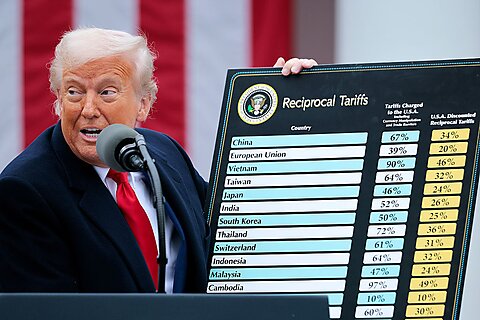

Within hours of the Supreme Court’s ruling that IEEPA does not authorize presidential tariffs, the Trump administration was back with a new legal hook: Section 122 of the Trade Act of 1974. This time it invoked “large and serious balance-of-payments deficits” and “fundamental international payments problems.” Those phrases are not just a fancy way of saying “trade deficit.” They come from an earlier monetary era, when exchange rates were fixed to the dollar and the United States stood ready to convert dollars into gold at $35 an ounce. Using them this way today is an anachronism.
The administration’s latest tariff move does not just rest on bad policy. It rests on a concept that no longer fits the world we live in. That is why I joined the economists’ amicus brief challenging the administration’s use of Section 122 in the US Court of International Trade, which can be found here. The core problem is simple: Section 122 was written for a monetary order that has passed. The administration is trying to revive it as if nothing important has changed in the international monetary system since the early 1970s.
Section 122 emerged from the breakdown of the Bretton Woods system, when exchange rates were fixed, and balance-of-payments crises had a particular meaning. In that world, a country could face pressure on its reserves, pressure on its exchange-rate commitments, and genuine difficulty sustaining international payments without emergency action. That was the setting Congress had in mind. The economists’ brief explains that this is the economic context in which Section 122 makes sense.
Under that old system, the problem was real. If foreign governments accumulated more dollars than they wanted to hold, they could turn around and demand gold from the United States at the official fixed price of $35 an ounce. That is what made a balance-of-payments deficit a genuine monetary emergency. Too many dollars abroad could become a direct claim on US gold reserves.
For example, in August 1971, President Georges Pompidou sent a ship to New York to retrieve French gold deposits, a vivid reminder that excess dollars in the old system could become a direct claim on US reserves.
In the modern system, foreigners may accumulate dollars because Americans buy more from them than they buy from us but also because global investors and central banks want to hold US dollar assets. In either case, those dollars are not redeemed for gold. They can be used to buy US goods and services, invest in US financial assets such as Treasury securities, corporate bonds, stocks, and real estate, or invest directly in US businesses. In other words, the modern counterpart to a trade deficit is a capital inflow.
Under floating exchange rates, adjustment occurs through flexible prices, while dollars return to the United States through financial markets rather than through a run on official reserves. The statutory idea the administration invokes is therefore not just stretched; it is historically out of place. The administration, nonetheless, speaks as if today’s trade deficits are historically large, while leaving out that the size of the US economy exceeded $30 trillion in 2025. Measured as a share of GDP, the current account deficit has averaged less than 3 percent over the past 30 years.
Those deficits are not evidence of some unresolved payments problem. They are the mirror image of net capital inflows, as Figure 1 shows. And even on this metric, 2024 was not historically unusual. At 4 percent of GDP, the current account deficit ranked eighth, well below the peaks reached from 2002 to 2008, as Figure 2 shows.
This is not a small definitional shift. A law directed at a narrow category of international payments emergency from the 1970s cannot be repurposed to justify tariffs in the modern American economy. The danger goes beyond this latest case. If “balance-of-payments deficits” can be redefined to mean some politically salient trade imbalance, then Section 122 stops being a narrow emergency provision designed for a fixed-exchange-rate system and becomes a standing reservoir of discretionary tariff authority.
It would also be a familiar mistake. American trade politics has a long history of treating emergency tools as if they were durable foundations for policy. Nixon’s 1971 import surcharge is the obvious example. It, too, was a temporary 10 percent measure, used as leverage during the breakdown of the Bretton Woods system. It helped produce the Smithsonian Agreement, which was heralded at the time as a major achievement. It did not last. The arrangement quickly gave way because it rested on deeper economic problems that temporary pressure and improvised bargains could not solve. The Trump administration’s use of Section 122 has the same improvised quality: temporary leverage, presented as a lasting fix.
That historical parallel matters for another reason. Even if one thought temporary tariffs might create negotiating leverage, it is a weak basis for credible long-term commitments, either from the United States or from its trading partners. But it has become a defining feature of recent executive deal-making. Major US trade agreements ordinarily rest on a firmer legal and political foundation. They are negotiated, scrutinized, and brought back through Congress for implementing legislation and a vote. That process is often slow and frustrating. But it is how trade commitments gain credibility and staying power.
Temporary presidential tariff authority is a poor substitute for legislative action. The economic costs here are not temporary. The Section 122 tariffs may be required to sunset after 150 days, but the disruption they cause does not. The economists’ brief rightly emphasizes that the damage is not confined to tariff collections that might be refunded at some point. Trade that never occurs is not restored later. Firms change suppliers. Investment is delayed or canceled. Supply chains are redrawn. Liquidity problems become employment problems, credit problems, and sometimes solvency problems. Those are real losses, and many are irreversible.
This point is especially important because tariff defenders often talk as if the only question is who writes the check at the border. That is not how economists think about the problem, and it is not how businesses experience it. The higher cost is the distortion itself: the transactions that disappear, the plans that are shelved, the uncertainty that spreads through pricing and sourcing decisions, the commercial relationships that are broken and not easily rebuilt. Refunds do not cure those harms.
That is one reason economists have spoken up here. Not because economists agree on every question of trade policy. We plainly do not. But there should be broad agreement on a more basic principle: the executive branch should not be able to launder old statutory language into new powers by using economic terminology loosely. If Congress wants to create new tariff tools for presidents, it can do so. What it should not get is a judicially blessed fiction that a law written for the payment crises of the fixed-exchange-rate era somehow fits the modern U.S. trade deficit.
Section 122 is not a general license for presidential tariffs. It is a remnant of a different monetary system. Treating it as a modern trade weapon is not just bad economics. It is an attempt to use an obsolete emergency rationale to claim a power Congress never clearly gave.