

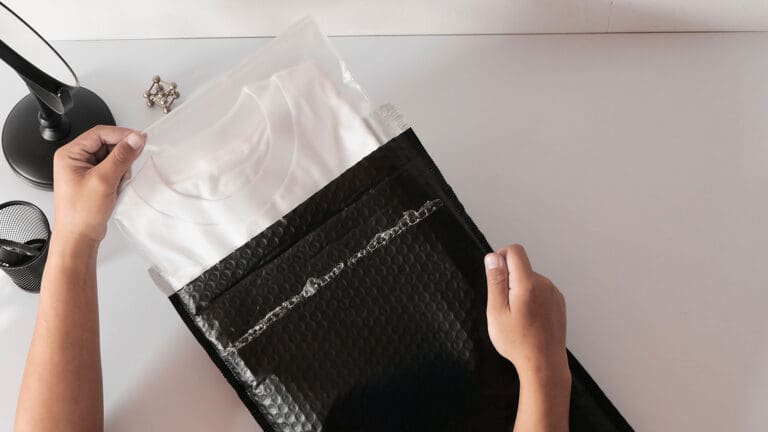
The decision depends on the garment, its details and the customer’s expectations. Compare the complete packed order rather than the empty materials.

Assess the garment’s vulnerability
A soft, unembellished item may have different needs from tailored clothing, a structured hat or a beaded dress. Check whether compression, snagging or bending could affect its condition.
Poly Mailers should be large enough for secure closure without being stretched around the contents. Protect sharp fastenings or accessories so they cannot puncture the material from inside.
Consider presentation and returns
If the customer expects a gift-ready product, a bag may need an internal presentation layer. Check whether that layer adds bulk or becomes crushed during handling.
Think about how the customer will open and, if needed, return the order. A reusable closure only helps if it remains functional after the first opening and suits the actual return process.
Compare complete costs
Measure packing time, material use and the finished parcel’s dimensions and weight. Include damage and repacking issues rather than comparing the price of a bag with the price of a box alone.
DHL’s clothing guidance covers preparation and different shipping formats. Use product-specific trials to decide which method suits the range.
Separate flexible garments from structured products
Start with what would happen if the packed order were compressed or bent. A soft T-shirt may tolerate handling that would distort a structured accessory or tailored detail. The choice should follow the product’s needs rather than a single rule for all clothing.
Inspect embellishments, zips, buckles and other hard components. These can press into neighbouring fabric or puncture the outer material from inside. Protect them appropriately and assess the complete arrangement before deciding a bag is suitable.
Consider mixed orders separately. A soft garment packed with a rigid gift item may require a different method from the garment alone. Keep a clear exception list so staff do not apply the simplest packing method to every purchase.
Check the fit after folding
Measure the garment in its approved folded state, including any inner protection. Leave enough space for the closure to work as intended. Stretching a bag around a bulky item can put strain on seams and make sealing inconsistent.
Avoid unnecessary empty material that folds awkwardly around the parcel. A loose arrangement may allow the clothing to bunch or the label area to become uneven. Compare a few suitable sizes using real order combinations.
Close the sample using the normal packing process and inspect it from every side. Check whether the item creates sharp pressure points and whether the closure is fully engaged. The fact that a bag can be closed once does not establish a reliable routine.
Consider the label and customer opening
The shipping label needs a suitable area where it remains readable during handling. Avoid positioning it across a heavily wrinkled surface or a closure that the customer must remove. Follow the carrier’s current labelling requirements.
Think about how the customer will open the parcel. The garment should not sit directly against the most likely cutting route. Where an opening feature is provided, make sure it remains accessible and understandable.
If the design supports returns, test that process after the first opening. A second adhesive strip is useful only when enough material remains to close the order properly and the customer can identify the correct step.
Use evidence when comparing alternatives
Record the packed dimensions, weight and preparation time for the bag and any suitable carton option. Include the materials needed inside each. Comparing empty outer-pack prices alone can hide meaningful differences.
Inspect representative deliveries for creasing, moisture exposure, punctures and closure problems. An intact bag may still contain a garment that has moved or become badly compressed, so check the product as well as the exterior.
Keep environmental descriptions specific to the verified materials and relevant disposal arrangements. Do not equate low weight with a proven overall environmental advantage.
Once the method is approved, show staff which garments qualify and which require another format. A clear decision rule keeps the convenience of mailing bags from becoming an unsuitable default.
Validate the method
Send representative garments using the intended service. Inspect arrival condition, closure security and the readability of the shipping label. Test more than the easiest item in the catalogue.
When evaluating custom packaging uk, provide the supplier with the folded garment dimensions and the requirements for puncture resistance, closure and handling. Confirm technical claims rather than inferring performance from thickness alone.
Keep disposal wording accurate for the actual material and relevant collection route. A bag is a sensible choice when it meets the product’s needs throughout delivery; it should not be selected solely because it appears lighter or uses less storage space.