

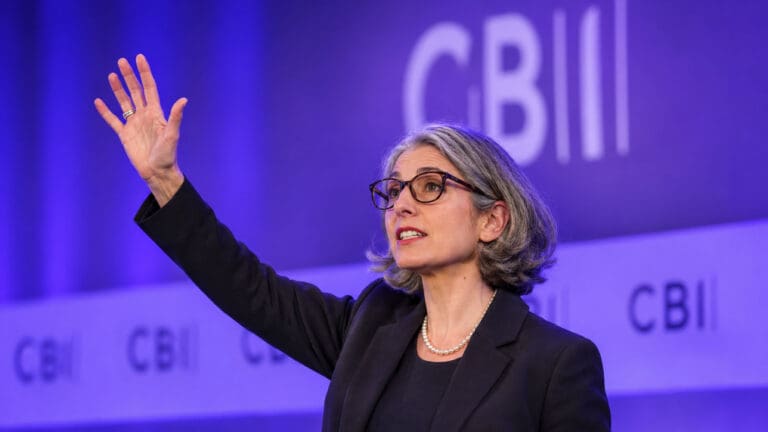
The government’s ten-year spending review must give businesses action rather than “ten more years of promises”, Rain Newton-Smith, chief executive of the CBI, was due to tell the business lobby group’s annual conference in London yesterday, arguing that the budget had left too many unanswered questions.

In remarks released ahead of her opening speech, Newton-Smith identified the “burden of doubt” as the biggest challenge facing business.
“The budget left too many question marks over our economy. The ten-year plan and the spending review must give us answers. We won’t grow from ten more years of promises. Give us decision, give us detail and give us action,” she was expected to say.
Her comments follow the budget delivered by the chancellor, John Healey, last month.
Political leaders from the five main parties were expected to address the conference. Kemi Badenoch, the Conservative leader, Ed Davey of the Liberal Democrats, Nigel Farage of Reform UK and Zack Polanski of the Green Party were due to attend, alongside bosses from Heathrow, National Grid and Skanska UK.
The CBI has about 850 direct members, as well as members drawn from more than 100 trade associations. They include Barclays, Tesco, BT and BP.
Louise Haigh, the first secretary of state and de facto deputy prime minister, was set to make the case for greater public control of utilities including water and energy.
“This government will put pragmatism and public interest ahead of failed political ideology. Public control is not anti-business, it’s about getting the foundations right, so that private enterprise can do what it does best,” she was expected to tell the conference.
Haigh was due to argue that governments overseas routinely own “significant stakes in water, electricity and gas networks with returns paid to their taxpayers” and have oversight of prices, grid connection and pollution.
“The status quo is the outlier. An exception that no other nation is trying to emulate,” she was to say.
Newton-Smith, for her part, was expected to call for reassurance that greater “public control” does not squeeze out private capital, warning that the phrase “sounds like code for renationalisation. That is kryptonite to investment.”
The conference came days after Andy Burnham’s government agreed a post-Brexit “reset deal” with the European Union in Brussels on Friday, which business groups have welcomed as a step towards cutting costs and red tape. The package covers food trade rules, a youth exchange scheme and a link between the two sides’ carbon markets.
Newton-Smith, an economist, was due to step up calls for “a closer relationship with our biggest trading partner”.
“Brexit was a wrong turn for our economy. It gave us greater sovereignty. But sovereignty without prosperity is not enough. We didn’t vote to be poorer,” she was expected to say.
She was also set to call for greater certainty over bringing down high industrial electricity bills, and over implementing the job creation parts of the Milburn review on young people out of work and training. The independent review by Alan Milburn, commissioned by the work and pensions secretary, was published last week.
“Business tax rises are locking young people out of a start in work and a start in life. And that is a tragedy. The Milburn review is a once-in-a-generation chance to change that,” Newton-Smith was expected to say.
On the public finances, she was due to say: “Right now, government spends one pound in 13 servicing debt. Growth is just 1 per cent. But demands on spending keep rising, while our tax burden is reaching the highest ever. We are in a financial straitjacket. And the only way out is backing business to unlock more investment.”
The CBI was also set to announce a partnership with the National Wealth Fund to deploy experienced investment and infrastructure-finance specialists from its members in mayoral authorities. The aim, according to the lobby group, is to give local leaders “hands-on” support to unlock investment and projects.