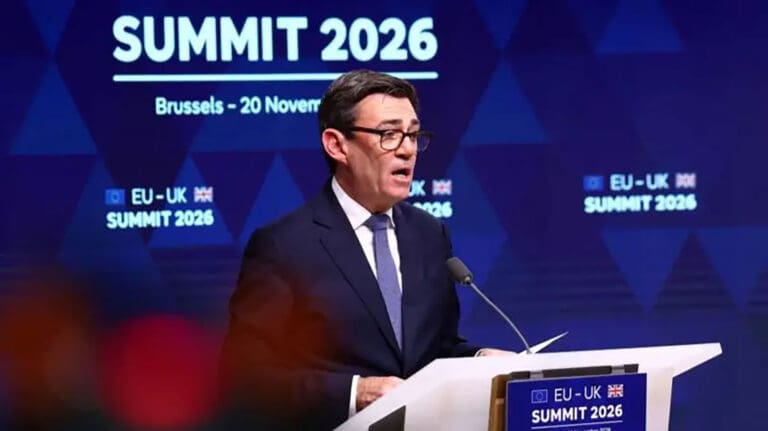
The UK and the EU today agreed a new deal covering food exports, youth mobility and carbon emissions, with legislation to enter Parliament next week. Talks on student tuition fees will continue after the summit.

Prime minister Andy Burnham described the agreement as a “win-win”. António Costa, president of the European Council, said the EU remained open to having the “closest possible relationship” with the UK.
Answering questions after the summit, Burnham said: “the deal is done, it’s there in black and white.” He said the bill would enter Parliament next week and that there were firm dates for its implementation. He said there would be “further discussions” on tuition fees specifically.
The package brings together three separate agreements: a sanitary and phytosanitary (SPS) deal on food, animal and plant rules, a link between the UK and EU emissions trading schemes, and a youth experience scheme.
In a factsheet published before the summit, the government said the food and drink deal could add up to £5.1bn a year to the economy and reduce paperwork for businesses. Once fully implemented, it said, the SPS deal would remove most “Not for EU” labels on UK food products.
A 200-page draft of the SPS agreement was agreed earlier this month. Under the draft food deal, exports of items including sausages, shellfish and seed potatoes could resume and export health certificates would no longer be needed. In return, the UK would commit to aligning with EU food and plant standards, a process known as dynamic alignment. The Conservatives oppose dynamic alignment, while the Liberal Democrats have described the deal as a partial fix.
The government said in its factsheet that linking the two emissions trading schemes could add up to £3.8bn a year to the economy. It said the link would protect steel and aluminium producers from the EU’s carbon border tax, known as CBAM, on about £6.5bn of exports.
The youth experience scheme would allow young people to live, work, study and travel in each other’s territory for a fixed period. The government has said the scheme will be “strictly capped and time-limited” and modelled on the UK’s existing youth mobility arrangements, and that it is not freedom of movement.
The factsheet also said none of the three deals would require UK taxpayers to pay into the EU budget, although both sides would make proportionate contributions towards running costs such as shared IT systems and databases. The government said it would not seek to rejoin the EU, the customs union or the single market, or restore freedom of movement, during this Parliament.
Talks on student tuition fees were not concluded at the summit. Ursula von der Leyen, president of the European Commission, said the work on tuition fees was on a different piece of paper but that she was confident the UK and the EU would find a solution. “Me too,” Burnham added.
Asked whether she was concerned that the UK could never make up its mind on the relationship it wanted with the EU, von der Leyen said she had many British friends who were good at making up their minds, and that the summit proved today “our British friends are good at making up their minds”.
She pointed to the three agreements, saying they had been reached in areas where many people thought the UK and the EU would not be able to reach the finish line.
Concluding his remarks, Burnham addressed young people directly, saying: “this deal is for you.” He said the past decade had been the hardest on young people, that opportunities had already been lost and that the impact had been made worse by Covid-19.
“We have to do something serious about that,” Burnham said, adding that it was important to open up “new opportunities”.
The bill to implement the agreements is due to enter Parliament next week.