

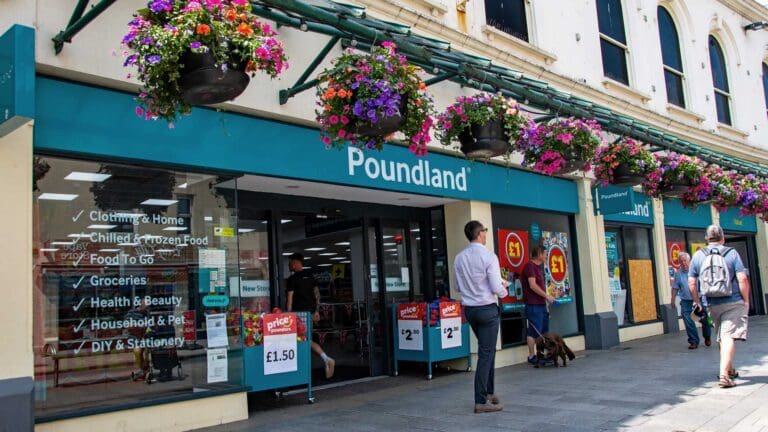
The government will meet Poundland’s leadership this week as political pressure builds to prevent the discount chain’s collapse, which would put up to 12,000 jobs and 600 shops in the UK and Ireland at risk.

Kate Dearden, the business minister, is expected to hold talks with Barry Williams, Poundland’s chief executive, and Shaun Wills, its finance chief, in the coming days, The Times reported.
Liam Byrne, chair of the business and trade committee, is seeking to table an urgent question in parliament asking what action the government is taking.
Poundland filed a notice of intent to appoint administrators in the High Court on Thursday, opening a window of 10 working days during which creditors are blocked from calling in their debts.
Under HMRC guidance on administration, filing the notice creates a moratorium in which no legal process may be started or continued against the company without the consent of the administrator or the permission of the court.
The notice names representatives of AlixPartners as administrators. In a statement on Thursday, the board of Poundland Limited said: “Our stores remain open as normal, and we thank our staff, suppliers and customers for their continued support.”
Andy Burnham, the prime minister, whose Makerfield constituency in Greater Manchester hosts one of Poundland’s largest distribution centres, has questioned why Gordon Brothers, the chain’s US owner, rejected a solvent takeover offer from the Irish real estate firm Martin Property Group.
“We want to see jobs protected. If there was a potential owner to avoid this that hasn’t been accepted, then the business secretary and I want to know why that is the case,” Burnham said on Thursday, according to Sky News.
Byrne previously told The Times there were “serious questions” about whether the restructuring was being pursued in “good faith”. He is calling for an investigation while there is “still time to protect jobs and save stores”.
Martin Property Group remains in talks with Gordon Brothers and its previous offer stands, according to The Times. Initial discussions collapsed because neither side could reach a resolution over who would cover a £30m loan that Gordon Brothers inherited when it bought Poundland for £1 last year.
Sky News reported that Martin Property Group contacted AlixPartners on Thursday to reconfirm two proposals. The first would repay the full £30m loan on maturity; the second would repay half of it on an accelerated basis. People close to the process told the broadcaster the reconfirmed offer was supported by a number of leading Poundland suppliers.
Pepco Group, which sold Poundland to Gordon Brothers, still owns a 25 per cent share of the loan, worth £7.5m at par, according to Sky News. Insiders told the broadcaster that Pepco had offered to defer its right to repayment for a number of years if a solvent sale could be achieved. Pepco declined to comment.
Gordon Brothers said last week that while Martin Property Group had been identified as the preferred bidder by Poundland’s management, “attention must now turn to other active bids”. The owner turned against the solvent offer after an analysis found Martin Property Group was unwilling to make an upfront repayment on the loan.
Several retailers have expressed interest in buying parts of Poundland’s store estate, although a sale on that basis would probably lead to hundreds of job losses, The Times reported.
Tesco, Britain’s biggest supermarket, has held talks to acquire as many as 150 of the discount retailer’s stores, sources told the newspaper. Other interested parties include Fortress Investment Group, the private equity firm that owns the rival Poundstretcher chain; CDS Superstores, owner of The Range and Wilko; the German discounters Lidl and Aldi; and Modella, the owner of TG Jones.
Fortress amended its offer last month to target between 200 and 250 of Poundland’s roughly 530 UK shops rather than the whole business, citing competition concerns, Sky News reported.
How staff would fare in a break-up depends on the form any sale takes. Government guidance on TUPE and insolvent businesses states that the regulations will normally apply if a business is rescued and taken over or transferred, but that employees are unlikely to be protected if it is closing down.