
The Trump administration has fared poorly in court in its attempts to shape the midterms to its political advantage, and its latest lawsuits against California and Alaska seem likely to fail as well. But would it have better luck if it dressed up a bid to intervene as a matter of national security? Courts are markedly more deferential to claims of presidential power when that is a factor, although their deference is still by no means absolute.
Last week, NPR reported that the top Democrats on the House and Senate intelligence committees, Rep. Jim Himes (D‑CT) and Sen. Mark Warner (D‑VA), are predicting that a president unwilling to accept adverse election results will claim foreign interference. (Himes also noted that despite the administration’s rumblings on the issue, it has failed to come up with what NPR calls “legally mandated pre-election reports to Congress assessing the state of play regarding foreign election meddling efforts.”)
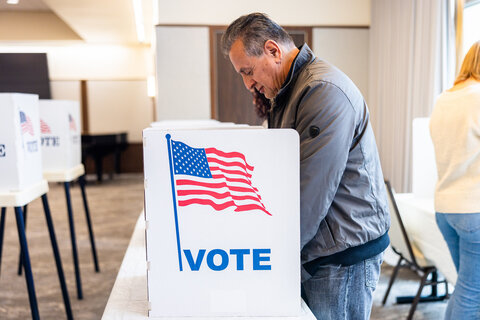
A persistent White House theme is that voting equipment with foreign-made components—which in the modern economy means virtually all voting equipment—cannot be trusted. Trump himself struck this theme in a July address seeking to rouse public alarm about possible foreign intervention, and DHS Secretary Markwayne Mullin has reinforced it more recently. What if, partway through Election Day, the White House were to make a dramatic public announcement that it had determined that one or more kinds of voting machines were unsafe and demand that states stop using them at once, across the board, or perhaps only in certain counties said to be of concern?
Julia Curlee, a public service fellow at Lawfare and a career national security professional, analyzed possibilities of this sort in a recent Lawfare article. Earlier this month, Curlee was the first guest on a new Cato online series on the midterms, which I hosted, and Cato colleague Stephen Richer also participated. You can watch here.
Just as Chinese-made components can be found in most consumer electronics, so they have figured into the voting equipment on which American elections have been held for many years. There is no evidence that they have led to security problems, nor, for that matter, any evidence that foreign actors have managed to tamper with the mechanics of voting in any way (as opposed to conducting “influence operations” to sway voters’ opinion in the US, which does happen regularly). Even assuming skullduggery, given the safety features built into designs, it would be unlikely to change actual results: Curlee puts it this way: “A vulnerability is not an intrusion, and an intrusion is not an altered vote.”
The state of federal law, as it happens, should reassure those concerned about rash White House action. While federal law does provide for the US Election Assistance Commission to certify voting systems as meeting certain standards, the guidelines are voluntary, and there is no federal power to, in effect, recall equipment or order its use to stop. Most election administrators know this.
Another worry is that administration lawyers would use the announcement to seek warrants from judges allowing them to seize, sequester, or inspect machines, a danger much discussed lately. (Guides for states and localities contesting search warrants can be found from several sources, including UCLA and the William & Mary Election Law Program.)
Other topics we discussed: the dismantling of the federal security effort against foreign election interference as carried on by the Cybersecurity and Infrastructure Security Agency (CISA) and by intelligence agencies, whether Trump is listening to more moderate or more extreme advisers, why the period from Election Eve through certification carries the greatest risk, how what happens in 2026 could set a pattern and precedent for 2028, and a second piece by Curlee offering an intelligence community-style analysis of the decline of democratic governance. Again, you can watch here.