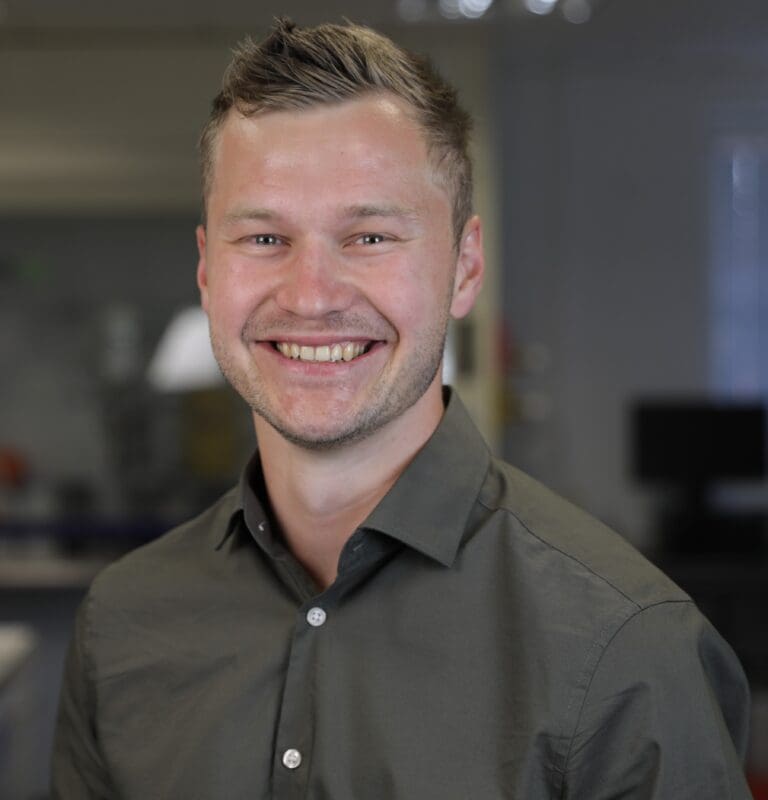
Dr Daniel Stewart is co-founder and chief executive of Viridi, a University of Southampton spin-out that uses captured carbon dioxide to make the ingredients behind everyday products such as shampoo, soap and washing-up liquid.

In February 2026 the company signed a joint development agreement with German chemical specialties supplier Zschimmer & Schwarz to scale up its technology for sustainable surfactants, five months after launching Vireya, a CO2-derived surfactant it says cuts product carbon footprint by up to 70 per cent. Viridi, which trades as ViridiCO2, is based on the university’s campus in Southampton.
He tells Business Matters why a strong technical result never explains itself, and why the chemistry only matters if manufacturers can actually use it.
What do you currently do at Viridi?
I am co-founder and CEO at Viridi, a Southampton-based scale-up changing how the essential ingredients behind everyday products are made. We are developing technology that uses captured carbon dioxide (CO2) as an alternative source of carbon to make ingredients that would traditionally rely on fossil fuels or crops such as palm oil.
One example is surfactants, the ingredients that help everyday products such as shampoo, soap and washing-up liquid foam, spread and lift away oil and dirt. Our first product, Vireya, launched in September 2025 as a replacement for workhorse surfactants such as SLES. Our aim is to give manufacturers a lower-carbon alternative that delivers the performance they need and works within the manufacturing infrastructure they already have.
I work across both the scientific and commercial sides of the business. Day to day, that means overseeing how our technology performs as we move it out of the lab and into industrial settings, and working with manufacturing partners to prove it at scale.
It also means building strategic partnerships, securing the investment needed to support the company’s growth, and helping customers, partners and investors understand why changing how these ingredients are made matters.
What was the inspiration behind your business?
My interest in climate change goes back to my school days, when I watched Al Gore’s An Inconvenient Truth. It opened my eyes to the scale of the problem and made me interested in the role science and technology could play in tackling it.
While I was studying chemistry at the University of Southampton, a sustainable chemistry module was a particular turning point. It helped me see how chemistry could be applied to real environmental challenges. That interest developed further during my PhD, where I explored how catalysts, materials that speed up chemical reactions, could be used to transform carbon dioxide into valuable materials.
Viridi was later founded as a spin-out from the university to take that research beyond academia and into industry. We saw particular potential in ingredients such as surfactants, which are used in so many everyday products but are still largely made from fossil fuels or land-intensive raw materials.
Because these ingredients are used at such a scale, changing how they are produced could make a difference across many different products and supply chains.
What does the agreement with Zschimmer & Schwarz mean for Viridi?
It represents a big milestone in our mission to help the chemical manufacturing industry, and ultimately society, to recycle CO2 and eventually defossilise. Zschimmer & Schwarz carried out extensive trials of our technology and identified several potential applications, including cleaning agents, which we will now develop together.
The early work was about proving the chemistry. The focus now is on scale-up, manufacturing readiness and working with commercial partners who need technologies that perform reliably in real manufacturing environments. That is why we have brought in Alastair Sanderson, formerly of Unilever R&D, as a strategic adviser, and Kostas Papanikolaou as our process chemist.
Who do you admire?
There is not one person. My parents have probably had the biggest influence on how I approach things. From my father, I learnt the value of hard work and being disciplined with money. From my mother, I got the confidence that it was possible to take a risk, start something yourself and make it work.
Professionally, I have a huge amount of respect for my co-founder, Professor Robert Raja. Working with him taught me the importance of rigour in science, and also to think about where that research could lead and how it could have an impact outside academia.
I have also taken inspiration from people building businesses on a much smaller scale. Earlier in my career, I worked with a friend who had set himself up as a landscape gardener. Seeing first-hand what it took to create your own work, find customers and take responsibility for everything gave me an early appreciation of what running a business actually involves.
Looking back, is there anything you would have done differently?
If I could go back, I would spend more time early on learning how to translate science into a business proposition. At the start, I was very focused on getting the chemistry right. What I learnt is that a strong technical result does not explain itself.
An investor wants to understand the scale of the opportunity, a customer wants to know what problem you are solving for them, and a manufacturing partner wants to know whether it will actually work in their process. Learning how to make each of those cases has been an important part of building Viridi.
I would also have been more deliberate about how we sequenced funding. Making good use of grant funding in the early stages can buy valuable time for academic founders to answer the hard technical questions properly before the pressure to commercialise really begins. That is something I understand much better now than I did at the beginning.
What defines your way of doing business?
We work to a simple principle: keep it practical. Make sure it actually works in the real world, not just in theory. Our technology is designed to work with the equipment manufacturers already have, rather than replace it. If it is too hard to adopt, it does not matter how clever the chemistry is.
We are honest and transparent about what we are doing: turning CO2 into something useful, namely ingredients that go into everyday products. We also do not celebrate a result until we have proven we can repeat it reliably, because one good outcome in the lab does not mean much if you cannot reproduce it consistently.
We would rather build something manufacturers can genuinely use than something that just sounds good on paper.
What advice would you give to someone starting out?
Understand what your customers are really struggling with, as early as you can. It is easy to get absorbed in the science or technology behind an idea, but it will only scale if it solves a real problem for your customers.
Beyond that, remember that you cannot scale a business on your own. Especially in industrial cleantech, you need manufacturers, investors and technical partners who understand that scaling takes time, and who are willing to be on that journey with you. Building those relationships early tends to pay off later.