
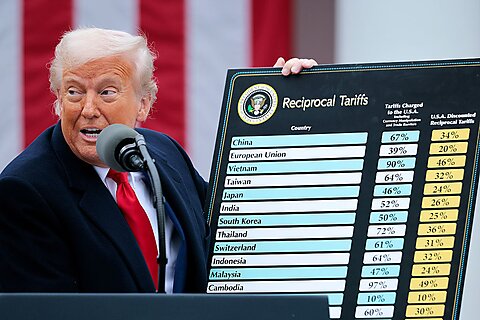

For nearly a decade, the conventional wisdom in Washington has been that protectionism is good for electoral politics. Most notably, Donald Trump won in 2016, when he promised to renege on existing trade agreements and impose tariffs on US trading partners for “ripping us off,” and once again in 2024, when he doubled down on his protectionist platform by promising “universal baseline” tariffs and higher duties on discrete US trading partners. From a theoretical perspective, this political instinct makes sense: appealing to constituencies that bear the highly concentrated costs of trade liberalization seems an intuitive strategy for electoral success. To the extent that protectionism truly carried the day in these previous elections—a debatable proposition—recent polling ahead of the forthcoming midterms suggests the opposite is happening: protectionism, specifically through high, sweeping tariffs, is not just failing to attract support among voters but has become a political liability for the president’s party.
For starters, Americans today care—a lot—about tariffs, a major shift from just a few years ago. In 2018, Cato’s Scott Lincicome documented that, according to various polls, trade was not a priority for most Americans, despite the heavy emphasis on it during the 2016 election. Meanwhile, only 1 percent of Americans surveyed by the Cato Institute/Morning Consult in 2024 listed trade and globalization as a top three issue. (Hence, why skepticism that protectionism propelled Trump to the White House is warranted.)
Fast-forward to the fall of 2026, and 75 percent of registered voters surveyed by Cato/Morning Consult said that tariffs will be “important” for their vote in this year’s midterms (Figure 1). Unsurprisingly, a higher share of respondents who self-identified as Democrats (88 percent) identified tariffs as important to their vote than self-identified Republicans (65 percent) or independents (64 percent). Of course, comparisons across surveys and over time are limited by differences in the questions asked in each, but tariffs being top of mind for more than 50 percent of voters across the political spectrum is an outcome that most trade analysts probably would not have expected before the Trump administration took office.
The bigger story, though, is not only that a large share of Americans cares a lot about tariffs, but also that most Americans disapprove of tariffs or blame them for raising prices and the cost of living (Table 1).
This general observation extends to where it matters most for election-savvy politicians. The Economic Innovation Group recently found that while most blue-collar workers—the constituency that tariff proponents argue benefits most from protectionism—supported tariffs in August 2025, 58 percent opposed them by October 2026. Meanwhile, a June 2026 New York Times/Siena poll of voters in Senate battlegrounds found that 54 percent of likely voters disapproved of the tariffs.
As with saliency, disapproval of tariffs is also higher among Democrats than Republicans. For instance, only 15 percent of self-identified Democrats surveyed by Cato/Morning Consult said that tariffs “are worth the costs,” whereas 68 percent of surveyed self-identified Republicans said the same. But a meaningful share of Republicans is also acknowledging the negative impacts of tariffs: nearly a third of Republicans surveyed by Cygnal called them harmful to the economy, and nearly a quarter said they have been made worse off by these policies.
One last aspect worth noting is that disapproval of tariffs and their economic effects predates other events that have rocked the US economy and caused prices to rise, most notably the Iran War, and has become more pronounced ever since (Figures 2 and 3). In short, the evidence points to most voters being displeased with tariffs, though partisan leanings color some of this perception.
Beyond polling data, perhaps the clearest indication that tariffs are a political liability for Republicans came on October 23, when the Trump administration modified the 50 percent “anti-discrimination” tariffs it had imposed on Canadian products to exempt goods such as packing materials, refrigeration equipment, and agricultural machinery and to levy duties on other products. Though justified by the president as a move to “better serve the public interest,” the Wall Street Journal reported that the administration aimed to help Sen. Susan Collins (R‑ME) and, possibly, other Republican candidates in states where these tariffs have been particularly unpopular, including Michigan and New Hampshire.
This move underscores the dynamic that has emerged across several campaigns, in which Democratic candidates target the tariffs in their messaging while their Republican opponents fail to defend them. As Figure 4 shows, across 46 campaign and national party channels on YouTube, 46 of 47 videos mentioning tariffs in their titles or descriptions were uploaded by Democratic Party-affiliated channels. Meanwhile, the lone Republican upload—from Mike Rogers’s campaign for Michigan’s Senate seat—called for an end to the US-Canada tariff war, a shift from his previous position that some tariffs on Canadian goods are needed. Corroborating this assessment is another October 23 report from the Wall Street Journal, finding that Democratic campaigns for the House of Representatives have spent more than $58 million on ads criticizing tariffs and trade protectionism, while Republicans have spent no money on ads defending them (Table 2).
Voters’ preoccupation with tariffs is most likely driven by a perception that these taxes are raising the prices they pay at the store. Concerns about affordability sit at the top of most voters’ minds these midterms, and thus, high and sweeping tariffs promoted by the White House have understandably become a culprit behind increases in Americans’ cost of living. Indeed, the finding in the Cato/Morning Consult poll that 74 percent of surveyed Americans blamed tariffs for increased store prices (see Figure 5) is replicated across different surveys:
82 percent of respondents surveyed in an October 2026 Reuters/Ipsos poll said that tariffs contributed to increasing the cost of living in the United States.
Tariffs were the most-cited cause for inflation in an October 2026 Harvard CAPS/Harris poll.
64 percent of Republicans surveyed for a March 2026 Guardian/Harris poll said that tariffs increased the prices they paid for goods.
Interestingly, voters’ opinions about tariffs are not one-sided, with many understanding—if not sympathetic to—their stated goal of bringing manufacturing back to the United States. For instance, 45 percent of Americans surveyed by Cato/Morning Consult in August 2026 said they would favor a tariff on most imports to encourage companies to create more jobs and make more products in America. Yet additional polling data suggest that Americans have soured on tariffs as a tool to boost manufacturing and, more notably, on the trade-offs, including higher prices. Fifty-eight percent of Americans surveyed by Cygnal said that tariffs have failed to bring back manufacturing jobs, while 54 percent said that, when it comes to tariffs on China, they are more concerned with lowering them to reduce prices for consumers and businesses than with keeping them high to protect American jobs.
Meanwhile, most Americans surveyed by the CFR/Morning Consult said that tariffs mainly had the effect of raising prices, rather than protecting American jobs. And when it comes to paying higher prices in exchange for bringing back more manufacturing jobs, while 51 percent of Americans surveyed by Cato/Morning Consult in March 2026 said they were willing to make that tradeoff, most were unwilling to pay even $100 more a year to achieve this goal (Figure 6).
In sum, though many voters may not have categorical opposition to tariffs, large shares acknowledge that they have failed to achieve their stated ends and reject the costs they have imposed on them in the form of higher prices, amid heightened concerns about the cost of living.
Of course, we have yet to see whether the increased saliency of tariffs and their disapproval by large shares of Americans results in an actual rejection of these policies at the ballot box. Furthermore, it remains unclear whether voters would embrace trade liberalization as an alternative policy, with many expressing that America should produce more “critical” goods such as energy and medicine at home and that trade relations with certain countries, such as China, are not “fair.” Yet it increasingly appears that the Trump administration’s decision to make tariffs a signature policy, despite mounting evidence of their effects on prices, will backfire. If it does, the idea that high, broad-based tariffs can be a recipe for electoral success will be called into question, which can only be good for sound policymaking in Washington.
The author thanks Cato Institute research associates Eli DeLuca and Jonah Messinger for their assistance in compiling the data and preparing the graphics for this post.