
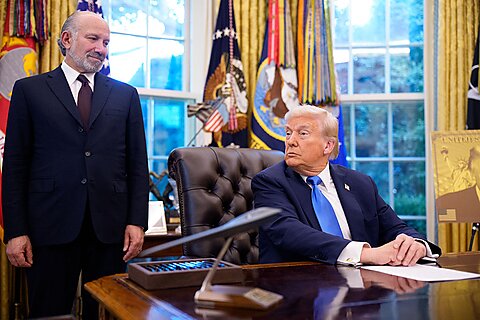

Yesterday, the Commerce Department announced equity stakes in four more private companies. That brings the total to 40 announced or completed ownership deals by the Trump administration, which can be viewed in the Government Ownership Dashboard on Cato’s new Restoring Free Enterprise site.
In a recent essay, I warned that Democratic investigations into the administration’s deals could lead Congress to turn Trump’s improvised portfolio into a permanent, formal ownership operation. Semafor’s Eleanor Mueller reports that Democrats indeed have “shopping plans, too” now that Trump has turned the federal government into a corporate owner. According to Mueller, former Biden administration officials suggested that a future Democratic president could build on “the precedent Trump has set” by “pressuring gun and oil companies.”
Here’s what some Democrats had to say:
Sen. Chris Van Hollen, after correctly criticizing the administration’s lack of transparency and accountability: “While this is something future administrations may want to consider, it’s clear that to actually serve Americans, it would require a totally different approach.”
Doug Farrar, a former Biden Federal Trade Commission official, on the administration’s growing stakes in the artificial intelligence supply chain: “That could be an important point of leverage for a future president of either party—but especially a Democrat who wants to seriously regulate this industry.”
Bharat Ramamurti, Biden’s former deputy National Economic Council director: “I hope there is not an overreaction to one of [Trump’s equity stakes] not panning out, especially because many of the other ones may end up being quite successful for taxpayers,” he said. “And you’ll be making a losing financial decision if you decide to cut all of that off.”
As the Trump administration’s corporate body count has mounted, so have pitches from the other team for a formal federal equity apparatus. In January, Daleep Singh, Biden’s former deputy national security advisor for international economics, said, “I think we have to institutionalize industrial policy. It’s here to stay,” and called for a strategic investment fund accountable to Congress. In July, Jake Sullivan, Biden’s national security adviser, argued for a federally chartered Strategic Investment Fund to invest alongside private capital in industries he considers strategically important. In August, former Biden economic official Peter Harrell proposed addressing the problems with Trump’s portfolio “by establishing a formal U.S. strategic investment fund.”
On the bright side, some congressional Democrats have noted fundamental problems with government ownership. In a letter to administration officials, Sen. Martin Heinrich and Reps. Jared Huffman and Robert Garcia criticized the advantages ownership gives selected companies, warning that “the government may undermine broader market competition and the development of innovative technologies or mineral or material substitutions.”