

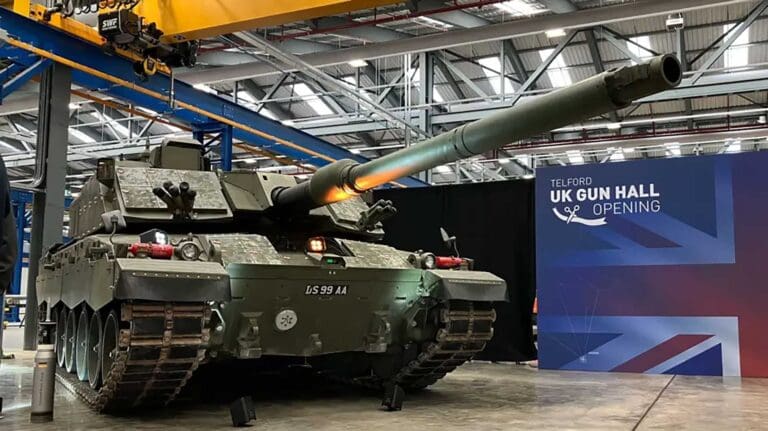
Large calibre gun barrels for tanks and artillery are being made in the UK for the first time in 20 years after German defence group Rheinmetall officially opened its UK Gun Hall in Telford today.

The Shropshire factory makes barrels and breeches for 120mm and 155mm weapon systems, including the RCH 155 howitzer and future artillery platforms, according to Rheinmetall. The company said the work also supports the Challenger 3 main battle tank programme.
Wes Streeting, the defence secretary, attended the opening ceremony with Armin Papperger, chief executive of Rheinmetall AG.
“Britain is back in the business of making the weapons that our Armed Forces need to defend the nation against our adversaries,” Streeting said. “From an empty site to full production in eight months, this is rapid reindustrialisation in action.”
“One hundred skilled jobs in world class manufacturing and the return of large calibre weapon production to UK soil for the first time in 20 years,” he said, adding: “This is what defence as an engine for growth looks like.”
Rheinmetall said the facility is expected to support more than 100 skilled jobs as production develops. It currently employs 35 people at the Gun Hall and around 685 across its Telford operations.
The site has 11,500 square metres of production space and at peak capacity can produce up to 245 barrels a year across both calibres, as well as more than 50 breeches, the company said. Production of breeches and breech blocks began in May, followed by barrels in June.
Specialist workers were recruited from the Telford area. Before production started, UK staff trained at Rheinmetall’s plant in Unterlüß, Germany, in precision manufacturing, quality assurance and specialist weapon production. The company said it would continue to expand its workforce as output increases.
The site also received funding through a £53m contract awarded in March by the procurement agency OCCAR on behalf of the British Army for RCH 155 weapon systems. According to Defence Equipment and Support, £30m of that contract was allocated to developing the Telford Gun Hall, which it said would give the UK operational independence in gun barrel production.
Rheinmetall said the Gun Hall forms part of more than £200m it has invested across its UK operations over the past five years. The company is already involved in the Boxer armoured vehicle programme and the Challenger 3 tank upgrade. It describes the factory as an example of the UK-German industrial partnership established under the Trinity House Agreement, which the two countries signed in October 2024.
Rheinmetall said it intends to introduce British steel from Sheffield Forgemasters, the steelmaker nationalised by the Ministry of Defence in 2021, into production at Telford. The company also said it would work with UK small and medium-sized enterprises to build long-term domestic supply chains as production increases.
Trade body Make UK Defence has previously called for foreign firms winning MoD contracts to be legally required to reinvest between 75 per cent and 90 per cent of contract value in the UK over 10 years, arguing that binding offset commitments would channel more defence spending to smaller manufacturers.
Papperger said the opening was an “important milestone” for Rheinmetall and the UK, and that the factory would strengthen Britain’s defence industrial base “for decades to come”.
“We are committed to investing in the UK for the long term, expanding our industrial footprint and working together to deliver the capabilities needed for the future,” he added.
Rebecca Richards, managing director of Rheinmetall UK, said: “In just eight months, we transformed an empty facility into an operational manufacturing capability by investing in British people, British skills and British industry.”
The opening follows Ministry of Defence figures published in August showing that jobs supported by defence spending in weapons, ammunition and military fighting vehicle manufacturing rose by 51 per cent in 2024/25, to 5,900.
The government’s Defence Investment Plan commits £298bn to defence over four years. In July, Streeting told industry that more than £11.8bn of contracts had been agreed in the 10 days after the plan was published.