

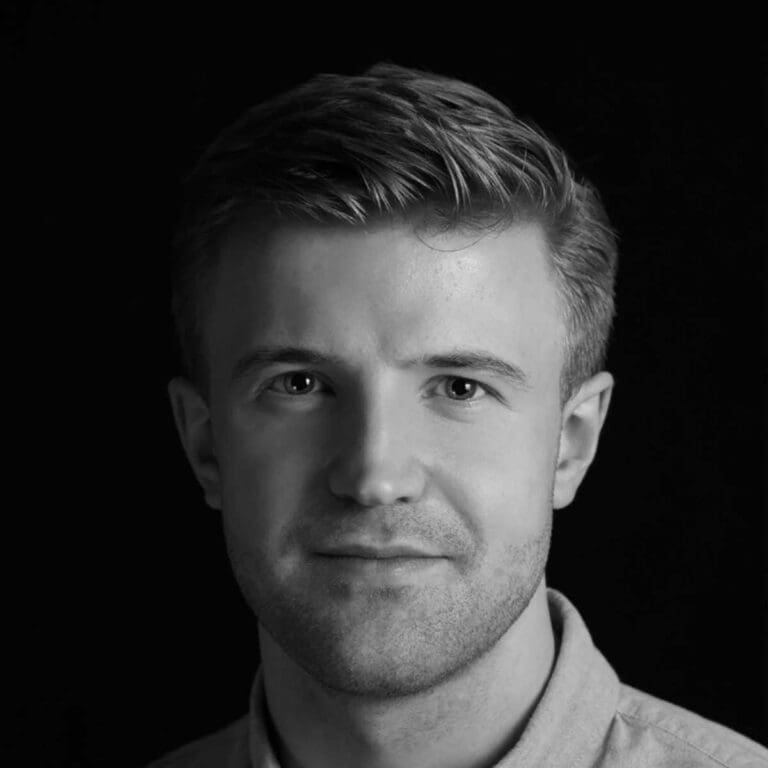
Matt Falconer is co-founder and chief executive of Ares Intelligence, a London-based company whose AI interviewer holds 20-minute voice conversations with employees about how their work gets done, then turns the findings into a ranked plan for where AI should be applied.

He joined IBM as a software engineer at 18 and later ran discovery workshops for Automation Anywhere before starting the business with Alfie Ranstead. The pair first built Instruct, a workflow automation platform that venture firm Creandum said in October 2025 it had backed, and the company says Lakestar is also an investor.
Here he tells Business Matters why too many firms are buying AI the wrong way round, what chasing perfection cost him and why giving Ares a human face was the wrong answer.
What do you currently do at Ares Intelligence?
I am co-founder and CEO of Ares Intelligence. Most companies know they need to do something with AI, but do not know where to start. We help them get there faster.
Ares uses AI to talk to employees about how their work actually gets done, then turns those conversations into a clear, prioritised plan for where AI will make the biggest difference, so businesses can move from uncertainty to adoption with confidence.
My time is divided between product, sales, and customer and partner relationships, with travel, events and a fair amount of unglamorous admin in between. At this stage nothing is too big or too small, and no two weeks look alike. We work with businesses across manufacturing, automotive and private equity, among other sectors. On any given day I can go from a product discussion to customer meetings in Europe or the US.
On the product side, I am deep in the details that decide whether someone feels comfortable talking to Ares. It has to feel approachable, reliable and secure. Even the length of a pause before it replies can decide whether someone opens up about their work or switches off.
What was the inspiration behind your business?
I skipped university and joined IBM as a software engineer at 18. I later moved into solution engineering, where the real job was understanding a customer’s problem before proposing anything.
At Automation Anywhere, I ran discovery workshops across Australia, India and Europe. You would move from a finance team to a marketing team in the same afternoon, each with its own language and priorities, and it could feel like whiplash. You had to stay completely focused and adapt on the fly, and the value came from asking the right follow-up questions. But one person can only have so many of those conversations, and you always knew you were working from a partial picture.
When my co-founder Alfie Ranstead and I initially built a workflow automation platform, we hit the same wall. Companies wanted the technology but could not tell us what to automate. The answers do not find themselves. You have to talk to people and understand what would genuinely make their working lives better.
We built Ares to run those workshops better, and at a far greater scale, than I ever could on my own. The aim is to give businesses the evidence they need to choose the right tools and support their people in using them.
The technology has moved incredibly quickly, but organisations’ understanding of where to apply it has not kept pace. Right now, a lot of businesses are buying AI and telling staff to use it without proper training or any real understanding of where it fits. That feels backwards to me. If the UK wants to stay ahead in AI, it is a gap we need to close.
Who do you admire?
I admire people for specific qualities. With Elon Musk, it is the scale of his ambition. He seems to start with a picture of what the future should look like, then work backwards to make it real. Reusable rockets and satellite internet both sounded like science fiction until they were not. He is willing to take enormous swings at ideas most people would dismiss as unlikely to work, and that pairing of imagination with the nerve to pursue it is what I find compelling.
I admire Jony Ive for his taste and conviction. He has a clear view of what an experience should be, and the ability to look at something familiar and see how it ought to work.
Through our investors, I have also been fortunate enough to hear Tom Blomfield and the Collison brothers speak in small settings. From the UK, ambitions can sometimes feel smaller than elsewhere, so seeing the scale of what they have built is a useful recalibration.
What stayed with me most was Tom’s candour about how hard building a company is. Hearing someone that successful speak honestly about the struggle makes you feel less isolated. It is a reminder that the people who appear to have made it have also had to keep getting back up.
Looking back, is there anything you would have done differently?
I would have got our products in front of customers much sooner. We spent months chasing perfection. Going from 95 per cent to 99 per cent finished soaks up a huge amount of effort, and customers rarely notice the difference.
Worse, once we did release, we would usually find we were heading in the right direction but had the details wrong. A lot of that polish went into things we ended up rebuilding anyway.
I would also have been scrappier. Early on, it is tempting to think about how you will operate as a big company. What you actually need is your first few customers, your first few releases, and enough progress to get to tomorrow. I would have kept my attention much more firmly on that.
What defines your way of doing business?
Speed and quality together. Alfie and I have won hackathons run by Anthropic and Meta, and shipping something good, fast, is part of how we think.
Over time we have added discipline about what we build. We used to race to deliver a feature because a customer had requested it, then discover we had not really solved the problem. That has been a key learning experience for us.
Early on, buyers repeatedly asked us to give Ares a human avatar. My instinct was against it, because Ares is not pretending to be human, but we tested a rough version and people found it strange. The voice worked. A face raised expectations we could not meet, because we are extraordinarily sensitive to anything slightly off in human appearance.
The underlying request was for a more immersive conversation. So Ares now shares its screen and shows its notes live as the interview unfolds. It is the same objective with a better mechanism. That is the principle: understand what someone is actually trying to achieve, make a judgement as to the best solution, then execute quickly.
What advice would you give to someone starting out?
Be relentless, and build in a domain you understand deeply and care about. It is almost always a longer, harder road than the overnight success stories suggest. By the time things click, people will call you lucky. Tune that out and stay focused on what you are trying to achieve.
Trust your gut, too. My instinct has often picked up on something before I could back it up with data.
At the same time, give yourself a clear target and a timeframe, such as six months to hit a particular milestone. Be prepared to change direction if you do not get there. We have had products overtaken by releases from the big AI labs, and staying with an idea too long has a real cost. I still wrestle with the “what if” of pushing on a little longer, which is exactly why having that rule matters.