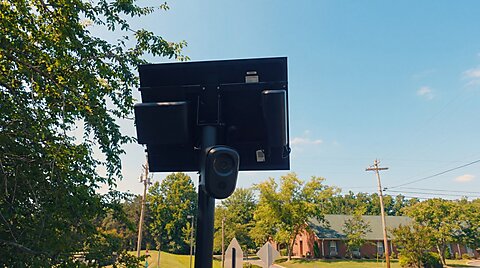

In an essay in The Atlantic titled “In Defense of Flock,” the Manhattan Institute’s Charles Fain Lehman rightly recognizes a foundational principle of criminology: The certainty of apprehension serves as a potent crime deterrent. Yet, in framing automated surveillance as a technological panacea, Lehman ignores the critical trade-off at the heart of a free society. As Benjamin Franklin famously warned: “Those who would give up essential liberty to purchase a little temporary safety deserve neither liberty nor safety.”
To test Lehman’s thesis, one need only apply his logic to his own doorstep. Imagine if the local police department installed a high-resolution pole camera directed squarely at his front door. By his own logic, Lehman should be elated: The camera would deter prospective burglars and, should an intruder ignore it, capture their every movement in crisp detail to ensure swift apprehension.
Naturally, this arrangement requires government officials to observe every detail of Lehman’s private life. With sufficient resolution, operators could log the packages delivered to his porch, track his every departure and return, note when he walks his dog, and monitor when his children leave for school. Under Lehman’s framework, none of this should disturb him; it is simply the price of crime suppression. His home might never be burglarized, but the cost is continuous state surveillance of his castle.
Lehman suggests that ubiquitous cameras will ultimately reduce the number of citizens entering the criminal justice system. While reducing crime is universally desirable, his thesis rests on a dangerous premise. In attempting to soothe public anxiety, Lehman contrasts American oversight with the pervasive surveillance apparatuses of authoritarian regimes such as the People’s Republic of China—inadvertently highlighting the troubling trajectory of his argument. Taken to its logical extreme, the absolute prevention of crime would require proactive, universal confinement: If no individual enjoys freedom of movement, no crime can occur. A free society deliberately accepts a baseline of risk to prevent state-sanctioned oppression.
The rapid expansion of automated license plate reader (ALPR) networks across American cities—spearheaded by private vendors like Flock Safety—represents one of the most radical expansions of domestic tracking in modern history. Proponents frame these networks as objective, impartial alternatives to subjective traffic stops, promising to curtail crime while eliminating human bias. In doing so, they routinely dismiss public concern as populist paranoia or an implicit defense of lawlessness.
However, this pro-surveillance narrative relies on a fundamental misunderstanding of the role of government in a constitutional republic and ignores the reality that institutional power is inevitably abused. Far from an impartial equalizer, private surveillance grids construct an unconstitutional panopticon that automates police error, mimics authoritarian tracking, and invites systemic abuse.
Proponents argue that computer algorithms eliminate human discretion, yielding a fairer, less punitive system. In practice, automated surveillance merely exchanges human subjectivity for algorithmic failure. Algorithms frequently misinterpret license plates—confusing the number zero with the letter O, misreading specialized state emblems, or failing entirely due to poor lighting, weather, or road grime.
The consequences of these technical errors are far from hypothetical; they inflict severe, real-world harm on innocent people. In Colorado, Kyle Dausman has been subject to repeat traffic stops because Flock cameras misread his license plate and flag it as a “hit” for officers, falsely indicating that Dausman’s plate is linked to a warrant. Also in Colorado, Chrisanna Elser was falsely accused of package theft after a Flock camera linked her to a home she’d never been to. Similarly, Angela Lipps, a Tennessee grandmother, spent more than five months in jail after AI facial recognition linked her to a crime in North Dakota—a state she’s never even been to.
When automated software misinterprets a plate, it generates an immediate, high-priority alert for a stolen vehicle or fleeing felon. Responding officers then initiate a high-risk felony stop, placing innocent drivers, and officers alike, in immediate danger. Far from making policing less punitive, surveillance technology outsources reasonable suspicion to flawed software, transforming minor computer glitches into life-threatening police encounters.
Defenses of these systems frequently cite operational efficiency. In authoritarian states, pervasive camera grids integrate with centralized AI databases to monitor travel in real time, constructing detailed behavioral profiles to enforce social control. By stitching together municipal, commercial, and residential cameras into a searchable national grid, private American vendors operate under the exact same structural logic.
To argue that such efficiency is justified by crime reduction is to adopt a fundamentally authoritarian premise: that state convenience outweighs individual freedom. The US Constitution was specifically designed to limit governmental efficiency to preserve liberty.
Furthermore, proponents contend that internal audit logs and query-justification rules prevent misuse. Historical evidence demonstrates that audit logs function merely as post-facto records of violations rather than active barriers to corruption. Officers nationwide have been investigated and prosecuted for using location-tracking databases to stalk former romantic partners, monitor personal rivals, and harass private citizens. Placing nationwide, real-time travel histories at the fingertips of law enforcement creates an irresistible tool for official harassment.
Reclaiming constitutional privacy from private surveillance vendors requires bold, targeted action at the federal level. Local camera grids do not remain local; without statutory boundaries, municipal databases inevitably merge into a national monitoring matrix.
Legislative strategies offer a clear framework for dismantling this dragnet. Rep. Tim Burchett (R‑TN) has introduced legislation to ban federal agencies from purchasing or accessing automated surveillance systems like Flock cameras and forbid state and local governments from using federal funding on surveillance technology.
Rep. Thomas Massie (R‑KY) has indicated that he intends to introduce legislation that, similar to Burchett’s Protection Against Mass Surveillance Act, would target the financial incentives driving camera proliferation by proposing to condition federal grants—from the Department of Homeland Security, Department of Justice, and highway safety programs—on jurisdictions not deploying mass ALPR surveillance systems. Complementing this effort, Rep. Anna Paulina Luna (R‑FL) has indicated that she is working on legislation to ban Flock cameras outright.
When an algorithmic misread by a commercial surveillance vendor causes an innocent motorist to be pulled over at gunpoint, victims should not be left without recourse. Companies like Flock Safety design and license technology specifically engineered to trigger rapid, high-stakes law enforcement interventions. When those systems fail, the victims deserve a day in court. Congress should pass a federal statute explicitly creating a private right of action authorizing victims of automated surveillance errors to sue technology vendors directly in federal court for civil damages.
This statutory remedy must complement—not replace—civil rights litigation against the police departments deploying these systems. Given the documented failure rates of ALPRs, an unverified hit should never serve as a constitutional shield for officers or municipalities. When departments deploy technology known to produce high rates of false positives, the agency should be on notice. Therefore, continuing to rely on an algorithm’s output should not qualify as objective good faith under the Fourth Amendment.
True accountability requires holding every link in the chain responsible: the corporations manufacturing and operating the automated tools, the jurisdictions purchasing them, and the officers executing high-risk traffic stops based on unverified alerts. Financial liability not only compensates citizens whose constitutional rights have been violated, but it also creates a powerful market disincentive against deploying flawed surveillance tech. While states and municipalities can, and should, follow the lead of cities like Chandler, Arizona, by discontinuing Flock-style contracts, federal legislation is essential to ensure nationwide legal accountability when these systems inevitably fail.
Flock is merely one piece of a vastly expanding surveillance state. The company’s potential downfall should not be blamed on legislation targeting ALPRs specifically but through the firm enforcement of the Fourth Amendment itself. In a free society, companies that thrive on infringing upon constitutional rights should not be economically viable.