

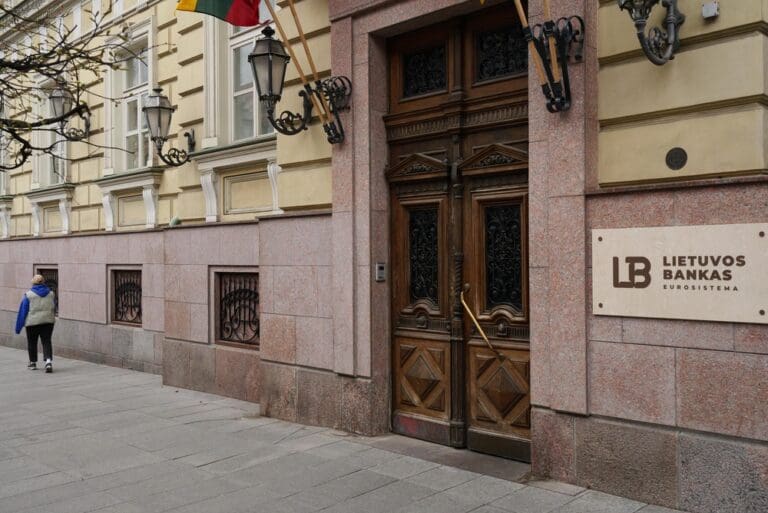
Lithuanian law allows a bank to freeze a suspicious transaction for a maximum of 10 business days without formal law-enforcement action. If your business account stays blocked longer than that, with no explanation and no evidence of a criminal investigation, courts have repeatedly ruled the freeze unlawful – and ordered the bank to return the funds plus interest.
Revolut, the London-founded fintech, provides its European banking services through a subsidiary licensed in Lithuania and supervised by the Bank of Lithuania and the European Central Bank. It is there, in Vilnius, that a recent set of figures has drawn scrutiny – and with them a question that will be familiar to any British business following the UK’s own debate over frozen accounts: how long may a bank withhold a customer’s money before the law requires it to be returned?

Rolandas Kiškis, head of Lithuania’s Financial Crime Investigation Service (FCIS – the country’s Financial Intelligence Unit), recently gave the Lithuanian Parliament’s Budget and Finance Committee a telling statistic: the agency receives around 100,000 suspicious transaction reports a year, and a striking 80% of them come from a single market player – Revolut Bank. As the FCIS head himself noted, most of these reports are generated automatically, by a system that files a report the moment it detects the faintest hint of risk.
Revolut’s explanation is straightforward: the bank serves 57 million customers across the European Economic Area, so it naturally generates proportionally more reports, and its transaction monitoring relies on AI-driven systems that respond to potential fraud in real time.
For a UK readership the relevance is twofold. Revolut is a British-founded company that many in the UK use, so how frozen funds are handled within its European operations is of natural interest. More practically, a large number of UK businesses operating across the Channel – those with EU subsidiaries, euro-denominated accounts or European customers – hold money with institutions licensed not by the FCA but by regulators in Vilnius, Dublin or Amsterdam. Where such an account is frozen, it is the law of that jurisdiction, not UK law, that governs the customer’s rights.
Anti-money laundering compliance is, without question, an important, legally mandated duty for financial institutions. But this statistic has another side, one rarely discussed in public: behind every automatically generated report there is often a real customer whose funds are frozen, whose account may be blocked, and who frequently receives no explanation for weeks, months, sometimes over a year. “In practice, a number of these situations have no legal basis at all, and courts are increasingly ruling in customers’ favour,” says Dr. Justinas Jarusevičius, a partner and attorney at Lithuanian law firm Motieka & Audzevičius.
How Long Can a Bank Legally Freeze Your Money? The 10-Business-Day Rule
Lithuania’s Law on the Prevention of Money Laundering and Terrorist Financing – the national implementation of the EU’s anti-money-laundering framework – sets out a clear mechanism. When a financial institution identifies a suspicious transaction, it must suspend it and report it to FCIS within three business hours (Art. 16).
From that point, the decision shifts to the state. FCIS has 10 business days to take the steps needed to confirm or dispel its suspicions. If, within that period, the financial institution receives no instruction to apply a temporary restriction on ownership rights under the Code of Criminal Procedure, the transaction must be resumed.
In other words, a customer’s funds can lawfully stay frozen over a suspicious transaction for longer than 10 business days only once law enforcement has become involved and applied criminal-procedure measures – measures that can themselves be challenged in court.
In practice, Jarusevičius says, a different scenario often plays out: the financial institution blocks the account on its own initiative, tells the customer only that “compliance checks” are under way, or offers no explanation at all, while the funds sit “under review” for months – with no FCIS instruction, no pre-trial investigation, no court order. In such cases, if the institution cannot point to a specific legal basis, the freeze is unlawful and the institution faces civil liability.
Who Has to Prove the Freeze Was Justified? What the Courts Have Ruled
A telling example is a dispute recently concluded against NIUM EU, UAB, an electronic money institution licensed in Lithuania, in which Jarusevičius’s firm, Motieka & Audzevičius, represented two business clients. In June 2022, the institution cut off the clients’ access to accounts holding close to EUR 490,000, without any warning. Their complaints went unanswered, not within the 15-business-day deadline set by the Law on Payments, nor afterwards: the first substantive response arrived more than six months later, and the actual legal basis for freezing the funds was never disclosed until the case reached court.
On 6 June 2024, the Vilnius Regional Court, in civil case No. e2-1187-643/2024, ruled that the institution had failed to prove any legal basis for withholding the clients’ funds. The court rejected the institution’s defence, which relied on an instruction from a UK regulator addressed to the institution’s sister company: that instruction was neither binding on the Lithuanian entity in its dealings with its own clients, nor did it cover the claimants, who had no contractual relationship with the entities named in it. It was also significant that nothing in the case showed FCIS had ever been informed about the clients’ transactions at all, meaning the statutory prevention mechanism had never even been triggered.
On 12 December 2024, the Lithuanian Court of Appeal, in civil case No. e2A-510-912/2024, upheld the first instance ruling and set out a rule with significant practical implications: in disputes of this kind, it is the financial institution that must prove it reasonably restricted the client’s account access and had the right to withhold the funds. A vague reference to AML law, or to a generic contract clause allowing the institution to suspend services “in accordance with legal requirements” is not enough – the institution must identify and prove the specific statutory provision, or the specific instruction from a competent authority, underlying its actions.
This Court of Appeal case is not an isolated one. Lithuanian courts are currently hearing a number of similar cases in which clients of Lithuania-licensed financial institutions are seeking the return of funds held in their accounts but frozen by those institutions.
The outcome for the clients was not just the return of their funds (the institution transferred most of it once it learned of the court proceedings) – the court also awarded 12.5% annual interest for the period between the filing of the case and the return of the funds, plus legal costs.
What Should a Customer Whose Funds Are Frozen Do?
Jarusevičius recommends three practical steps. First, demand a written explanation of the grounds for the freeze. Under the Law on Payments, payment service providers must inform customers about the blocking of a payment instrument and its reasons (with narrow statutory exceptions), and must review a written complaint and provide a reasoned response within 15 business days.
Second, track the timeline. If more than 10 business days have passed since the transaction was suspended and the customer has received no information about any measures taken by law enforcement, the continued freeze is likely without legal basis.
Third, enforce your rights. Consumers can turn to the Bank of Lithuania, which resolves disputes between consumers and financial market participants out of court. For business clients, the main route is litigation, where they can claim not only the return of their funds but also interest for the period the funds were unlawfully withheld. The case law above shows that the burden of proof in these disputes falls on the financial institution, and that a passive stance by the institution, failing to respond to complaints, failing to disclose grounds, is weighed by courts in the client’s favour.
Clients often ask whether they have to simply wait for the bank to act first. They don’t, Jarusevičius says. Once the 10-business-day window has passed with no sign of law-enforcement involvement, the customer can send a formal legal demand and, if that goes unanswered, file a claim – there is no requirement to keep waiting indefinitely for the institution to volunteer an explanation.
Prevention – Yes. Arbitrariness – No.
The problem is not the filing of suspicious activity reports itself – that is a statutory, socially useful duty, and a high volume of reports does not by itself indicate wrongdoing. The problem arises when risk management turns into the indefinite withholding of customer funds without legal basis, without information, and without law enforcement involvement.
Lawmakers struck this balance clearly: a suspicion gives an institution the right to suspend a transaction for days, not months. After that, it is for the state to decide, and if it doesn’t, the money must go back to its owner. As the volume of automated reports keeps growing, that rule only becomes more relevant. For UK businesses that hold funds with EEA-licensed institutions, it is a distinction worth understanding before, not after, an account is frozen.
Justinas Jarusevičius is an attorney representing clients in financial services litigation, including the case against NIUM EU, UAB described above.