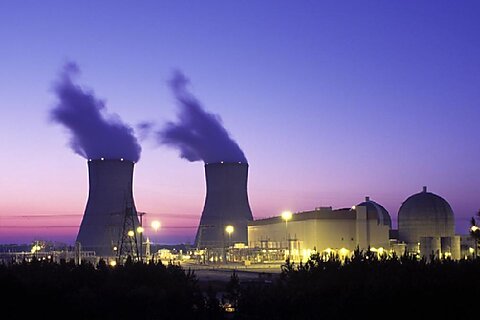

Last week, the Trump administration announced it is offering $17.5 billion in financing to build five new two-reactor nuclear power plants featuring Westinghouse Electric’s AP1000 large reactor. The offer comes on the heels of last November’s Trump announcement of an $80 billion deal with Westinghouse intended to jump-start a fleet of new US reactors.
Government doling out money (and other breaks) to nuclear power is old hat. But the two announcements, taken together, put a new spin on the practice of politicians picking winners and losers in the marketplace: Under the November deal, Uncle Sam could get a 20 percent equity stake in Westinghouse if its nuclear business booms in the coming years. Writing at the time, I predicted that it probably won’t happen: Nuke makes lousy business sense, as energy economist Steve Thomas recently detailed in Cato’s policy magazine Regulation, and it’s doubtful energy companies would take on such risk. Apparently, my prediction’s been right so far, so the Trump administration is offering a sweetener to get things going.
The announced financing envisions $3.5 billion in federal loan money per plant, with Westinghouse and the recipient energy companies contributing a billion dollars of their own money to each project, giving them some “skin in the game.” According to US Energy Secretary Chris Wright, there is “tremendous interest” in the initiative.
But interest is one thing, and completed nuclear plants are something else entirely.
The last time Uncle Sam meddled in nuke was back in the early 2000s under George W. Bush’s Nuclear Power 2010 Program. Enticed by government loan guarantees and rate subsidies, energy companies quickly proposed some 30 reactors. But interest faded after those companies crunched the financial numbers and found they didn’t add up. Only four reactors went into construction, and just two—Units 3 and 4 at the A.W. Vogtle power station in Georgia—ultimately entered service.
Vogtle shows why the other energy companies backed off: Construction of those two units—featuring Westinghouse AP1000s, it bears noting—began in 2013 (though site work started in 2009). Completion was expected in 2016/2017 at a cost of a little over $14 billion. But the reactors didn’t come online until 2023/2024, at a cost of $30 billion. That’s a common pattern with nuke: Expect it to take twice as long and cost twice as much as projected.
When asked about Vogtle’s $30 billion plant cost compared to the $4.5 billion envisioned by the Trump financing initiative, Wright averred that things will be different this time. Building “at fleet scale” will let the industry avoid Vogtle’s cost burden, which he attributed to bad planning, supply-chain snags, and the pandemic (which happened 3–4 years after Vogtle was to be completed). In his mind, nuclear plants are like cars on an assembly line: The more units you build, the lower the total cost per unit. But as Thomas explains in his Regulation article, nuclear plants are bespoke and offer minimal economies of scale.
This push for nuke is perplexing not just because the economics are grim, but also because of other Trump policies. If the administration really is interested in increasing America’s electricity supply (in part to power new data centers), then why is it spending billions of taxpayer dollars to get wind companies to not build generation? Moreover, why is the administration so keen on nuclear, given its hostility to climate change concerns (though even a reasonable carbon tax wouldn’t make nuclear competitive with other low- and no-emission power sources).
Perhaps the answer is nuclear socialism: Trump wants to boost an industry in which Uncle Sam could have an equity stake. This is part of the broader pattern of Trump corporate socialism, with government stakes in Intel, US Steel, MP Materials, Lithium Americas, Trilogy Metals, Vulcan Elements, ReElement Technologies, Korea Zinc, USA Rare Earth, L3Harris Technologies, Anduril, xLight, and others.
Circling back to nuclear power specifically, is there no way the technology will ever make economic sense? Never say never, but the odds are long. That goes not just for large reactors like the AP1000, but also the “small modular reactors” (SMRs) now lionized by some politicians and parts of the industry. As Thomas explains in his article, SMRs face the same problems and are bespoke like their bigger brothers, but with much less output. Again, never say never, but it’s bad policy for politicians to be pushing this mature technology—whether large reactor or small—on taxpayers and ratepayers.
My Cato colleague Travis Fisher said it best when he questioned the executive branch’s becoming so deeply embedded in the electricity business, especially when some future administration could offer sweeteners to different technologies entirely. Removing barriers to entry and letting energy companies build generation that passes a market test remains a much better policy than government picking winners and losers—especially when it’s acting as owner, banker, and regulator of those competitors.