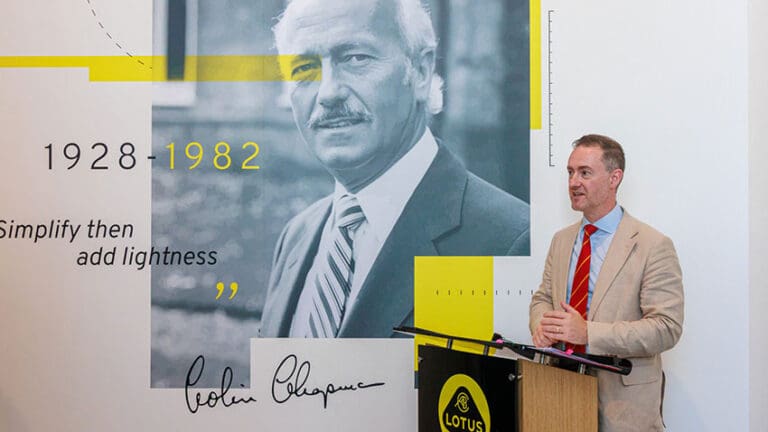
Lotus has formally opened the doors of its storied Norfolk home to other manufacturers, with industry minister Chris McDonald officially launching the Hethel Performance Hub and signalling that the government sees the site as a test bed for the future of British car-making.
The hub is an attempt to turn Lotus’s long-established engineering, manufacturing and testing capability at Hethel into a shared resource. Rather than guarding its designers, engineers, test track and assembly lines for its own use, the Geely-owned firm wants to let similar manufacturers and technology companies develop and build alongside it, on the principle of partnership rather than competition.

“By creating an environment where partners can collaborate, develop and deliver side by side, we enable a faster, smarter way to innovate in a sector where traditional models often slow things down,” said Matt Nice, deputy managing director at Lotus Cars. The aim, he added, was to unlock “the full potential” of a site that already has “everything here to be a perfect incubator for partners to bring their concepts and ideas to production”, while ensuring those products do not compete directly with Lotus’s own cars.
Four partners are already working within the Hethel environment. Charge Holdings is relocating its full operations, including Charge Cars and wider group vehicle programmes, to the Norfolk site, while Zenos Cars has signed Heads of Terms with Lotus with a view to using the hub as a future production base. DR Automobiles is a confirmed partner, with further details of a confidential project expected later this year, and Cranfield University is collaborating on an Emira GT4 race car project.
Matt Sanger of Zenos Cars, which is already producing vehicles at the site, said the relationship was complementary rather than combative. “We don’t clash with Lotus Cars, it’s a very complimentary relationship,” he said. “The skills and the facilities on site mean we can benefit from that without having to spend huge amounts of investment.”
That access matters in a low-volume sector where the cost of designers, engineering talent and a private test track can be prohibitive for smaller specialist marques. Paul Abercrombie, group chief executive of Charge Holdings, called the move “a defining moment”, describing Hethel as offering “something genuinely unique: a live, integrated environment where engineering, manufacturing and motorsport capability sit side by side”.
The launch lands at a delicate moment for Lotus. The firm, which built a record 2,200 sports cars in the first half of 2023 at its former wartime bomber factory near Wymondham, announced last summer that it would axe up to 550 jobs to secure a sustainable future in what it called a rapidly evolving and uncertain automotive environment. Speculation has since swirled about the long-term future of the plant, although the company has repeatedly denied any plan to close Hethel.
Nice was keen to draw a line under further cuts. “The production rate is on target, we have very stable, efficient production, the staff here are doing a fantastic job to deliver that,” he said. “There are no plans to reduce that further and we remain very comfortable with the workforce and head count we have here at Hethel.”
During the official launch, McDonald unveiled a commemorative plaque and toured the facilities, where a display traced Hethel’s heritage in specialist vehicle development, from the Lotus 100T Formula 1 car and the Vauxhall VX220 to the all-electric Evija hypercar. The minister also took the wheel of the 2,011hp Evija, which is handbuilt alongside the award-winning Emira at the Norfolk headquarters, and viewed exhibits from Charge Cars, Zenos and the Cranfield GT4 project.
For ministers, the hub is a useful showcase at a bruising time for the wider industry. UK vehicle production fell 15.5 per cent in 2025 to 764,715 units, the lowest level since 1952, according to the Society of Motor Manufacturers and Traders, dragged down by the JLR cyber-attack, the closure of Vauxhall’s Luton plant and the drag of US tariffs.
McDonald used the visit to press a more optimistic case, pointing to the £4bn of government support pledged to the sector through the DRIVE35 programme and a longer-term ambition to lift annual output back towards 1.3 million vehicles. “The UK has been a leader in performance automotive and this centre will really be at the heart of that for the future,” he said.
“There is £4bn of investment in research and innovation for the automotive industry as well, and all that is available to Lotus and the rest of the UK manufacturers to really underpin our supply chain, give them the confidence to invest and make sure we get lots of British cars like this around the world,” the minister added.
The hub forms part of a wider programme of investment around Hethel, underpinned by road infrastructure improvements delivered by South Norfolk Council and Norfolk County Council that are unlocking development land for further engineering and manufacturing growth. The neighbouring Hethel Engineering Centre is supporting the project as a local ecosystem partner, while Cllr Daniel Elmer, leader of South Norfolk Council and chair of the Greater Norwich Growth Board, said the next phase of development would “cement its role as a cornerstone of regional growth”.
Nice said the growth potential of the hub was “directly linked” to those road improvements, which he argued would help keep Hethel “one of the most iconic and innovation-led places in the automotive world”. For a site best known to the wider public as the home of James Bond’s submersible Lotus Esprit in The Spy Who Loved Me, the next chapter is less about a single marque and more about whether shared infrastructure can keep specialist British car-making on the road.