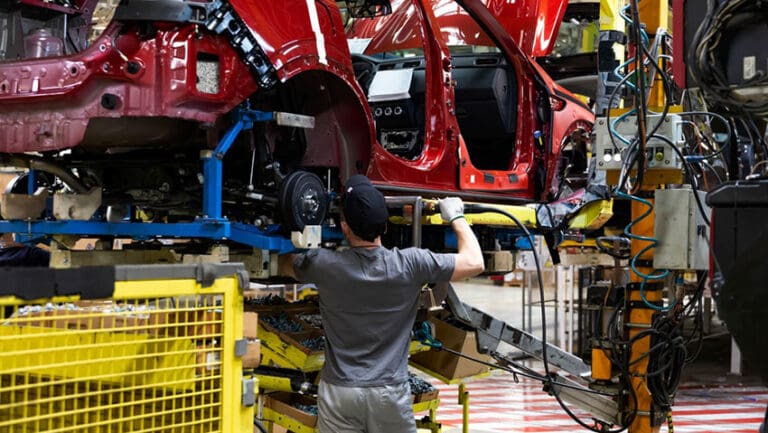
Britain’s beleaguered car industry has eked out its first monthly increase of the year, a flicker of momentum that the trade body warns could just as easily be snuffed out by stubbornly high energy costs and a fractious global trade picture.
Factories rolled 49,200 vehicles off their lines in May, up 2.3 per cent on the same month a year earlier, according to the Society of Motor Manufacturers and Traders. It is a modest figure by historical standards, but a welcome one after a run of declines that had become wearily familiar to anyone watching the sector.

The catch, and there is always a catch, is that the year-to-date numbers remain firmly in the red. UK plants have produced 306,000 cars in the first five months of 2026, down 4.1 per cent on the same period last year. May’s bounce, in other words, has trimmed the deficit rather than erased it.
Some of the month’s improvement is a quirk of the calendar. This time last year, Jaguar Land Rover, the Solihull-based maker of the Range Rover, paused shipments to the United States after President Trump slapped fresh tariffs on British exports. Set against that depressed base, almost any number was going to look better. The plants behind the figures read like a roll-call of what remains of British volume manufacturing: Nissan in Sunderland, JLR in Solihull and BMW’s Mini factory in Oxford.
It is worth holding May’s number up against the longer arc of decline. In 2016, when the country voted to leave the European Union, Britain was assembling more than 1.7 million cars a year. The current rolling 12-month average sits at 704,000, less than half that. The slump has been a long time in the making, and a single good month does not reverse it.
If the car numbers are sobering, the commercial vehicle figures are grim. UK factories built 11,500 vans in the year to date, a fall of 60 per cent year-on-year. On a rolling 12-month basis the total stands at 30,000, less than a quarter of what the country was turning out just two years ago.
The collapse follows Stellantis’s decision to shut its historic Luton van plant and convert Ellesmere Port into a low-volume electric van operation. The owner of Vauxhall has, in effect, taken a large slice of British van-making capacity off the board, and the data now reflects it. The country’s output recently slid to its lowest level in decades, a reminder of how quickly industrial capacity can erode once the investment case weakens.
The SMMT, which compiles the figures, is blunt about the causes: punishing energy costs, the unpredictability of international trade, particularly with the United States, and a domestic market that remains soft.
“May’s growth is welcome, and the priority must be to turn this into a sustained recovery by making the UK more competitive as a place to make and sell vehicles,” said Mike Hawes, the society’s chief executive.
He also pointed to a threat on the horizon. New EU trade barriers due next year could shut British automotive firms out of European supply chains if their products or components are deemed to be manufactured outside the bloc, a technicality with potentially expensive consequences for an industry that sends most of its output across the Channel. The full breakdown sits in the SMMT’s vehicle manufacturing data, and the message running through it is consistent: the firms that survived the long contraction are doing so on the finest of margins.
For now, the industry will take the win. A single month of growth is not a recovery, but after a year that has tested the sector’s resilience to the limit, it is at least a reason to look up. Whether it becomes the start of something more durable depends less on the factories themselves than on the cost of the electricity that powers them and the trade rules that govern where their cars can go, themes the government set out to address in its advanced manufacturing plan.