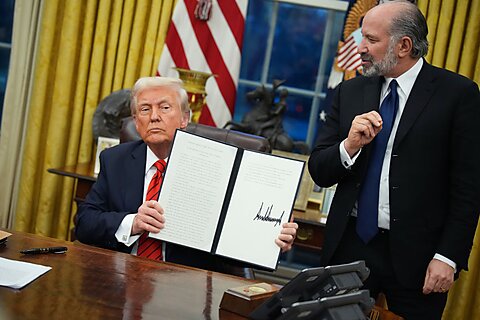

America is celebrating its 250th anniversary, but President Trump has forgotten the Constitution. The Bank Secrecy Act is one of the biggest attacks on the Fourth Amendment, and yet he has chosen to expand it with his latest executive order.
We’ve seen this playbook before. The war on drugs and the war on terror were used to create expansive surveillance regimes. Now it seems to be the war on immigration.
When the original executive order leaked, David Bier and I both warned that forcing banks to collect citizenship information would be a mistake. Despite claims from Treasury Secretary Scott Bessent that he doesn’t read our work, it seems our warning didn’t go unheard because the new executive order takes a slightly different path.
Rather than immediately deputize banks as immigration officers, President Trump ordered the Department of the Treasury to advise banks of the risks of serving undocumented immigrants. That would be small on its own, but then President Trump goes further, saying banks need to start reporting people they suspect of being in the country illegally or of engaging in other illegal activity. This reporting would be done through suspicious activity reports (SARs) under the Bank Secrecy Act.
Yet, as if this were not enough, President Trump also created another new avenue for debanking. The executive order instructs the Consumer Financial Protection Bureau (CFPB) to warn all banks that undocumented immigrants pose a credit risk because of their “potential deportation.” In other words, he is saying that anyone suspected of being undocumented should be debanked.
If the administration genuinely wants a freer, fairer financial system, the answer isn’t more surveillance dressed up as due diligence. It’s reforming the Bank Secrecy Act and getting regulators out of micromanaging banks.
The good news is that Congress can act. Representative Ritchie Torres (D‑NY) introduced the Financial Access Protection Act earlier this year to stop financial surveillance from expanding to citizenship checks. And Representative John Rose (R‑TN) has introduced the Bank Privacy Reform Act to rein in the Bank Secrecy Act.
As America celebrates its 250th anniversary, Congress should remember that one of its jobs is to be a check on the executive branch’s power.