

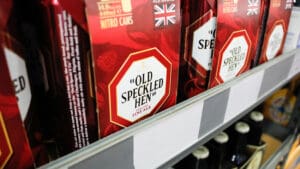
After more than a quarter of a century pouring Old Speckled Hen down the throats of British shoppers, Greene King has decided enough is enough.
The Suffolk pub group has agreed to sell its best-known supermarket ale to Damm UK, the British arm of the family-owned Spanish brewer behind Estrella Damm, in a deal that effectively ends its ambitions in the off-trade.

The price has not been disclosed, but the strategic message is loud. Old Speckled Hen, which Greene King has owned since acquiring Morland Brewery in 1999, accounts for more than half of the company’s off-trade sales, the volumes that flow through Tesco, Sainsbury’s, Asda and the independents rather than across the bar. By handing the brand to Damm, chief executive Nick Mackenzie is conceding that the supermarket beer aisle is no longer a battleground worth fighting in.
“This has been a long-term decision,” Mackenzie told The Times, pointing to the structural challenges facing cask ale and the wider beer category. Selling through pubs, restaurants and bars, he added, “is where our long-term strategy and focus is”.
Why a spanish brewer was the natural buyer
For Damm, the deal is the logical next step in a UK push that began in 2023, when it picked up the former Charles Wells brewery in Bedford. The site, rechristened Damm Eagle Brewery, has since been the focus of a £70m investment programme designed to make it the company’s flagship outside Spain, as The Grocer reported when the upgraded facility opened last autumn. Folding Old Speckled Hen, together with Old Golden Hen, Old Crafty Hen and Old Hen sister brands, into that operation gives Damm a heritage British cask name to sit alongside its lager imports, and the volume to keep its new lines humming.
Brewing of the Hen family is expected to migrate from Greene King’s Westgate Brewery in Bury St Edmunds to Bedford by June next year. Crucially for drinkers, the beers will still pull through in Greene King’s 1,600 managed pubs and on supermarket shelves once the transition is complete, according to the Morning Advertiser, which first detailed the wider brewing reset.
A tighter, on-trade-led brewing model
The transaction sits inside a much bigger reshaping of Greene King’s production footprint. The group is pouring £40m into a new, smaller brewery on the edge of Bury St Edmunds, alongside a fresh distribution depot. From next year it will brew only its core on-trade portfolio, Greene King IPA, Abbot Ale and the newer Hazy Day, at the site, replacing the historic Westgate Brewery in the town centre. Belhaven Brewery in Dunbar, East Lothian, is untouched by the changes.
“We are reflecting the size of the new brewery to reflect the market we are now operating in, and the market has changed pretty significantly,” Mackenzie said. “We believe we can control what we can control by focusing on our beers in our pubs.”
That candour will land uncomfortably with brewery staff. Greene King has declined to put a number on the jobs at risk, but a consultation began on Tuesday. The new plant is designed to be more efficient and to need fewer hands. For an industry already navigating brutal economics, the UK lost 100 breweries in 2024 alone, as Business Matters reported in its review of rising brewery insolvencies, it is another sign that scale-back, not expansion, is the order of the day.
The off-trade retreat in context
The decision to walk away from supermarkets is striking, given how much energy big brewers have historically spent on shelf space. But the maths has changed. Off-trade beer is a heavily promotional, low-margin game dominated by global lager brands, while cask ale, once a supermarket fixture, has been in slow retreat as drinkers gravitate to lager, world beers and low-and-no alternatives.
For Greene King, which still pulls a competitive pint through its own estate, the calculus is simpler than ever: a barrel sold in a managed pub earns far more than the same barrel battling for promotional slots in a multiple grocer. The Old Speckled Hen sale crystallises that logic.
The wider strategic reset under hong kong ownership
The brewing shake-up is the latest move in a sweeping rethink of the business under Hong Kong owner CK Asset Holdings, which bought Greene King for £4.6bn in 2019 in a deal led by billionaire Li Ka-shing. Last year the group posted revenues of £2.53bn but slipped to a £23.4m pre-tax loss, with net debt, excluding lease liabilities, running at around £2bn and annual servicing costs of close to £95m.
In March, Greene King confirmed it would sell 150 of its managed pubs and convert another 150 into tenanted houses as part of a refreshed estate strategy. Combined with the brewing slimdown and the Old Speckled Hen disposal, the picture is of a group methodically shedding the things it does not need to own and concentrating capital on what it considers core, wet-led, managed pubs where it controls the customer, the menu and the margin.
“For us, this is about how we future-proof the wider business and how we leverage our model,” Mackenzie said.
What it means For SME drinks and hospitality operators
For independent brewers and smaller pub operators, the implications cut both ways. The exit of a heritage cask brand from Greene King’s in-house portfolio frees up roughly half a pump line’s worth of off-trade attention and could give regional cask ale producers a slightly better shot at supermarket buyers. Equally, Damm’s decision to back a British ale at scale signals continued international appetite for UK-brewed brands, and reinforces Bedford’s emergence as a serious brewing cluster.
The blunter truth, though, is that one of the country’s most recognisable cask ales is now under foreign ownership because its British parent has concluded that supermarkets are not where its future lies. In an industry still struggling with input costs, business rates and shrinking discretionary spend, that is as honest a piece of strategic communication as the sector has heard for some time.
Read more:
Greene King pulls the plug on supermarket strategy with sale of Old Speckled Hen to Spain’s Damm