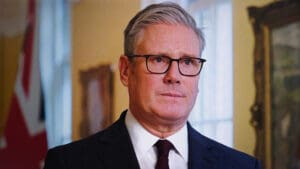
Britain’s bond market delivered its sharpest rebuke yet to Sir Keir Starmer’s premiership on Tuesday, with 30-year gilt yields climbing to their highest level this century as the prime minister stared down a growing chorus of Labour MPs demanding he step aside.
The sell-off, which dragged sterling and equities lower in lockstep, wiped out the relief rally that followed Starmer’s defiant intervention last week. Tuesday’s cabinet meeting, at which the prime minister once again refused to countenance resignation, did little to settle nerves. Investors are now openly pricing in the prospect of a leftward lurch in Labour policy, with the attendant risks of looser fiscal rules, higher gilt issuance and a further squeeze on the cost of capital for British business.

For the country’s 5.5 million small and medium-sized enterprises, the implications are far from academic. Higher long-dated gilt yields feed directly into the swap rates that underpin commercial lending, business mortgages and asset finance, raising the prospect of yet another leg up in the borrowing costs faced by Britain’s corporate backbone at a time when many are still nursing the legacy of post-pandemic debt.
The 30-year gilt yield rose 13 basis points to 5.81 per cent, the highest since May 1998. The benchmark 10-year yield gained 10 basis points to 5.1 per cent, within a whisker of breaching the post-2008 peak it set earlier this month. Bond prices move inversely to yields.
“A new Labour leader may face pressure to ease the fiscal rules and raise gilt issuance,” warned Jim Reid, analyst at Deutsche Bank, capturing the City’s central concern that any successor would lean towards higher spending and heavier taxation of the very businesses the Treasury is counting on to drive growth.
Sterling’s slide alongside government bonds will draw uncomfortable parallels with the dark days of Liz Truss’s mini-budget. When a currency weakens in concert with rising borrowing costs, it is the trading pattern of an emerging market that has lost the confidence of foreign capital, not that of a G7 economy. The pound fell 0.64 per cent against the dollar to a two-week low of $1.352, and shed 0.21 per cent against the euro to €1.152, its weakest since mid-April.
Some of the pressure is undeniably imported. Bunds, OATs and BTPs all sold off as President Trump declared the Iran ceasefire was “on life support”, sending Brent crude up 2.8 per cent to $107.17 a barrel and reigniting inflation fears across advanced economies. The Strait of Hormuz, through which a fifth of global oil and gas once flowed, remains largely shut. Germany’s Dax bore the brunt of the European sell-off, falling more than 1 per cent. But gilts underperformed by a substantial margin, marking out Westminster’s political turmoil as a uniquely British risk premium.
Mohit Kumar, chief European economist at Jefferies, urged clients to short sterling, arguing any change in the composition of government “would likely be left-leaning”. Anthony Willis, senior economist at Columbia Threadneedle Investments, cautioned that the bond market was unlikely to settle “until greater clarity emerges”.
Equities followed suit. The FTSE 100 surrendered 0.3 per cent having opened the week with a 0.4 per cent gain, while the more domestically focused FTSE 250 dropped 211 points, or 0.9 per cent, extending its losing streak to a second day. Mid-cap stocks, dominated by UK-facing businesses, are the clearest read on how the City judges Britain’s economic prospects.
The grim verdict from Andrew Goodwin, chief UK economist at Oxford Economics, is that there is little prospect of meaningful relief. He expects 10-year borrowing costs to remain stuck above 5 per cent for the remainder of the year, regardless of who occupies Number 10. “Markets clearly perceive the UK has a bigger inflation problem and that tighter monetary policy will be needed to limit second-round effects from the energy shock, while political uncertainty has added to pressures at the long end,” he said.
Even were Starmer to dig in, Goodwin argued, the bond market would have little to celebrate, with the prime minister’s “attempts to regain popularity, or, more likely, from a successor implementing more costly left-wing economic policies” weighing on sentiment. “If Starmer sets out a timetable to stand down, the uncertainty premium will persist.”
For owner-managers already navigating a punishing cost base, a softening consumer and the fallout from this spring’s National Insurance changes, the message from the bond vigilantes is unambiguous: brace for borrowing to stay dear, and for political risk to remain firmly on the balance sheet.
Read more:
Gilts plunge to 28-year low as Starmer clings on, leaving SMEs braced for borrowing squeeze