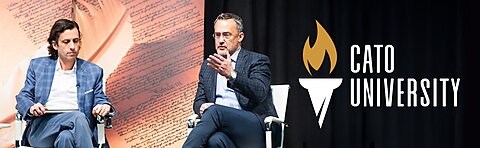

My journey to Cato truly began during my 2L year, standing amidst the vibrant, jazz-filled streets of New Orleans on a warm Saint Patrick’s Day Weekend. Thanks to the generosity of our Cato partners, I spent my Spring Break at the Cato University College of Law. At the time, Clark Neily—now Cato’s Senior Vice President for Legal Studies—had recently taken over the Project on Criminal Justice and was beginning to articulate a bold new vision for our program. He identified four key pillars that continue to define our work: unconstitutional overcriminalization, self-defeating policing, insufficient accountability for law enforcement/prosecutors, and the practical elimination of the citizen jury trial—which has been largely displaced by a regime of plea-driven mass adjudication.
As libertarians, we firmly believe that peaceful people ought to be left to their own devices. However, we recognize that once someone’s conduct poses a genuine harm to others, the state must step in to protect the public. The Framers articulated a federal government of only finite, enumerated powers. But thanks to a Congress that has little regard for constitutional constraints and a highly deferential Supreme Court, that is not the world we live in today. While states generally enjoy vast latitude over what they can criminalize, we as a society have become far better at policing morality than taking violent offenders off the streets. In this landscape, it is the jury—apprised of its historical power to prevent injustice—that must impart the community’s perspective and spare neighbors from the wrath of a tyrannical government.
We invite you to join us this August 6 through 8 at Cato’s Washington, DC headquarters as we explore how the Bill of Rights devotes more text to criminal procedure than anything else. We’ll dive headfirst into the doctrine of enumerated powers and the novel idea that the Constitution vests Congress, not unelected, unaccountable bureaucrats, with the power to proscribe crimes and punish violators. We’ll examine the historical conception of the criminal jury as an injustice-preventing institution and discuss how coercive plea bargaining has made securing a criminal conviction—a process the Framers intended to be arduous and costly—frighteningly easy and cheap. We’ll discuss how judicially concocted immunity doctrines foster a culture of misconduct and foreclose relief for victims of even the most egregious constitutional violations. And we’ll illustrate how the self-professed Originalists on the Supreme Court have ignored the Constitution’s original public meaning where state power and policing prerogatives clash with individual rights.
Beyond the theory, we’ll talk about the incremental progress we at Cato have made moving the needle towards individual liberty and the tangible wins we’ve scored for real people, including John Moore, Tanner Mansell, and Michelino Sunseri. While DC in August may lack the specific charm of St. Patrick’s Day in New Orleans, the experience promises to be just as insightful and informative. We don’t ask for total agreement, but we hope to share our vision for a constitutionally limited government that respects individual rights—a system that gets better at targeting those we are afraid of rather than simply locking up those we are mad at.
Each Cato University program uses classical liberal philosophy as a foundation for navigating modern policy. This specialized program for outstanding law students offers a unique opportunity to engage directly with Cato’s leading legal scholars through lectures, roundtable discussions, and close readings of foundational texts. Participants will leave with a deeper understanding of the legal landscape, a stronger professional network, and the analytical tools to pursue principled reform.
This program is open to United States-based applicants, and while we cannot currently accept international applications, those selected will receive room and board, over 20 hours of academic programming, and a $500 travel stipend upon completion. We review applications on a rolling basis, so we encourage you to apply before the deadline on Monday, June 22, 2026, at 5:00 p.m. EDT. If you have any questions or need assistance with the process, please reach out to our staff at events@cato.org.