
Iran has thrown open the Strait of Hormuz to commercial traffic once again, delivering an immediate jolt of relief to jittery global markets and, crucially for British businesses, shaving almost 10 basis points off the government’s cost of borrowing in the space of a single trading session.
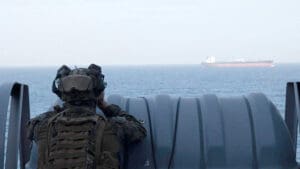
Foreign minister Abbas Araghchi confirmed on Friday that the world’s most strategically important oil chokepoint, through which roughly a fifth of seaborne crude passes every day, would be “completely open” until the Lebanon ceasefire expires on 26 April. Donald Trump offered measured thanks from the White House but was quick to stress that the American naval blockade of Iranian ports stays firmly in place.

“The naval blockade will remain in full force and effect as it pertains to Iran only, until such time as our transaction with Iran is 100 per cent complete,” the US president said, hinting at a peace deal he insists is all but done. “This process should go very quickly in that most of the points are already negotiated.” Reports circulating in Washington suggest face-to-face talks could pick up again in Pakistan as early as Sunday.
For British boardrooms, the financial consequences were instant. Brent crude slipped to $91 (£72) a barrel within minutes of the announcement, while yields on 10-year gilts, the benchmark for government borrowing and, by extension, the price of business credit across the UK, fell from 4.85 per cent to 4.76 per cent. That is the lowest reading since 9 April and a world away from the 5.1 per cent peak touched in late March, when gilt markets briefly traded at their most stressed level since the financial crisis of 2008.
The mechanics are straightforward enough. Lower oil feeds through to softer headline inflation, which eases pressure on the Bank of England to hold rates higher for longer, which in turn reduces the yield investors demand to lend to the Treasury. For the thousands of owner-managed firms up and down the country currently refinancing term loans, overdraft facilities and commercial mortgages, any sustained easing in gilts should translate into cheaper money within weeks.
There is, however, a sting in the tail. Mr Araghchi was careful to specify that vessels must follow the route dictated by Tehran, a requirement that industry insiders have begun referring to, only half in jest, as the “Tehran tollbooth”. Shipowners may find that safe passage comes with a price tag attached, and those costs will inevitably drift down the supply chain to British importers of everything from fertiliser to finished electronics.
The broader lesson being drawn in diplomatic circles is uncomfortable for the West. In roughly 50 days of squeezing Hormuz, Tehran has achieved what decades of nuclear brinkmanship never managed: forcing the United States, the Gulf states and the Europeans to sit down and negotiate in earnest. The strait, analysts now openly concede, has proved a far more persuasive bargaining chip than any centrifuge. A single hand on the tap moves Brent by close to $30 a barrel and conjures the spectre of global recession faster than any enrichment announcement.
From Tehran’s vantage point, the reopening is a demonstration not of concession but of control. The regime can switch the flow off again whenever it judges the moment right, and should Mr Trump’s blockade continue to bite, it will have little difficulty pinning the blame for any fresh spike in petrol prices on the White House.
For UK SMEs, particularly those in logistics, manufacturing and any business running on thin fuel-sensitive margins, the practical takeaway is twofold. Near-term, enjoy the breathing space: cheaper diesel at the pumps, a softer currency backdrop and marginally friendlier lending conditions are all in prospect if the détente holds into May. Longer-term, stress-test your exposure. Tehran has shown it can turn the taps on and off at will, and the assumption that cheap oil and predictable shipping lanes are a birthright of the global trading system has quietly been retired.
Geography, it turns out, still beats technology. Controlling a 21-mile stretch of water between Oman and the Iranian coast has proved rather more valuable than any nuclear programme, and British businesses would do well to plan accordingly.
Read more:
Hormuz reopens: what Iran’s climbdown means for British SMEs