

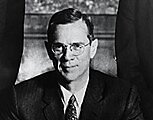

William McChesney Martin Jr. was chairman of the Federal Reserve Board from 1951 to 1970. He is perhaps best known for his “punch bowl” speech delivered on October 19, 1955, to the New York Group of the Investment Bankers Association of America. His often-quoted line in the penultimate paragraph reads: “The Federal Reserve … is in the position of the chaperone who has ordered the punch bowl removed just when the party was really warming up” (Martin 1955: 12). He made this statement in the context of a recent increase in the Fed’s discount rate, which tightened monetary policy.
Did Martin Coin the Punch Bowl Metaphor?
Although Martin is frequently credited with coining the punch bowl metaphor, he clearly acknowledged that it was the idea of another writer, who remains unnamed in his speech. In the above quote, the following is left out, “as one writer put it.” It is unfortunate that the anonymous writer has never been identified.
Recently, Nick Timiraos, a prominent monetary journalist for the Wall Street Journal, wrote: “The Fed continued to raise rates [in 1951, after President Truman appointed Martin, a Treasury official, chairman of the Fed]. Martin would later [in 1955] coin the phrase that it was the Fed’s job to take away the punch bowl just as the party gets going” (Timiraos 2026).
In fact, Martin did not coin the phrase; he popularized it. To coin a phrase is to create it, which is much different than popularizing another writer’s phrase. Also, the Timiraos quote does not match that used by Martin. It is a paraphrase, not a direct quote. This may seem like nitpicking, but it’s important to get things right when examining monetary history.
The punch bowl metaphor is a good one. That is why it has become so popular. In his speech, Martin recognized that, “In the field of monetary and credit policy, precautionary action to prevent inflationary excesses is bound to have some onerous effects” (1955: 12). He emphasized that the Fed’s primary job is to ensure long-run price stability (see Hetzel 2013). Martin did not think that “creeping inflation” is conducive to economic growth. A persistent inflation, even if low, still erodes the purchasing power of money (1955: 8).
Martin recognized that there are limits to the Fed’s power to prevent business fluctuations. However, prudent monetary and fiscal policy can minimize disruptions. As he stated:
While money policy can do a great deal, it is by no means all powerful. In other words, we should not place too heavy a burden on monetary policy. It must be accompanied by appropriate fiscal and budgetary measures if we are to achieve our aim of stable progress. If we ask too much of monetary policy we will not only fail but we will also discredit this useful, and indeed indispensable, tool for shaping our economic development [1955: 4].
Between 1952 and 1960, the Fed held inflation to an average annual rate of less than 2 percent (see FRED chart), and real economic growth averaged nearly 3 percent per year. Meanwhile, the 1951 Treasury-Federal Reserve Accord helped restore competitive yields in the government securities market and allowed the Fed to regain independence in setting monetary policy—subject to congressional oversight. Martin welcomed those changes.
The punch bowl metaphor comes at the end of Martin’s speech to illustrate the importance of taking a long-run view in policy decisions, rather than engineering a myopic policy based on political expediency. The remainder of this article takes a deeper look at Martin’s speech, which mainly focused on a principled approach to policy and the moral element of private enterprise.
Freedom and the Moral Element in Private Enterprise
As Fed chairman under President Eisenhower, Martin spoke out against central planning and price controls. He supported limited government, free enterprise, and monetary stability, as shown in the following quotes.
The answers we sought to the massive problems of the 1930s increasingly emphasized an enlarging role for Government in our economic life. That role was greatly extended again in the 1940s when the emergency of World War II led to direct controls over wages, prices, and the distribution of goods ranging from sugar to steel.
That experience led to growing concern over the effect of a straitjacket of controls on the economy’s productive capacity, and the price that would be exacted in terms of individual liberty if the harness of wartime economic controls were carried over into the postwar years.
Such a strait jacketing of the economy is wholly inconsistent with our political institutions and our private enterprise system. The history of despotic rule, of authoritarian rule, not merely in this century but throughout the ages is acutely repugnant to us. It has taken a frightful toll in human misery and degradation [Martin 1955: 4].
Most importantly, Martin saw that a free-market price system not only enhances efficiency, but it also allows individuals the freedom to choose. Thus, in his speech, he notes:
The advantages of a system where supply capacities and demand wants and needs are matched in open markets cannot be measured in economic terms alone. In addition to the advantages of efficiency in the use of economic resources, there are vast gains in terms of personal liberty. Powers of decision are dispersed among the millions affected instead of being centralized in a few persons in authority [1955: 5].
Martin’s emphasis on individual freedom provides a moral element to his punch bowl speech. In particular:
We cannot substitute the judgment of a few in authority for the free and independent judgments of the community as they are expressed in the market place. We cannot do so, that is, and retain our concept of freedom in a competitive, private enterprise economy [1955: 7].
Of course, Martin recognized that with freedom comes responsibility. The choices people make—subject to a just rule of law protecting persons and property—have consequences, both good and bad. For a private enterprise system to operate smoothly, individuals must be able to capture rewards for successful decisions and bear losses for unsuccessful ones.
Martin expounded on the importance of “first principles,” by which he meant: “time-tested basic concepts of the marketplace and the development of competitive private enterprise, with only that degree of Government interference or regulation necessary to prevent abuses and excesses” (1955: 10). He recognized that “the return to first principles in many parts of the free world … [was] the most significant aspect of world-wide recovery and progress outside the iron curtain” (ibid.).
With regard to the United States, Martin notes: “We have returned to some of those fundamental principles under which our society, our institutions, have flourished with incomparable benefits, benefits not merely material” (1955: 10–11).
Lessons
Two main lessons can be drawn from Martin’s punch bowl speech. First, the Fed needs to be prudent and humble in exercising its monetary powers. There are limits to what the Fed can do. Its main function should be to safeguard the dollar’s long-run value by adhering to a predictable, responsible monetary framework. Second, a rules-based approach to policy—both monetary and fiscal—is consistent with the moral element in private enterprise. Freedom is best protected by limited government, so individuals have a wide range of choices under a just rule of law.
Today, we have a discretionary government fiat money system. Much of the Fed’s bureaucracy could be abolished by a simple monetary rule rather than the complex framework currently in place (see Dorn 2018). Whether the punch bowl will be removed, under increasing political pressure to use the Fed to monetarize fiscal deficits and expand its mandate to include environmental and social issues, remains to be seen. After more than 70 years, Martin’s speech remains relevant both for monetary policy and the moral state of the union.