For many years, internal material handling was considered a secondary function, necessary to feed lines, clear areas and move materials between departments.
This is changing. Rising operational complexity and higher volumes are transforming internal flows into a lever for continuity, labor sustainability and reduced congestion within plants. SKU proliferation, omnichannel strategies, flexible production schedules and multi-shift operations are increasing pressure on material movements. Disruptions in these flows can slow production, increase Work-in-Progress (WIP) and create bottlenecks in critical areas. Internal logistics, once invisible, is now treated as part of the industrial system.

A more complex operating environment
Manufacturing is no longer based solely on homogeneous batches and linear sequences. Lines are supplied more frequently and with product variants. The result is a higher density of movements on wheels (carts, containers and dedicated carriers) that must reach the line regularly to sustain continuity. At the same time, several sectors are reducing the use of heavy vehicles near production. In automotive, pharma, food and packaging, forklifts are being replaced with lighter and more ergonomic solutions. Drivers include safety, congestion, space constraints and costs related to licensing, insurance and maintenance.
The workforce variable
Labor availability is another structural element. Repetitive manual handling requires physical force, increases injury risk and is difficult to sustain over three shifts. Improving ergonomics is no longer a collateral benefit but a way to protect uptime, reduce turnover and retain qualified personnel.
Not only automation: the gradual transition
The debate around automation in internal logistics is often framed as a choice between manual handling and fully autonomous systems such as AGVs, AMRs or industrial robots. Adoption, however, tends to be more incremental. Many plants are not yet prepared for full automation due to investment levels, layout implications, integration requirements and the rigidity associated with fixed automated flows. This is creating space for an intermediate category: operator-assist electric solutions that remove physical effort, support flow continuity and retain operator flexibility. These systems require no infrastructure, no software integration and no plant modifications, and typically deliver a faster ROI than full automation.
Across sectors, three priorities are shaping decisions on internal handling upgrades:
Labor sustainability → reducing strain, injuries and turnover
Operational continuity → regular line feeding, including multi-shift
Flexibility → avoiding rigid systems that limit layouts and product mix
There is also growing interest in reducing heavy vehicles in high-density human areas for safety and space configuration reasons.
Renova’s proposal in the operator-assist segment
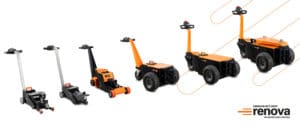
In this context, operator-assist technologies represent a strategic intermediate layer between manual processes and autonomous systems. Renova has developed a dedicated material handling range, including cart movers and electric tow tugs, designed to prioritize ergonomics, ensure continuity across multiple shifts, and provide high operational flexibility.
A range designed for operational versatility
Renova’s new material handling line covers a wide range of applications, from line-side movements in tight spaces to heavy-duty movements in aerospace, marine and waste-handling environments. With capacity to move wheeled loads up to 6 tons, these systems can be deployed in sectors that have significantly increased the density of internal movements over recent years. Globally, industries such as pharma, food & beverage, aerospace and industrial logistics are growing at annual rates of 5–7%, driven by higher volumes, SKU expansion and multi-shift production. In Europe, this trend is reinforced by the progressive reduction of forklifts near production and the rise of operator-assist solutions as a stable intermediate category.
The range includes Cart Movers and Electric Tow Tugs.The MCE 400/500 cart mover models handle up to 5-ton carts, while the MTE electric tow tug series covers 1.5 to 6-ton applications. Compact models such as MTE 1000/1500 are suited for line-side, end-of-line and machine feeding; MTE 100W is optimized for two-wheel carts often used in the textile industry; and MTE 3500, MTE 6000 and MTE 6000S address heavier towing tasks typical of waste handling, airport and marine sectors.
Integrated with ergonomic handles, the heavy-duty design enables precise maneuverability both indoors and outdoors, including irregular surfaces, tight layouts and non-linear paths. The systems easily overcome obstacles while maintaining full control and operational safety, with compliance to ISO 11228. The Plug&Play lithium battery system supports multi-shift operations without charging downtime, and no operator license is required, reducing training costs and expanding workforce eligibility. Both the device and the battery system come with a two-year warranty, ensuring operational continuity and lower lifecycle costs. For sectors with specific requirements, including chemical and pharmaceutical, ATEX configurations are available.
Balancing efficiency, continuity and flexibility
Ultimately, the shift in internal handling is being driven as much by economics as by ergonomics. Plants are seeking continuity with fewer forklift interventions, shorter integration cycles and a lower total cost of ownership, all while facing tighter layouts and more demanding labor models. Operator-assist systems respond to these constraints by offering a scalable upgrade path that does not require infrastructure, software integration or specialized licensing.
If warehouse and fulfilment operations have already been heavily automated, the open question for the coming decade is how far internal flows can evolve without compromising flexibility. Renova’s new Material Handling range moves precisely in this direction, enabling a more balanced distribution of tasks between operators, equipment and automated systems, and opening the discussion on what the next stage of internal handling might look like inside modern plants.
Sources:
2025 Warehouse Automation & Order Fulfillment Study – Peerless Research Group
2025 Warehouse Automation Industry Outlook- Modern Materials Handling
Warehouse Automation Market Report 2025–2029-ResearchAndMarkets.com
OSHA 2023 Work-Related Injury & Illness Summary (PDF)
OSHA Warehousing Hazards & Safety Guidance
Read more:
Internal handling evolves: Renova’s approach between ergonomics and operational continuity