
The distinctive feature of capitalism, properly understood, is freedom: the freedom to own property (i.e., to be a capitalist); the freedom to trade in private markets; and the freedom to express one’s ideas. The primary function of government is to safeguard these fundamental freedoms.
Because the principle of nonintervention/freedom is the foundation for capitalism, that system is best described as liberalism, in the classical sense. Adam Smith and other classical liberals never used the words capitalist or capitalism. They emphasized individual freedom, limited government, and natural rights to life, liberty, and property. A laissez faire system—or what Smith called a “simple system of natural liberty”—is at the heart of liberalism.
The Heart of Liberalism
In 1776, Smith made a strong case for a free society, stating that if “all systems either of preference or of restraint” were “completely taken away,” a “simple system of natural liberty” would evolve “of its own accord.” Each individual then would be “left perfectly free to pursue his own interest his own way, and to bring both his industry and capital into competition with those of any other man, or group of men,” provided “he does not violate the laws of justice” (Wealth of Nations, Book IV, Chapter 9).
The idea that a harmonious economic and social order can emerge spontaneously from individual action—provided government enforces just rules that protect individual rights to life, liberty, and property—is central both to liberalism and to the case for limited government. As Friedrich Hayek argued:
Under the enforcement of universal rules of just conduct, protecting a recognizable private domain of individuals, a spontaneous order of human activities of much greater complexity will form itself than could ever be produced by deliberate arrangement, and … in consequence the coercive activities of government should be limited to the enforcement of such rules” (Hayek 1967, p. 162).
Those ideas are often lost when examining capitalism.
Freedom and Capitalism
The meaning of liberalism has been turned on its head by modern liberals. Moreover, many people see capitalism as a system in which the rich use their power to obtain wealth at the expense of society. That zero-sum mentality is blind to the link between freedom and capitalism.
Frédéric Bastiat, in his famous essay, “The Law,” recognized the importance of freedom—bounded by a just rule of law—not only as a moral principle but also as a means of attaining social and economic harmony:
It is under the law of justice, under the rule of right, under the influence of liberty, security, stability, and responsibility, that every man will attain to the full worth and dignity of his being, and that mankind will achieve, in a calm and orderly way—slowly, no doubt, but surely—the progress to which it is destined [(1850) 2007, p. 53].
History has proven him right. Nations that have abolished private property and suppressed freedom have not fared well in terms of human progress (see McCloskey 2019; Norberg 2021; Tupy and Pooley 2022). The range of choices open to people in a free society far exceed what is found in nations that use the law to control people rather than to protect their natural rights. As Ludwig von Mises noted in Liberalism: A Socio-Economic Exposition:
It is thanks to … liberal ideas … that the great mass of our contemporaries can enjoy a standard of living far above that which just a few generations ago was possible only to the rich and especially privileged [Mises (1962) 1976, p. 10].
Socialist means have not attained capitalist ends (i.e., making society better off through free markets).
Creeping Toward Socialism
Karl Marx distinguished between property in the legal and economic sense. A firm may have legal title to the means of production, but if the government siphons off capital income, the state socializes part of the firm’s legal property rights. As Aleksander Bajt pointed out in an article in the Journal of Law and Economics (April 1968):
In analyzing different economies and in categorizing them as socialist and capitalist ones, we are usually inclined to be too much impressed by their institutional structure, that is, by their legal or constitutional structure. If this were not the case we could discover elements of socialism in capitalist countries and of private property relations in socialist countries and we would be able not to classify countries into black and white categories, but would have to measure the degree of socialization in these different countries. Speaking a priori, we might even discover that the degree of socialization, measured by some appropriate criteria, is higher in some capitalist than in some socialist countries [p. 2, emphasis in original].
When government violates individuals’ natural rights to life, liberty, and property, the spontaneous order of free-market capitalism is weakened. Both freedom and prosperity suffer. “State capitalism” and “deals capitalism” have been used to describe this situation. The reality is that capitalist institutions are slowly being infringed upon by socialism.
President Trump’s use of executive orders to extract revenues from Nvidia and AMD for prescribed chip sales to China, as well as his deals to take equity stakes in US Steel and Intel, are examples of the socialization of capital—that is, creeping socialism (see Bourne 2025).
Returning to True Liberalism
Because the meaning of capitalism has been distorted, those who value genuine capitalism are more likely to gain ground if they return to the primacy of freedom for a capitalist order and present the case for a free society—that is, “a society of equal freedom, at least insofar as that term connotes the freedom from interference that is described by our equal rights” (Pilon 1983, p. 175, emphasis in original).
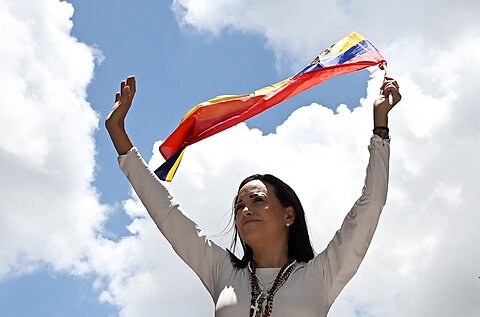
When Maria Corina Machado, the recipient of this year’s Nobel Peace Prize, speaks, she does not raise a banner for capitalism but for freedom. Her message for a free society under the rule of law is much more powerful than a technical argument for capitalism. In her Nobel Lecture, she states:
I have come here to tell you a story: the story of a people and their long march toward freedom.… This prize carries profound meaning; it reminds the world that democracy is essential to peace. And more than anything, what we Venezuelans can offer the world is the lesson forged through this long and difficult journey: that to have democracy, we must be willing to fight for freedom. And freedom is a choice that must be renewed each day, measured by our willingness and our courage to defend it. For this reason, the cause of Venezuela transcends our borders. A people who choose freedom contribute not only to themselves, but to humanity.
If she had substituted the word “capitalism” for “freedom,” she never could have won the hearts and minds of millions of people.
The Future of Freedom
Maintaining a free society is always a challenge. The pressure for expanding government power to satisfy special interests is always present. Effectively limiting the reach of state action requires an electorate that understands the institutions that support a free society and that respects the rights to life, liberty, and property. It is not enough to say that capitalism outperforms socialism to persuade people to join forces against creeping socialism.
What is even more important is to reinforce the moral imperative of adhering to the principle of nonintervention and emphasizing the primacy of freedom in fostering both social and economic harmony. People like Maria Corina Machado are fighting for freedom and a just rule of law to protect their families from harm and to give them a better life. Their emphasis is on liberalism—not capitalism.
To ensure that the light of liberty prevails, there must be vigilance in protecting the free market for ideas and civil discourse. The United States should set the example by adhering to our Founding principles rather than eroding the liberal constitutional order through state capitalism.